Thursday, November 13, 2025

KRIGSTEIN'S SWAN SONG: BLIND MAN'S BLUFF

 "BLIND MAN'S BLUFF"

by Lionel Ziprin and Bernie Krigstein
(Four Color #1309: 87th Precinct, Dell Comics, 1962)

review by BK MUNN

Bernard Krigstein is best known for the 44 short stories he illustrated for EC, and 
especially his magnum opus "Master Race" (1955), but he also did very strong, 
interesting work for Timely/Atlas and, near the end of his frustrating career in the 
American funnybook industry, several stories for Dell Comics. In fact, his final 
comic book work is a bizarre, 32-page occult epic disguised as a run-of-the-mill genre 
exercise hiding under a photo cover for a licensed tv show. The story is "Blind Man's 
Bluff" and it was written by one of the most fascinating writers ever to work in U.S.
mainstream comics, Lionel Ziprin.


Ziprin, the Beat poet, occultist, artist and filmmaker, briefly supported himself in the 
early 1960s writing comic scripts. He described his work in typically hyperbolic terms:

"Dell made contracts with all the movie companies and I wrote a series of comic books on every battle in the Pacific and European theatres. They gave me the theme, or movies would come out, big movies; they handed me the script, and I had to put it into comic book form. All I got was ten dollars a page: six boxes, balloons and lines, and I had to sign away everything, that it was not my property, no credit. But I was America’s best-selling writer of comic books, my comic books sold in the millions of copies."


Ziprin was not above slipping the occasional Kabalistic reference into the kids comics he wrote, and seemed to relish the rare opportunity to cut loose and freewheel-it with some of his science fiction and fantasy assignments. When he was handed the job of adapting the now-forgotten police procedural tv series
87th Precinct, based on the Ed McBain novels, Ziprin cooked up a convoluted tale about a psychotic blind artist who kills his models. Perhaps because Ziprin was, like the villain in his story, a visual artist who also fancied himself a wizard, the script is loaded with weird meditations on art and the occult, providing plenty of meaty opportunities for his illustrator to go wild, and this is just what Krigstein does.


Krigstein and Ziprin were a perfect match. He called Ziprin's script “the most fantastically absurd story that has ever been typed or presented to an artist for a breakdown,”  and his resulting finished pages display a level of graphic inventiveness and full-throttle cartooning rarely seen in his oeuvre. Police cars scoot around in Duchamp-ian blurs, the mad ravings of the artist are represented with cartoon lightning bolts and emanata bouncing off the inside of his skull, and the act of artistic creation is rendered in a series of largely wordless panels full of manic action and swirling, slashing movement. Eyeballs are everywhere, and Krigstein looks like he's having a ball. The pedestrian framing device to all this madness, the squad of police detectives searching for a killer, is not without its charms, either; Krigstein's caricatures of the tv actors have a wild, wide-eyed look, and angular, sloping body language, like everyone in the pocket universe of this comic is slightly unhinged and off-balance. The full story is worth checking out, and its themes are a fitting coda for Krigstein's brief Sisyphean effort to expand the artistic frontiers of corporate comics storytelling.


Wednesday, August 20, 2025

GRAPHIC NOVEL REVIEW: THE MOON PRINCE BY KEVIN FRASER MUTCH


The Moon Prince
by Kevin Fraser Mutch
(Fantagraphics Books, 2025)


review by BK Munn

I just devoured this big beautiful epic of a graphic novel that combines some of the best aspects of HG Welles, Hergé, Flash Gordon, and The Wizard of Oz in a science fiction tale about a pair of Dickensian orphans on a quest to discover their origins and save enslaved humanity. Kevin Mutch has made a name for himself as a graphic designer and gallery artist with a couple of well-received Lynchian semi-autobiographical graphic novels under his belt, but this all-ages, full-colour romp, 15 years in the making, is quite the departure and is sure to come as a pleasant surprise to readers of his previous work. Drawn in his patented clear-line, semi-realistic style, with an eye-popping colour palette that makes the absurd science-fantasy palatable, the book is action-packed and takes big swings, with plot reversals and twists worthy of classic adventures I loved as a kid by the likes of Edgar Rice Burroughs or Jules Verne. Great fun!


Thursday, March 20, 2025

TOONERVILLE TROLLEY IN NEWFOUNDLAND

by BK Munn

During WWII, Newfoundland, and especially the airfields at Gander, was the centre of the universe, and there was a heavy Allied presence in the area. This 1945 article from the Atlantic Guardian details the construction of a railway for moving troops and supplies to Ernest Harmon Air Force Base, a U.S. base that existed from 1941 to 1966 and is now the Stephenville International Airport. Toonerville Trolley was a long-running U.S. comic strip by Fontaine Fox that ran from 1905-1955. Also known as Toonerville Folks, the strip centred on a small-town streetcar operated by the grizzled Skipper who interacted with a cast of eccentric local characters. The popular strip was adapted into silent movies and a series of 1930s animated cartoons produced by The Van Beuren studio. Between 1927 and 1934, a series of short Our Gang-styled comedies set in Toonerville and starring a young Mickey Rooney as the titular Mickey McGuire, a character from the comic strip, were produced in Hollywood. 


Friday, January 31, 2025

COMICS IN FILM: LOLA (1961), DIRECTED BY JACQUES DEMY


Comics in Film: Lola (1961), directed by Jacques Demy.


French schoolgirl Cecile and American sailor Frankie discuss the idea of a “mysterious planet” from Meteor, a monthly science fiction comics magazine that features the long-running bande dessinée “Les Conquérants de l'Espace” by cartoonist Raoul Giordan and writer Robert Lortac. In this scene, Cecile has been sent to get a few groceries by her mother with the incentive of also picking up the latest issue of her favourite comic. Frankie has bought the last copy, but charitably gives it to her, and the two form a brief friendship. Cecile is on the cusp of her 14th birthday and has a teenage crush on Frankie, on leave from his U.S. Navy ship but almost finished his tour of duty and on the verge of returning to his exotic far-away home of Chicago, Illinois. Set in the port city of Nantes, Lola is a beautiful film about arrested adolescence and liminality, with people always on the threshold of departure and change, all wrapped up in myths of romance, escape, travel, coincidence, circularity, movement, ritual, repetition, nostalgia, impermanence, death, rebirth, transformative space, and reinvention. 


Tuesday, January 28, 2025

VINYL + TURNTABLES IN FILM: PERFECT DAYS


Perfect Days (2023), directed by Wim Wenders.

Professional toilet cleaner Hirayama (Kōji Yakusho) listens to his collection of classic cassette tapes while driving in his van to work and in his meticulously clean home on a small ghetto blaster. His feckless young co-worker Takashi (Tokio Emoto) takes him to a record store (Tokyo’s Flash Disc Ranch) to get a valuation on some of his tapes, including Lou Reed’s Transformer which the record store clerk describes as rare. Hiragana refuses to sell, and instead gives Akashi some cash so he can impress a woman. Earlier, Takashi had introduced Hirayama to his girlfriend Aya (Aoi Yamada), who borrows Hirayama’s cassette of Patti Smith’s Horses after she hears the track “Redondo Beach.” This music, mostly meticulously-curated English-language classic rock from the 1960s and 70s, and Hirayama’s use of outdated, mostly analog tech, is central to the themes of Perfect Days, a film that fetishizes and nostalgizes certain outmoded aspects of Japanese working class life and celebrates a zen-like approach to living simply, seemingly outside of history, presented without comment or curiosity, although sometimes contrasted with images of industrial ugliness and social anomie and alienation. It’s a beautiful film, filled with many moving scenes and images, paired perfectly with some of my favourite music that actually had me crying like a little baby at key moments.


Sunday, January 05, 2025

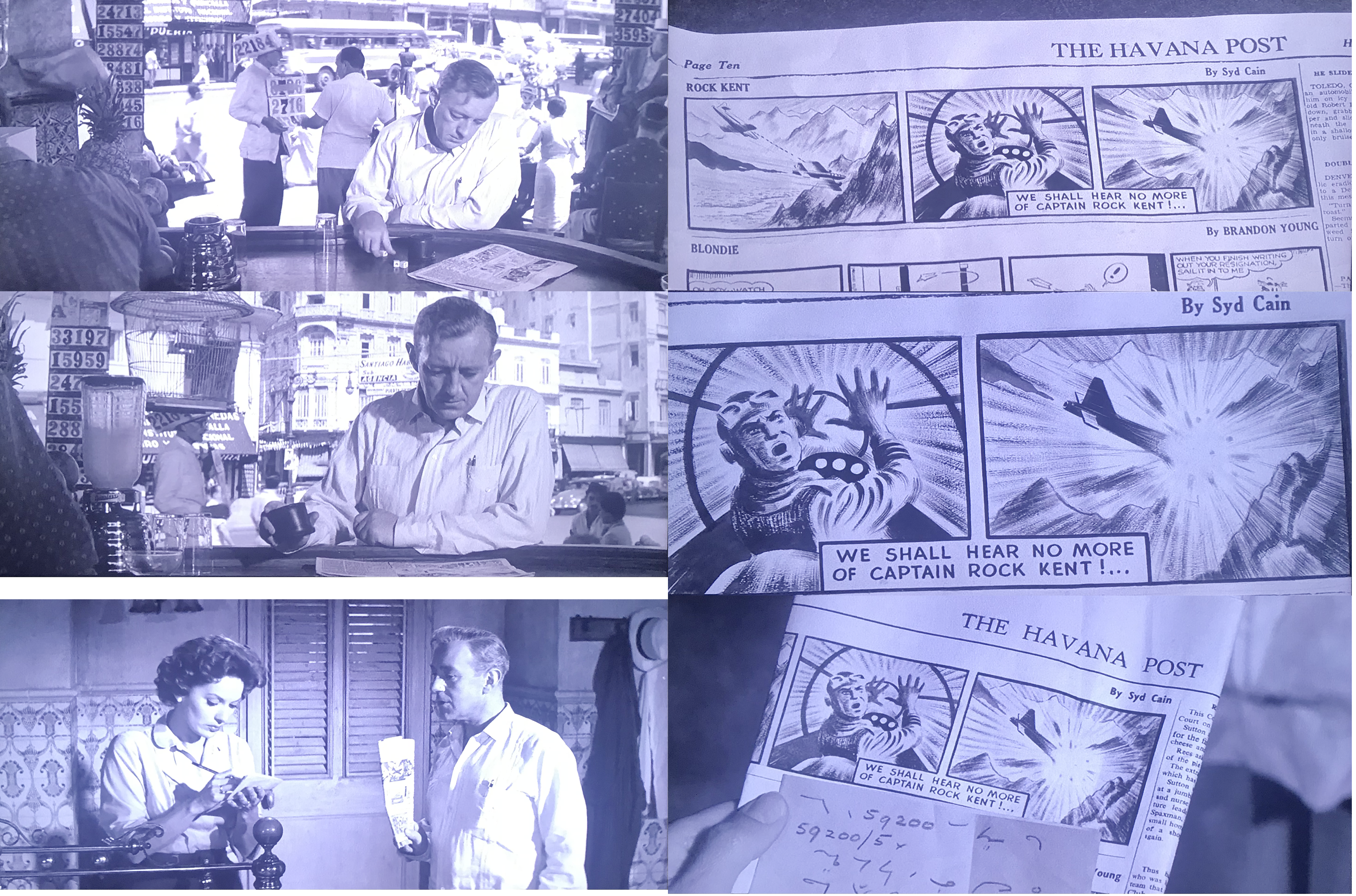
Comics in Film: Our Man in Havana (1958)


Comics in Film: Our Man in Havana (1958).

by BK Munn

Vacuum cleaner salesman James Wormold (Alec Guinness) is inspired by the fictional comic strip "Rock Kent" to claim one of his non-existent agents, a pilot, has been killed. Wormold has been randomly recruited by the British Government to create a spy network in Cuba, but having neither the inclination or imagination for espionage, he simply makes up the network based on items he stumbles across and submits false reports to his superiors. Thus, a list of members at his country club becomes the spy network, the design of a vacuum cleaner becomes the model for a drawing of a secret weapon installation, and this comic strip becomes the explanation for why he can't provide actual photos to London. Unfortunately the plan backfires, and the Cuban police kill a real pilot after intercepting his coded message, dictated here to his secretary Beatrice (Maureen O'Hara). "Rock Kent" is meant to be similar to other Cold War aviation strips of the period like "Buzz Sawyer" and "Steve Canyon." The Havana Post was a real newspaper and you can see the top of Blondie, a real comic, in one of the close-ups. The bar location was real, too: it was actually shot on the streets of Havana right after the Castro Revolution overthrew the corrupt Batista regime, represented in the film by the amorous torturer Captain Segura (Ernie Kovacs), and Castro reportedly visited the set during filming.