Friday, October 27, 2017
Working Class Heroes: Humphrey Bogart and the Steel Fist
Tuesday, October 24, 2017
The Future of (Digital) Collecting?
by BK Munn
The future of collecting? As a marxist grad student in the 90s I was obsessed with comics/the commodification of art and wrote a bit about simulacra and the then-new phenomenon of eBay and slabbing (encasing old comic books in plastic to protect their condition and "grade"). As I recall, Baudrillard had something to do with it all., but the point was that people had really stopped collecting actual physical objects and were instead bidding on the "idea" of the object, virtual alienated labour, or some such. I was not then and am not now very good at expressing these ideas... Most non-rich, non-artist people still don't collect capital 'A' art, and even the kind of industrial production culture I like to collect, like original comic book art, may soon disappear as cartoonists make more and more of their work digitally and not on paper with ink and pencils. Instead of buying antiques and collectibles, most of us are content to curate photos of them on Pinterest and Instagram. Can we now say that collecting has entered a new phase?
From an article by McKenzie Wark:
To think about digital objects as collectable, it may help to start by asking what it is that is actually collected. We tend to think that what is collected is a rare object. But what makes it rare? Perhaps there is more than one way to make an object rare. To make a digital object rare, it can be “locked” in various ways. Take for example The Clock (2010) by Christian Marclay. It is only supposed to be seen in specially designed installations where it runs for twenty-four hours, although apparently the artist’s wishes about that did not stop the hedge-fund manager Steven A. Cohen from using his copy as a screen saver or his gallerist Jay Jopling from screening it for a party.1
Attempting to lock the information in the digital work to some material form or situation may create more problems than it solves. As Cory Doctorow has argued, relying on digital locks does not really empower the artist or the owner. It empowers the makers of digital locks. And in any case it takes away some of the special qualities of a digital object if its form merely imitates the kind of objects that collections already collect.
What might be more interesting is to consider how the very properties of spreadability that characterize digital objects can be turned to advantage to make them collectable as well.2 Paradoxically, an object whose image is very widely spread is a rare object, in the sense that few objects have their images spread widely. This can be exploited to create value in art objects that are not in the traditional sense rare and singular. The future of collecting may be less in owning the thing that nobody else has, and more in owning the thing that everybody else has.
The artwork is not what it used to be. Perhaps one could think of three stages in the evolution of the artwork, each of which has its own kind of rarity and collectability. The first stage we now think of as that of the old masters. The second stage is that of modern art. The third stage begins with what we call contemporary art, but is perhaps only now starting to reveal its true form.
[...]
The third stage is something else. It corresponds to the period in which information becomes the key to value in both the wider economy and also in art.3 The artwork is no longer a special kind of commodity as it was in the modern-art period. The artwork is now a special kind of financial instrument. The artwork is now a special kind of derivative.4 The collectable artwork is now less about being an object that stores value because of its special qualities as a rare thing made by a special kind of worker, the artist. The artwork is now collectible because it is a financial instrument in a portfolio that manages and hedges risk.
The key is the role of information about the artwork. The information about the artwork is actually the most important thing about it. What establishes the value of the work is that people talk about it, write about it, circulate (unauthorized) pictures of it. The more it circulates, the more value it has. The actual work is a derivative of the value of its simulations.
Friday, October 20, 2017
Comic Fan Project: Don Heck era Avengers
This entry brings us a letter printed in Marvel's Avengers #31 from August 1966. The letter is a comment on the character and plot developments in the run of Avengers co-plotted and illustrated by cartoonist Don Heck who replaced Avengers co-creator Jack Kirby on the feature and was the other primary visual chronicler of the era before Big John Buscema and Neal Adams made their mark later in the "Silver Age":
Dear Stan and Don,
No! No! You can't do this! You can't leave Henry Pym a ten-foot-tall freak!.You'll be rouing one of the most beautiful romances in comicdom. We Marvelites will never tolerate this man's being deprived of what he has needed most in life since the loss of his first wife --the love of Janet Van Dyne. On this we all stand firm. As a matter of fact I'm still amazed that he and the Wasp are not already married. They had plenty of time in which to be wed during their recent period of inactivity. Except for this weakness, the come-back of Giant-Man was rather spectacular. His new costume finally adds that last basic color that has been missing in the new Avengers, and that is yellow. Two things still puzzle me --one is his size. The 25-foot version is too big and too clumsy, as we frantic fans noticed as he struggled to squeeze through the corridors of the Collector's castle. In this state he more of a hindrance than a help to the Avengers. The ten-foot height is slightly undersized. Giant-Man always was and will ever be at his peak in mobility, strength, and power at his standard 12-foot combat height which is the height he displayed on the cover of issue #28. This is the way I and many other old-time Marvelites remember him and will always remember him. The other thing I find hard to accept is his new name. Somehow the name Goliath will never overshadow the glory tha was once in the name of he who we called Giant-Man, for this was how we grew to admire him. The old name sticks close to the heart of many of us. Should these few flaws be remedied, I am sure the new Avengers would reach a peak that might even surpass the glory of the old Avengers.
Claude Paquet5834 Molson St.Montreal 36Quebec, Canada
A great letter full of early fan entitlement and some size puns devoted to perennial nobody's favourite Hank Pym aka Ant-Man aka Giant-Man aka Goliath aka Yellowjacket. At this point in Marvel's development, it's interesting to read a reader self-identify as both a Giant-Man fan and as an "old-time Marvelite" --the Marvel U is at this point only 4 or 5 years old and the letter is written in response to Avengers #28! Also interesting that at this point, the Avengers was basically "The Adventures of Giant-Man"...
Thanks to Claude Paquet of Montreal!
Tuesday, October 17, 2017
Forgotten Comic Book Character: The Lepra-Duck
Panels from the first appearance of The Lepra-Duck from the story "The Battle at Hadrian's Wall", the cover-feature of Walt Disney's Donald Duck #107 (Gold Key, May 1966). The story was written by Vic Lockwood and drawn by Tony Strobl. In the story, Donald is given the Lepra-Duck's wishing stone, previously in the possession of Donald's lucky cousin Gladstone Gander, and, through a series of wishes, first travels to Uncle Scrooge's ancestral homeland of Scotland, and then back in time where he and his nephews meet Emperor Hadrian and some of Donald's own "barbarian" ancestors who they teach to play baseball!
The Lepra-Duck is in the tradition of puckish magical interlopers like Superman's Mr. Mxyzptlk, Batman's Bat-Mite, Aquaman's Quisp and Quirk, Impy from The Fantastic Four, and Gazoo from The Flintstones. Like these other characters, he magically appears to vex the main characters and introduce some sorcerous obstacle or faux-helpful spell. The Great Gazoo was introduced a year earlier on tv and is a likely influence on the Lepra-Duck, and ditto Lucky from the Lucky Charms cereal ads (first appearance 1963), although leprechauns are plentiful in fiction and popular culture, as is the idea of a magical token like the Wishing Stone (cf. Monkey's Paw) or the tradition of wishes that act as a form of hubris and backfire to punish greedy or prideful.
There are other magical characters in Donald Duck's world (Magicka de Spell) and the concept of luck is central to the characters of both Uncle Scrooge and Gladstone Gander, but we rarely see magic used as a form of time-travel. Rather, the characters in these stories interact with historical places and artifacts in the modern era.
As a kid I hated it when Bat-Mite would pop up in the Batman cartoon show. I wanted Batman to be a serious superhero and the existence of this magical elf from another dimension, constantly getting into bumbling slapstick adventures while trying to help his "hero" Batman, really put a damper on my suspension of disbelief, to say the very least. I was a little bit more forgiving of The Great Gazoo because the Flintstones was a comedy show and the wonderful droll voice acting of Harvey Korman really put the character over. As an adult, I love all of these magical characters and prefer the older superhero comic books with a sense of humour.
I came across this character in a really beat-up and coverless copy of a Donald Duck comic that I was actualy about to throw in the garbage. after investigating I was surprised that a) this seems to be his only appearance and b) there isn't really anything online about him, even on websites run by ultra-nerdy Dinsey comics fanatics in Europe, like the Inducks wiki. The story he appears in has been reprinted at least once, so thousands of kids and older fans have read it. Obviously, the cliche magical deus ex machina nature of the character has left a sour taste in the mouth of fans who love the mostly well-plotted, logical stories of the Barks Ducks universe. Or maybe it's just not that memorable of a story. The character really only appears in a few panels at the beginning, popping back in for a few more panels at the end to take back his wishing stone.
Monday, October 16, 2017
I Want This Old Jack Kirby Thing T-Shirt
Friday, December 16, 2016
Prole Art Threat: The Gong, Time, Work-Discipline, and the Revolt Against Industrial Capitalism in Batman #55
Sunday, November 27, 2016
Umberto Eco On Fascism and His Introduction to U.S. Comics, or, "Is Dick Tracy Fascist or Not?"
![]() |
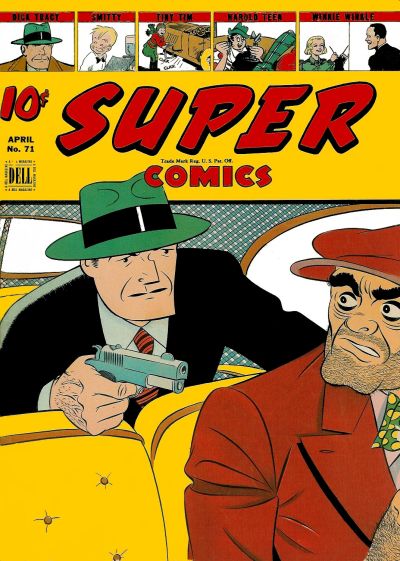
| Dick Tracy on the cover of Super Comics #71, April 1944 |
by BK Munn
I recently came across this great concise summary of Umberto Eco's list of 14 characteristics of fascism. When you follow the links, you get the full original essay from The New York Review of Books, in which Eco talks a bit about growing up in Italy in the '40s under Mussolini and the liberation of his small town by partisan rebels and U.S. soldiers:
"A few days later I saw the first American soldiers. They were African Americans. The first Yankee I met was a black man, Joseph, who introduced me to the marvels of Dick Tracy and Li’l Abner. His comic books were brightly colored and smelled good."
Chester Gould's Dick Tracy comic strip was translated to comic books many times. During the years of World War II it was reprinted in Dell's Super Comics alongside other funny pages cohorts like Little Orphan Annie. Perhaps this is how Eco first encountered the strip? Likewise, Al Capp's L'il Abner was a regular feature in Tip Top Comics during the same period.
I wonder, by mentioning them here, is Eco hinting at the weird right-wing politics of Gould and Capp and their comic strip tough-guy counterparts? Or is he simply conflating his budding awareness of the wonders of U.S. pop culture with this primal example of the democratic nature of post-Fascist society? As usual with Eco and his playful essays, there is probably a lot more going on than it seems on the surface.
Is Tracy fascist? Eco starts his piece by wondering why the Italian "Fascist" became the default term for describing any and all varieties of totalitarian strongman, from dictator or president right on down the line to your friendly neighbourhood cop on the beat.
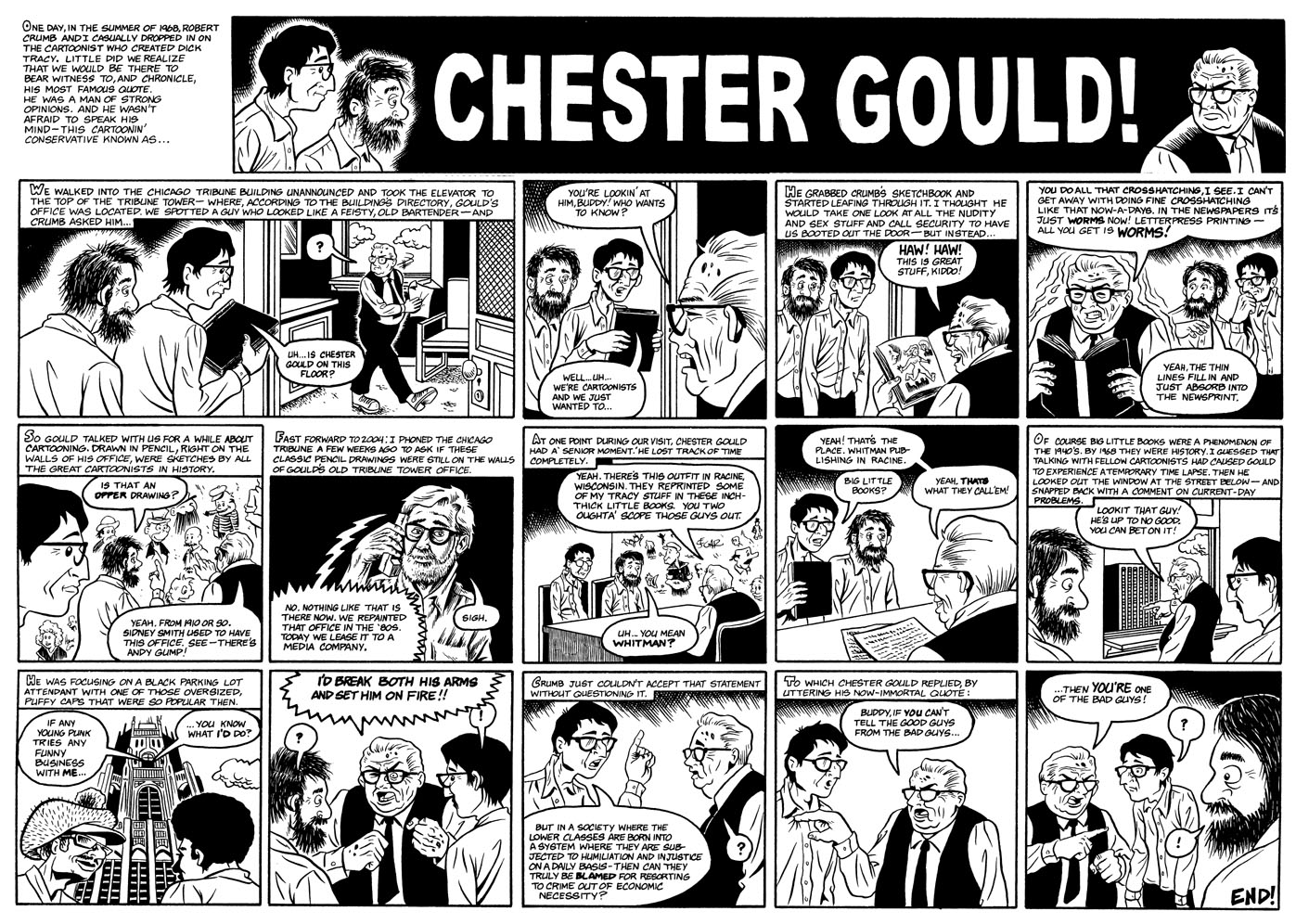
Tracy is a cop, and his tough-guy, decades-long merciless war on crime was calcified and largely out of favour by the time the late-60s counter-culture was in full bloom (although it didn't stop Underground cartoonists like Jay Lynch and Robert Crumb from seeking an audience with Gould in his Herald-Tribune office in 1968). Cantankerous conservatives Gould and the acerbicly satiric Al Capp (think of Capp vs John Lennon and Yoko Ono), and the comics they created, were labeled fascist by 60s observers, just like 80% of the mainstream culture of the time. But it's a big leap from "asshole" to "fascist" and so much of this seeming cultural change can be explained away as adolescent posturing and inter-generational iconoclasm. But the shift in tenor on both right and left during the Cold War was also very much a reality. Outside of an increasing graphic/artistic weirdness, and the occasional patronising stab at "with-it" trendiness, Tracy and Gould were out of step with their surrounding culture. (This was true of the Underground vs Mainstream dialectic everywhere. For left-wing intellectuals like Art Speigelman in the 60s and 70s, it didn't matter that the Jewish creator of Captain America had personally shot Nazis during the War. 1960s Captain America had turned to fighting communism in the comics and in the era of Vietnam and the draft, that made Kirby and Marvel the enemy.)
This was not always the case. 1940s Tracy in the comic strips was a big supporter of the U.S. war effort and, as part of the frontline of comic strip propagandists, fought his fair share of Nazis, most notably in a well-known continuity begun in 1944 and featuring The Brow, an Axis spy who bedevils Tracy and the gang for months, escaping a variety of the usual Gould-ian deathtraps (and even a romance with Gravel Gertie!) before finally being impaled on a flagpole flying the U.S. flag.
Eco wraps up his famous essay with a plea for vigilance, noting that "Ur-Fascism is still around us, sometimes in plainclothes." What comics fan doesn't remember that the name of Gould's strip was originally "Plainclothes Tracy" until it was changed by the publisher Captain Joseph Patterson to the tougher, slang-ier-sounding "Dick Tracy"? Certainly the past few years have seen a reassessment of our relationship with police of all stripes, in popular culture and in real life, and we can only wonder what having actual neo-Nazis (Bannon, et al) in the White House will mean for this horrible trend.
"We must keep alert, so that the sense of these words will not be forgotten again. Ur-Fascism is still around us, sometimes in plainclothes. It would be so much easier, for us, if there appeared on the world scene somebody saying, “I want to reopen Auschwitz, I want the Black Shirts to parade again in the Italian squares.” Life is not that simple. Ur-Fascism can come back under the most innocent of disguises. Our duty is to uncover it and to point our finger at any of its new instances—every day, in every part of the world. Franklin Roosevelt’s words of November 4, 1938, are worth recalling: “I venture the challenging statement that if American democracy ceases to move forward as a living force, seeking day and night by peaceful means to better the lot of our citizens, fascism will grow in strength in our land.” Freedom and liberation are an unending task."
Anyway, here's the shortened list from the article mentioned above. Some of these track to Tracy, but there is more Trump here than Chester Gould:
While Eco is firm in claiming “There was only one Nazism,” he says, “the fascist game can be played in many forms, and the name of the game does not change.” Eco reduces the qualities of what he calls “Ur-Fascism, or Eternal Fascism” down to 14 “typical” features. “These features,” writes the novelist and semiotician, “cannot be organized into a system; many of them contradict each other, and are also typical of other kinds of despotism or fanaticism. But it is enough that one of them be present to allow fascism to coagulate around it.”
1. The cult of tradition. “One has only to look at the syllabus of every fascist movement to find the major traditionalist thinkers. The Nazi gnosis was nourished by traditionalist, syncretistic, occult elements.”
2. The rejection of modernism. “The Enlightenment, the Age of Reason, is seen as the beginning of modern depravity. In this sense Ur-Fascism can be defined as irrationalism.”
3. The cult of action for action’s sake. “Action being beautiful in itself, it must be taken before, or without, any previous reflection. Thinking is a form of emasculation.”
4. Disagreement is treason. “The critical spirit makes distinctions, and to distinguish is a sign of modernism. In modern culture the scientific community praises disagreement as a way to improve knowledge.”
5. Fear of difference. “The first appeal of a fascist or prematurely fascist movement is an appeal against the intruders. Thus Ur-Fascism is racist by definition.”
6. Appeal to social frustration. “One of the most typical features of the historical fascism was the appeal to a frustrated middle class, a class suffering from an economic crisis or feelings of political humiliation, and frightened by the pressure of lower social groups.”
7. The obsession with a plot. “The followers must feel besieged. The easiest way to solve the plot is the appeal to xenophobia.”
8. The enemy is both strong and weak. “By a continuous shifting of rhetorical focus, the enemies are at the same time too strong and too weak.”
9. Pacifism is trafficking with the enemy. “For Ur-Fascism there is no struggle for life but, rather, life is lived for struggle.”
10. Contempt for the weak. “Elitism is a typical aspect of any reactionary ideology.”
11. Everybody is educated to become a hero. “In Ur-Fascist ideology, heroism is the norm. This cult of heroism is strictly linked with the cult of death.”
12. Machismo and weaponry. “Machismo implies both disdain for women and intolerance and condemnation of nonstandard sexual habits, from chastity to homosexuality.”
13. Selective populism. “There is in our future a TV or Internet populism, in which the emotional response of a selected group of citizens can be presented and accepted as the Voice of the People.”
14. Ur-Fascism speaks Newspeak. “All the Nazi or Fascist schoolbooks made use of an impoverished vocabulary, and an elementary syntax, in order to limit the instruments for complex and critical reasoning.”
Tuesday, October 11, 2016
Notes: Towards A Short History of the Cartoonist Guild
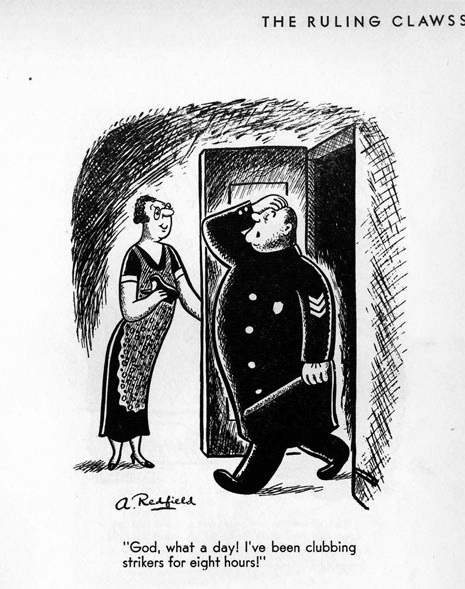
I had a nice Thanksgiving mini-holiday and of course bought some old comics, including a couple issues of The Little Scouts by Roland Coe. The series was published by Dell in the 1950s and is kind of a milder version of Little Lulu. Very charming. It was based on the magazine cartoons by Coe, who was well-known for his very family-friendly advertising and gag panel work. He died in 1954 and so is not widely-known among old-time comic art fans, but digging into his life it seems he was sort of an interesting guy and maybe even a pivotal figure. As a result of this digging, I've started researching the short-lived (1936-1939) Cartoonist Guild of America, a leftist grouping of mostly New York City magazine artists that organized to standardize payment rates for gag cartoons, etc. It predated the more conservative National Cartoonist Society by about a decade but seems to have embodied the same spirit of fraternity and good-time hijinks the Society is known for. The Guild was also quite militant, with many members marching in protests and engaging in other forms of activism. They published a blacklist of low-paying magazines, picketed College Humor magazine*, and some were even arrested, as reported in the New York Tmes and in some of the stories below. The group published its own magazine/newsletter, called OK, copies of which I have not seen. I hope they exist!
"Janice Duncan was as politically left as her husband, and both were strong supporters of workers as they fought to form unions in the 1930s. Gregor Duncan had been a founding member of the Cartoonists’ Guild, a precursor to the National Cartoonists Society, in March 1936. The Cartoonists’ Guild, led by President Roland Coe and Vice President Ned Hilton, fought for better working conditions for artists, including a $15 minimum fee for magazine cartoons. The guild also kept a watchful eye out for “scab cartoonists” who would take the place of one of their own who went out on strike in sympathy with the unions. One of Duncan’s best friends, New Yorker cartoonist Charles E. Martin, who signed his work “CEM,” was also a member of the guild, along with another friend, Gregory d’Alessio. Duncan was an active member of the guild, both politically and through his contributions to OK, the official publication of the organization. He contributed ink and litho crayon portraits of Gregory d’Alessio, Garrett Price and Fritz Wilkinson to the “Thumbnails” feature of the magazine in 1937, as well as a lithographic image titled “Longshoremen.” The magazine regularly featured fine art examples of the cartoonists’ work, such as Duncan’s lithograph. The Cartoonists’ Guild patterned its constitution after that of the American Newspaper Guild, cofounded by journalist Heywood Broun. The two groups often met together, in support of causes that affected their respective memberships." --Tom Heintjes
___
"Here's the story I was told about Syd Hoff and his mother's three little words that signaled her acceptance of his career:
Bronx-born Syd sold his first cartoon at the age of 17 and didn’t waste any time joining The Cartoonists Guild. The Guild, run by then NY Post cartoonist extraordinaire Roland Coe, was founded as a union for its members. (This is before the existence of/no relation to the current animators' union, also referred to as The Cartoonists Guild.)
When Syd joined in 1930, the prevailing New York City-based magazine gag cartoon rate was between $3 to $5. The Guild had mailed a letter to all of its cartoon markets. The letter asked magazine editors to sign it, pledging a uniform pay rate of $15 per cartoon. Most of the magazine editors acquiesced.
However, College Humor magazine refused to sign. College Humor was an important, major cartoon market. So Coe, Ned Hilton, Colin Allen and other Guild members picketed in front of the College Humor offices. College Humor called the police. The cartoonists were hauled away.
That night, Syd’s mother was at home, oblivious to all this, cooking dinner. The radio, as usual, was tuned to the six o’clock news. She hear the announcer's voice: “There was a demonstration this afternoon. Among the demonstrators arrested was Sydney Hoff.”
And Syd’s mother fainted.
As Syd told it to Bill, it was many hours later; late that night, when Syd was released from the Manhattan holding cell. Syd took the long subway ride back home, and walked back to their dark apartment building. Upon entering, his mother, who had recovered and was waiting up, calmly announced to her son, “Your dinner’s cold!”
Bill would always laugh out loud at this moment of motherly resignation. Syd was, for better or worse, a cartoonist from that point on." --Mike Lynch
"Yet, Syd’s mother didn’t find anything humorous about the day when Syd wound up in a holding cell at the local police station after supporting fellow members of the local Cartoonists Guild in a protest against below-scale rates paid by College Humor Magazine.* Although Syd’s prices were at scale, he decided to support his friends and join the protest march on the corner of 48th Street and 5th Avenue – until a police officer decided to haul them off to jail for obstructing pedestrian traffic. As they sat in the holding cell, the group sang “Solidarity Forever,” the popular union anthem originally written for the Industrial Workers of the World. Unfortunately for Syd, this made the evening news, which his parents heard over the radio while preparing dinner. “Among those cartoonists arrested was Sydney Hoff.” My grandmother immediately fainted. Later that evening, Syd was released from jail, and after a long subway ride home he walked through the front to be greeted by his mother’s welcoming words – “Your dinner is cold.” His kid sister, one of his great supporters, was quick to follow, asking “How’s Alcatraz?” " --Carol Edmonston
___
Ned Hilton was a founding member of the Cartoonists Guild of America in March 1936. According to the Times, June 7, 1936, the guild blacklisted six magazines: College Humor, Rockefeller Center Weekly, The Voyager, Promenade, Movie Humor and Real Screen Fun. These magazines refused the guild’s demand to pay a minimum of $15 for comic drawings and to pay for the drawings within thirty days of acceptance. At the time, Hilton was vice-president of the guild.
Eleven days later, Hilton and seventeen other cartoonists for arrested for picketing outside the College Humoroffice. According to the Times, the police confiscated 45 pencils from the cartoonists. After five hours at the police station cells, the cartoonists spent another four hours in the night court detention room. The magistrate dismissed the charge.---Alex Jay
___
The Buffalo Courier-Express, January 3, 1937, covered Coe’s guild presidency:
Artist Leader
Roland Coe Heads Guild
Former Buffalo artist first president of cartoonists: We have with us all kinds from John L. Lewis, champion of industrial unions to Robert Montgomery who captains the glamorous hosts of Hollywood in the Screen Guild. Now a new leader arises, Roland Coe, former Buffalo newspaper cartoonist, to fight the battles of his brother artists as first president of the Cartoonist Guild of America.
March, 1936, in New York City, seven men, headed by Mr. Coe, organized to force from national magazines a minimums price per drawing, second rights, and payment on acceptance. Growing from seven to several hundred in nine months the membership includes well-known men like Sidney Hoff, Frank Owen, William Gropper, Whitney Darrow, Jr., Ned Hilton, Charles Adams and Garrett Price.
So far most of the editors have signed the Guild contract agreeing among other things to a minimum price per drawing and of the guild. --Alex Jay
"First Exhibit of the Cartoonist Guild of America A rival of our own International, loaned to Pittsburgh for one week by the Cartoonist Guild of America original cartoon drawings, cover designs, and sketches by Howard Baer, A. Birnbaum, Roland Coe, Gregory D'Alessio, Whitney Darrow, Jr., Jaro Fabry, Hoff , Jay Irving, Melisse, Frank Owen, Garrett Price, Carl Rose, and many others. All of the drawings are complete with "gag" lines, and many have appeared in leading publications such as The New Yorker, Esquire ,-Life, Judge, Saturday Evening Post and Colliers. Take a few minutes this week for an exhibit of rare humor and interest." --ad in Pittsburgh Post-Gazette, Nov 16 1936 pg 11
___
*"College Humor Disputes Guild". The New York Times. June 10, 1936.
1930s political cartoon by Syd Hoff (signed "A. Redfield")
Thursday, June 04, 2015
Review: Little Archie #50
Little Archie #50 (November, 1968), by Dexter Taylor, Joe Edwards, et al.
review by BK Munn
My big comic book purchase this week. The Adventures of Little Archie #50. I'm a sucker for Archie Giants and this one just kind of gave off a "Summer" glow. Luckily, Ray Mitchell threw it in when Kara and I bought a mannequin from his store.
I don't normally go for Little Archie. I prefer the mind-numbing antics of Archie and his gang as teenagers (or as teenage cavemen, or as teenage superheroes, or as teenage spies, etc). The Little Archie series to me has always been slightly terrifying. Not only are the children drawn in a hideous style, all with uniform buck teeth, but the very concept, that Archie, Betty, Veronica, Jughead, and Reggie have been locked in the same grotesque cyclical relationships since childhood, is very disturbing.
Everytime I sit down to read one of these stories, I try to put aside my prejudices. After all, the Hernandez Brothers are huge fans and some of my favourite Love and Rockets stories are basically built on a Little Archie template. And this issue in particular has a lot to offer. I think most of the stories are by Dexter Taylor, the man who took over on the title from Little Archie's original creator Bob Bolling for most of the 1960s. This is from 1968. Peak period. This is the year of "Sugar Sugar" and the Archie band's pop music breakthrough, so a couple of the stories have Archie and the gang trying to rehearse at the Lodge mansion. As well, there are adventures at the soda shop and in school.
As I get older, I identify more and more with the adults in Archie's world, especially the constantly humiliated Mr. Weatherbee (he ends up in front of the School Board and an auditorium of children in his boxers in one story here) and of course Pop Tate, the owner of the soda shop. Even snobby self-made millionaire Mr. Lodge gets my sympathy here, forever tormented by Little Archie and Little Jughead. In the story in #50, he runs for town council but when Archie mixes up his photo with the mugshot of a crook on a wanted poster, he keeps getting dragged into the police station by every prole in Riverdale until he finds and beats up "Bruiser McTuff" himself. You can kind of see a mid-life wish fulfillment thing going on in many Archie strips. The main characters are so eerily monstrous and unsympathetic (whether children or teenagers) and the put-upon parents, supposedly the moral compasses and bourgeois standard-bearers of the comics universe, often play-act at non-conformist rebellion, whether it's Mr. Lodge taking up prize-fighting and vigilantism, or "The 'Bee" trying out for Ed Sullivan. But of course, regardless of what they are doing in the final panel, all is safely back in its proper place by the first panel of the next story.
Monday, June 01, 2015
Read the First 30 Pages of "Catharsis" by Luz for Free
Charlie Hebdo Cartoonist Documents the Aftermath of the Massacre in New Book of Cartoons
CLICK HERE
"The book is, of course, about how everything changed on Luzier’s birthday. But his confessional volume should have a wider interest. That’s because its subtext is the artist’s secret fear of an unforeseen loss of inspiration.Luz describes it in a little preface.
“One day, drawing left me. The same day as a bunch of good friends. The only difference was that the drawing returned, little by little. Both darker and more light-hearted. With this returning ghost, I talked, cried, laughed and screamed… This book is not a testament, even less is it a comic. It’s the reunion of two friends who almost never met again.”