Saturday, February 03, 2018
Seth Profile in Toque Magazine
Thursday, January 25, 2018
R.I.P. Mark E. Smith
Mark E. Smith 1957-2018.
Marvel Team-Up #41-44, by Bill Mantlo and Sal Buscema (Marvel Comics, 1976).
In this 4-issue series of stories, the sorcerous super-villain Dark Rider uses Cotton Mather to transport Spider-Man and the Scarlet WItch to the Salem Witch Trials in 1692 in order to lure Dr. Doom and siphon his mystic powers. The story is referenced in The Fall song, "Various Times," the B-Side to the band's second single, "It's the New Thing" (1978). Fall singer and chief song-writer Mark E. Smith was a comic book reader and made many comics references in his art, including nods to Jack Kirby, Brian Talbot, Viz Comics, and, most famously, to the work of Jack Cole in his song "How I Wrote Elastic Man." Smith was something of a prole-art visionary, obsessed with time-travel, the Holocaust, rockabilly, Arthur Machen, H.P. Lovecraft, 60s Motown, Philip K. Dick, Rasputin, the Witch Trials, and other arcane aspects of U.S. and UK pop culture and history.
Mark E. Smith died today at age 60.
The relevant lyrics from "Various Times" are as follows (the lyric also references a novel by science fiction writer Ursula K. LeGuin, whose death is also being widely mourned today). The song examines racism and ideological extremism during three different points in human history (The Salem Wich Trials, World War II Germany, and modern-day Britain) and ponders how seemingly normal people could become complicit in mass hysteria and horrible historical atrocities.
"Future:
1980
Black windows
And smokey holes
My head is full of lead
And the beer is so weak
Since they got rid of time around here
Dr. Doom
Fresh from Salem
And the witch trials
The Lathe of Heaven
Time mistaken
Three places at once
Human [race]
Don't think, ask him
Ask him
Ask him”
Thursday, November 02, 2017
Jack Kirby on Unions and Efforts to Organize Comic Book Artists
Kirby was very much of his times in the post-War world. Although many of his heroes seek solutions in collective action, many of his early characters were individualists and his themes tended towards the little guy against vast conspiracies...
From the Comics Journal interview with Gary Groth...
The first stories were deadly serious. Fighting American was the first [C]ommie-basher in comics. We were all caught up in Senator McCarthy's vendetta against the 'red menace.' But soon it became evident that McCarthy ... had gone too far, damaging innocent Americans.... Then, the turnaround, [as] his side became talked of as the lunatic fringe.... Jack and I quickly became uncomfortable with Fighting American's cold war. Instead, we relaxed and had fun with the characters
Friday, October 27, 2017
Working Class Heroes: Humphrey Bogart and the Steel Fist
Tuesday, October 24, 2017
The Future of (Digital) Collecting?
by BK Munn
The future of collecting? As a marxist grad student in the 90s I was obsessed with comics/the commodification of art and wrote a bit about simulacra and the then-new phenomenon of eBay and slabbing (encasing old comic books in plastic to protect their condition and "grade"). As I recall, Baudrillard had something to do with it all., but the point was that people had really stopped collecting actual physical objects and were instead bidding on the "idea" of the object, virtual alienated labour, or some such. I was not then and am not now very good at expressing these ideas... Most non-rich, non-artist people still don't collect capital 'A' art, and even the kind of industrial production culture I like to collect, like original comic book art, may soon disappear as cartoonists make more and more of their work digitally and not on paper with ink and pencils. Instead of buying antiques and collectibles, most of us are content to curate photos of them on Pinterest and Instagram. Can we now say that collecting has entered a new phase?
From an article by McKenzie Wark:
To think about digital objects as collectable, it may help to start by asking what it is that is actually collected. We tend to think that what is collected is a rare object. But what makes it rare? Perhaps there is more than one way to make an object rare. To make a digital object rare, it can be “locked” in various ways. Take for example The Clock (2010) by Christian Marclay. It is only supposed to be seen in specially designed installations where it runs for twenty-four hours, although apparently the artist’s wishes about that did not stop the hedge-fund manager Steven A. Cohen from using his copy as a screen saver or his gallerist Jay Jopling from screening it for a party.1
Attempting to lock the information in the digital work to some material form or situation may create more problems than it solves. As Cory Doctorow has argued, relying on digital locks does not really empower the artist or the owner. It empowers the makers of digital locks. And in any case it takes away some of the special qualities of a digital object if its form merely imitates the kind of objects that collections already collect.
What might be more interesting is to consider how the very properties of spreadability that characterize digital objects can be turned to advantage to make them collectable as well.2 Paradoxically, an object whose image is very widely spread is a rare object, in the sense that few objects have their images spread widely. This can be exploited to create value in art objects that are not in the traditional sense rare and singular. The future of collecting may be less in owning the thing that nobody else has, and more in owning the thing that everybody else has.
The artwork is not what it used to be. Perhaps one could think of three stages in the evolution of the artwork, each of which has its own kind of rarity and collectability. The first stage we now think of as that of the old masters. The second stage is that of modern art. The third stage begins with what we call contemporary art, but is perhaps only now starting to reveal its true form.
[...]
The third stage is something else. It corresponds to the period in which information becomes the key to value in both the wider economy and also in art.3 The artwork is no longer a special kind of commodity as it was in the modern-art period. The artwork is now a special kind of financial instrument. The artwork is now a special kind of derivative.4 The collectable artwork is now less about being an object that stores value because of its special qualities as a rare thing made by a special kind of worker, the artist. The artwork is now collectible because it is a financial instrument in a portfolio that manages and hedges risk.
The key is the role of information about the artwork. The information about the artwork is actually the most important thing about it. What establishes the value of the work is that people talk about it, write about it, circulate (unauthorized) pictures of it. The more it circulates, the more value it has. The actual work is a derivative of the value of its simulations.
Friday, October 20, 2017
Comic Fan Project: Don Heck era Avengers
This entry brings us a letter printed in Marvel's Avengers #31 from August 1966. The letter is a comment on the character and plot developments in the run of Avengers co-plotted and illustrated by cartoonist Don Heck who replaced Avengers co-creator Jack Kirby on the feature and was the other primary visual chronicler of the era before Big John Buscema and Neal Adams made their mark later in the "Silver Age":
Dear Stan and Don,
No! No! You can't do this! You can't leave Henry Pym a ten-foot-tall freak!.You'll be rouing one of the most beautiful romances in comicdom. We Marvelites will never tolerate this man's being deprived of what he has needed most in life since the loss of his first wife --the love of Janet Van Dyne. On this we all stand firm. As a matter of fact I'm still amazed that he and the Wasp are not already married. They had plenty of time in which to be wed during their recent period of inactivity. Except for this weakness, the come-back of Giant-Man was rather spectacular. His new costume finally adds that last basic color that has been missing in the new Avengers, and that is yellow. Two things still puzzle me --one is his size. The 25-foot version is too big and too clumsy, as we frantic fans noticed as he struggled to squeeze through the corridors of the Collector's castle. In this state he more of a hindrance than a help to the Avengers. The ten-foot height is slightly undersized. Giant-Man always was and will ever be at his peak in mobility, strength, and power at his standard 12-foot combat height which is the height he displayed on the cover of issue #28. This is the way I and many other old-time Marvelites remember him and will always remember him. The other thing I find hard to accept is his new name. Somehow the name Goliath will never overshadow the glory tha was once in the name of he who we called Giant-Man, for this was how we grew to admire him. The old name sticks close to the heart of many of us. Should these few flaws be remedied, I am sure the new Avengers would reach a peak that might even surpass the glory of the old Avengers.
Claude Paquet5834 Molson St.Montreal 36Quebec, Canada
A great letter full of early fan entitlement and some size puns devoted to perennial nobody's favourite Hank Pym aka Ant-Man aka Giant-Man aka Goliath aka Yellowjacket. At this point in Marvel's development, it's interesting to read a reader self-identify as both a Giant-Man fan and as an "old-time Marvelite" --the Marvel U is at this point only 4 or 5 years old and the letter is written in response to Avengers #28! Also interesting that at this point, the Avengers was basically "The Adventures of Giant-Man"...
Thanks to Claude Paquet of Montreal!
Tuesday, October 17, 2017
Forgotten Comic Book Character: The Lepra-Duck
Panels from the first appearance of The Lepra-Duck from the story "The Battle at Hadrian's Wall", the cover-feature of Walt Disney's Donald Duck #107 (Gold Key, May 1966). The story was written by Vic Lockwood and drawn by Tony Strobl. In the story, Donald is given the Lepra-Duck's wishing stone, previously in the possession of Donald's lucky cousin Gladstone Gander, and, through a series of wishes, first travels to Uncle Scrooge's ancestral homeland of Scotland, and then back in time where he and his nephews meet Emperor Hadrian and some of Donald's own "barbarian" ancestors who they teach to play baseball!
The Lepra-Duck is in the tradition of puckish magical interlopers like Superman's Mr. Mxyzptlk, Batman's Bat-Mite, Aquaman's Quisp and Quirk, Impy from The Fantastic Four, and Gazoo from The Flintstones. Like these other characters, he magically appears to vex the main characters and introduce some sorcerous obstacle or faux-helpful spell. The Great Gazoo was introduced a year earlier on tv and is a likely influence on the Lepra-Duck, and ditto Lucky from the Lucky Charms cereal ads (first appearance 1963), although leprechauns are plentiful in fiction and popular culture, as is the idea of a magical token like the Wishing Stone (cf. Monkey's Paw) or the tradition of wishes that act as a form of hubris and backfire to punish greedy or prideful.
There are other magical characters in Donald Duck's world (Magicka de Spell) and the concept of luck is central to the characters of both Uncle Scrooge and Gladstone Gander, but we rarely see magic used as a form of time-travel. Rather, the characters in these stories interact with historical places and artifacts in the modern era.
As a kid I hated it when Bat-Mite would pop up in the Batman cartoon show. I wanted Batman to be a serious superhero and the existence of this magical elf from another dimension, constantly getting into bumbling slapstick adventures while trying to help his "hero" Batman, really put a damper on my suspension of disbelief, to say the very least. I was a little bit more forgiving of The Great Gazoo because the Flintstones was a comedy show and the wonderful droll voice acting of Harvey Korman really put the character over. As an adult, I love all of these magical characters and prefer the older superhero comic books with a sense of humour.
I came across this character in a really beat-up and coverless copy of a Donald Duck comic that I was actualy about to throw in the garbage. after investigating I was surprised that a) this seems to be his only appearance and b) there isn't really anything online about him, even on websites run by ultra-nerdy Dinsey comics fanatics in Europe, like the Inducks wiki. The story he appears in has been reprinted at least once, so thousands of kids and older fans have read it. Obviously, the cliche magical deus ex machina nature of the character has left a sour taste in the mouth of fans who love the mostly well-plotted, logical stories of the Barks Ducks universe. Or maybe it's just not that memorable of a story. The character really only appears in a few panels at the beginning, popping back in for a few more panels at the end to take back his wishing stone.
Monday, October 16, 2017
I Want This Old Jack Kirby Thing T-Shirt
Friday, December 16, 2016
Prole Art Threat: The Gong, Time, Work-Discipline, and the Revolt Against Industrial Capitalism in Batman #55
Sunday, November 27, 2016
Umberto Eco On Fascism and His Introduction to U.S. Comics, or, "Is Dick Tracy Fascist or Not?"
![]() |
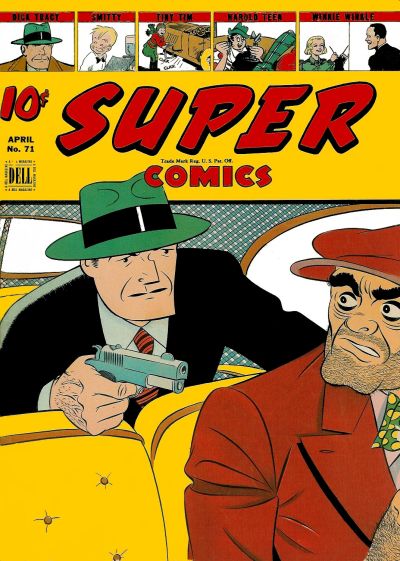
| Dick Tracy on the cover of Super Comics #71, April 1944 |
by BK Munn
I recently came across this great concise summary of Umberto Eco's list of 14 characteristics of fascism. When you follow the links, you get the full original essay from The New York Review of Books, in which Eco talks a bit about growing up in Italy in the '40s under Mussolini and the liberation of his small town by partisan rebels and U.S. soldiers:
"A few days later I saw the first American soldiers. They were African Americans. The first Yankee I met was a black man, Joseph, who introduced me to the marvels of Dick Tracy and Li’l Abner. His comic books were brightly colored and smelled good."
Chester Gould's Dick Tracy comic strip was translated to comic books many times. During the years of World War II it was reprinted in Dell's Super Comics alongside other funny pages cohorts like Little Orphan Annie. Perhaps this is how Eco first encountered the strip? Likewise, Al Capp's L'il Abner was a regular feature in Tip Top Comics during the same period.
I wonder, by mentioning them here, is Eco hinting at the weird right-wing politics of Gould and Capp and their comic strip tough-guy counterparts? Or is he simply conflating his budding awareness of the wonders of U.S. pop culture with this primal example of the democratic nature of post-Fascist society? As usual with Eco and his playful essays, there is probably a lot more going on than it seems on the surface.
Is Tracy fascist? Eco starts his piece by wondering why the Italian "Fascist" became the default term for describing any and all varieties of totalitarian strongman, from dictator or president right on down the line to your friendly neighbourhood cop on the beat.
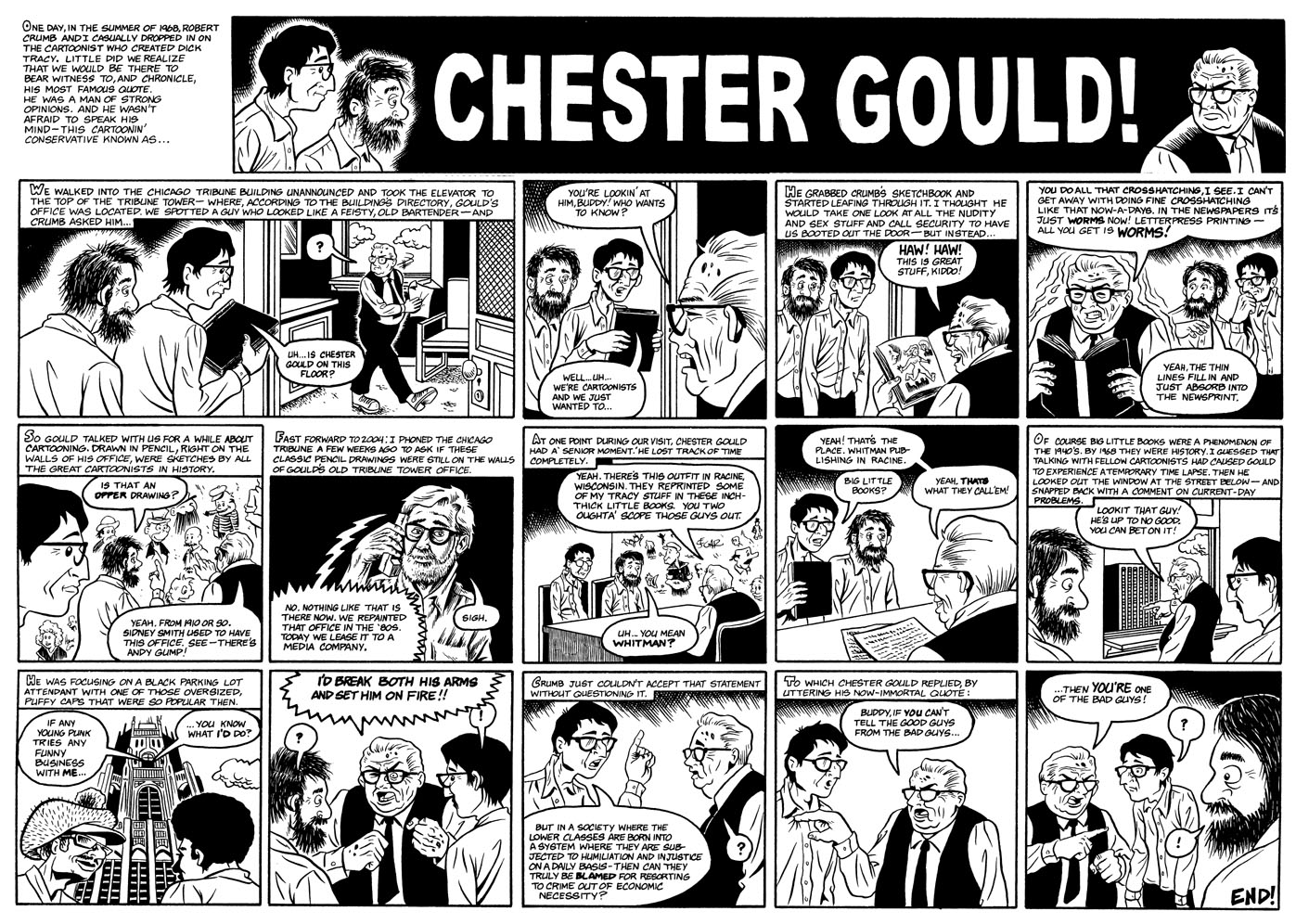
Tracy is a cop, and his tough-guy, decades-long merciless war on crime was calcified and largely out of favour by the time the late-60s counter-culture was in full bloom (although it didn't stop Underground cartoonists like Jay Lynch and Robert Crumb from seeking an audience with Gould in his Herald-Tribune office in 1968). Cantankerous conservatives Gould and the acerbicly satiric Al Capp (think of Capp vs John Lennon and Yoko Ono), and the comics they created, were labeled fascist by 60s observers, just like 80% of the mainstream culture of the time. But it's a big leap from "asshole" to "fascist" and so much of this seeming cultural change can be explained away as adolescent posturing and inter-generational iconoclasm. But the shift in tenor on both right and left during the Cold War was also very much a reality. Outside of an increasing graphic/artistic weirdness, and the occasional patronising stab at "with-it" trendiness, Tracy and Gould were out of step with their surrounding culture. (This was true of the Underground vs Mainstream dialectic everywhere. For left-wing intellectuals like Art Speigelman in the 60s and 70s, it didn't matter that the Jewish creator of Captain America had personally shot Nazis during the War. 1960s Captain America had turned to fighting communism in the comics and in the era of Vietnam and the draft, that made Kirby and Marvel the enemy.)
This was not always the case. 1940s Tracy in the comic strips was a big supporter of the U.S. war effort and, as part of the frontline of comic strip propagandists, fought his fair share of Nazis, most notably in a well-known continuity begun in 1944 and featuring The Brow, an Axis spy who bedevils Tracy and the gang for months, escaping a variety of the usual Gould-ian deathtraps (and even a romance with Gravel Gertie!) before finally being impaled on a flagpole flying the U.S. flag.
Eco wraps up his famous essay with a plea for vigilance, noting that "Ur-Fascism is still around us, sometimes in plainclothes." What comics fan doesn't remember that the name of Gould's strip was originally "Plainclothes Tracy" until it was changed by the publisher Captain Joseph Patterson to the tougher, slang-ier-sounding "Dick Tracy"? Certainly the past few years have seen a reassessment of our relationship with police of all stripes, in popular culture and in real life, and we can only wonder what having actual neo-Nazis (Bannon, et al) in the White House will mean for this horrible trend.
"We must keep alert, so that the sense of these words will not be forgotten again. Ur-Fascism is still around us, sometimes in plainclothes. It would be so much easier, for us, if there appeared on the world scene somebody saying, “I want to reopen Auschwitz, I want the Black Shirts to parade again in the Italian squares.” Life is not that simple. Ur-Fascism can come back under the most innocent of disguises. Our duty is to uncover it and to point our finger at any of its new instances—every day, in every part of the world. Franklin Roosevelt’s words of November 4, 1938, are worth recalling: “I venture the challenging statement that if American democracy ceases to move forward as a living force, seeking day and night by peaceful means to better the lot of our citizens, fascism will grow in strength in our land.” Freedom and liberation are an unending task."
Anyway, here's the shortened list from the article mentioned above. Some of these track to Tracy, but there is more Trump here than Chester Gould:
While Eco is firm in claiming “There was only one Nazism,” he says, “the fascist game can be played in many forms, and the name of the game does not change.” Eco reduces the qualities of what he calls “Ur-Fascism, or Eternal Fascism” down to 14 “typical” features. “These features,” writes the novelist and semiotician, “cannot be organized into a system; many of them contradict each other, and are also typical of other kinds of despotism or fanaticism. But it is enough that one of them be present to allow fascism to coagulate around it.”
1. The cult of tradition. “One has only to look at the syllabus of every fascist movement to find the major traditionalist thinkers. The Nazi gnosis was nourished by traditionalist, syncretistic, occult elements.”
2. The rejection of modernism. “The Enlightenment, the Age of Reason, is seen as the beginning of modern depravity. In this sense Ur-Fascism can be defined as irrationalism.”
3. The cult of action for action’s sake. “Action being beautiful in itself, it must be taken before, or without, any previous reflection. Thinking is a form of emasculation.”
4. Disagreement is treason. “The critical spirit makes distinctions, and to distinguish is a sign of modernism. In modern culture the scientific community praises disagreement as a way to improve knowledge.”
5. Fear of difference. “The first appeal of a fascist or prematurely fascist movement is an appeal against the intruders. Thus Ur-Fascism is racist by definition.”
6. Appeal to social frustration. “One of the most typical features of the historical fascism was the appeal to a frustrated middle class, a class suffering from an economic crisis or feelings of political humiliation, and frightened by the pressure of lower social groups.”
7. The obsession with a plot. “The followers must feel besieged. The easiest way to solve the plot is the appeal to xenophobia.”
8. The enemy is both strong and weak. “By a continuous shifting of rhetorical focus, the enemies are at the same time too strong and too weak.”
9. Pacifism is trafficking with the enemy. “For Ur-Fascism there is no struggle for life but, rather, life is lived for struggle.”
10. Contempt for the weak. “Elitism is a typical aspect of any reactionary ideology.”
11. Everybody is educated to become a hero. “In Ur-Fascist ideology, heroism is the norm. This cult of heroism is strictly linked with the cult of death.”
12. Machismo and weaponry. “Machismo implies both disdain for women and intolerance and condemnation of nonstandard sexual habits, from chastity to homosexuality.”
13. Selective populism. “There is in our future a TV or Internet populism, in which the emotional response of a selected group of citizens can be presented and accepted as the Voice of the People.”
14. Ur-Fascism speaks Newspeak. “All the Nazi or Fascist schoolbooks made use of an impoverished vocabulary, and an elementary syntax, in order to limit the instruments for complex and critical reasoning.”