Showing posts with label snow. Show all posts

Sunday, December 02, 2007

Snow in the Comics, Part 3: Only 15 More Days Until Beethoven's Birthday!


Snow in Charles Schulz's Peanuts
Part 3 of 3

by BK Munn

I'm sure that Robert Short tackled this in his Gospel According to Peanuts --before the recent Michaelis bio, the most extensive critical treatment of Schulz's work in print-- but I have to wonder if the use of Beethoven's birthday in the strip, coming so close to Christmas, is another aspect of the religiosity of Peanuts, some sort of parable about empty ceremony or advertising. It's funny, I've never really thought about it before. For some, Beethoven is on a Christ-level of greatness (plus, he actually existed), and therefore an apt metaphor for Baby Jesus and his season. I always thought this sign business was hilarious but I also always suspected I was missing something: a function of what Jonathan Franzen called "the koanlike inscrutability" of Schulz's humour.


Anyway, with all this snow, I'm put in mind of how Peanuts seems to contain the most extensive treatment of snow and winter of any comic, with the possible exception of some theoretical Scandinavian or Inuit strip I have yet to encounter. Of course, you could pick almost any subject and Peanuts will have treated it exhaustively, from football to philosophy, from World War I to worms --it was a smart strip that ran for 50 years. (And with the handy index in Fantagraphics' new Complete Peanuts, you can actually look these things up.) Winter holds a central place in the iconography of the strip, not just as a marker for the passage of time and the basis for seasonal gags, but as a metaphor for psychological states and the various major themes of the strip.

snoopy dance winter

I'm sure Schulz liked winter --he certainly liked to play hockey. Sometimes, though, it does seem like he's stretching it a bit, playing on what he thinks other people feel about the season, and poking at those feelings as bit.

snoopy is cold peanuts

Like everything in the strip, snow has its bad side, something capable of instilling terminal ennui and a soul-blackening, body melting, shivering dread.

Speaking of which, I wonder if Canada is ever mentioned in the strip? That would be a grim series of strips. Back to the index...


Next time: the forecast calls for more snow
Part 2
Part 1

Friday, February 02, 2007

Snow in the Comics, Part 2

Part 2 of 3
"We're Wolf" by Genevieve Castree
Drawn and Quarterly Showcase Three
edited by Chris Oliveros
D&Q
95 pages
ISBN 1-896597-88-2
$19.95 Cdn/$14.95 US


It's snowing again today, which puts me in mind of snow in the comics (technically, since it hasn't really stopped snowing for several weeks, there should be many more of these entries, but I've been too busy shoveling).

Perhaps the most famous of all snow-themed comics is Herge's Tintin in Tibet, the classic, austere graphic novel that Herge identified as his favourite. Who could forget, after reading this story as a child, the epic journey of the indomitable boy reporter to find his long-lost friend Chang? During a troubled period of his life, Herge poured all his artistry into this simple tale of Tintin's adventure in the Himalayas, his encounter with the lonely Yeti, and the struggles of his companions to survive and reunite Tintin with Chang, his friend from an adventure drawn decades earlier. The only Tintin album without a villain, Tintin in Tibet is full of haunting cartoon images, emotion, and lots and lots of snow.

The iconic nature of this book, and the place it holds in the imagination of its readers, is one of the themes of Genevieve Castree's (she signs herself Genevieve Elverum here) contribution to the third volume of the Drawn and Quarterly Showcase anthology. "We're Wolf!" is a beautiful meditation on nostalgia, self, and lycanthropy that takes as its inspiration Tintin's snow-bound adventure --its pace, use of silence, and feeling. The story follows a young woman through two seasons, Summer and Winter, both highly suggestive of states of mind as well as stages of life and love, and with aspects of Herge's book used as outward emblems of an interior life.


The title page of Castree's story features a highly stylized version of the famous cover from Tintin in Tibet, grasped in a tiny hand --an elaborate play on words that refers to her title ("We're Wolf" or "Werewolf") and her subject, as well as to the character on her faux-Tintin cover.


The metaphor is stretched even further throughout the story as Castree's character, a young woman/cartoonist surrogate, in turn reads the comic, imagines herself inside it, hiking over snow-covered mountains, and finally giving birth to a brood of tiny Yeti-like werewolves. The narrative is quite dreamlike and Castree's art is a charming mix of ligne-clare cartooning and gorgeous colour with a very personal style. And of course there is quite a bit of snow. Ice-caves, mountain peaks, sleeping bags, pine-needles, vast expanses of white. The story is very evocative of childhood (I particulary like the idea of dealing with a Summer-time depression by curling up with your favourite kids comic --kind of like a snowball saved from winter in the freezer and unwrapped in the hottest day of the year) and it is wide open to interpretation.

How are these images connected? What does it all symbolize? I cannot say. I only know that it is beautiful and that the book (and Castree) is a treasure: the other selections include a nice coming-of-age story by Sammy Harkham ("Somersaulting") and a quirky postmodern pastiche of a 1930s pulp adventure by Matt Broersma ("The Mummy") that is someways reminiscent of early Herge. And yes, I know this book was published in 2005 --I've been saving it for a snowy day.


Next time: the forecast calls for more snow
Part 3
Part 1

R.I.P. Geneviève. Her husband wrote a song about their first meeting and reading comics.


Wednesday, December 06, 2006

Snow in the Comics


Part 1 of 3

by BK Munn

It's snowing again this morning, putting me in mind of snow in the comics. Trying to remember my experience of snow in the comics, the first thing that comes to mind is Peanuts which always was very seasonal in its rhythms. Although other daily strip cartoonists did winter-themed gags and even created snowy adventure storylines (I think the final episode of Caniff's Terry and the Pirates took place on a snow-filled runway), Peanuts is really the winter strip par excellence, a position that was ratified with the animated Christmas special back in the 1960s. Outside of the strips, U.S. kids comics creators like John Stanley, Carl Barks, and the Archie gang always published season-specific issues. As well, I'm sure I read the occasional superhero comic as a kid featuring a chilly, John Romita Spider-Man brawling over snowy New York City rooftops. But the first time I think I really noticed snow as an actual presence and plot device in a graphic novel context was Cerebus.
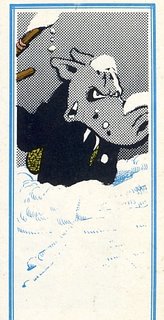

At some point in the early 1980s, Dave Sim seemed to decide to make snow a major character in his High Society graphic novel. I'm sure there was snow in earlier issues since much of the series was a parody of the Barry Windsor-Smith Conan comics and I'm pretty sure there was at least one issue of Conan that featured barbarians fighting frost giants in the wilds of Hyperboria, or wherever it was that Conan was from, but Sim's use of snow in these later Cerebus issues really struck a chord with my 13-year-old self.
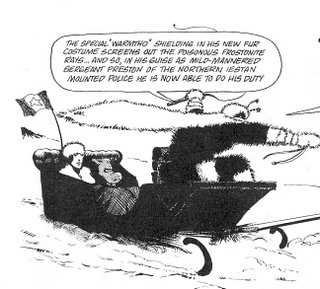
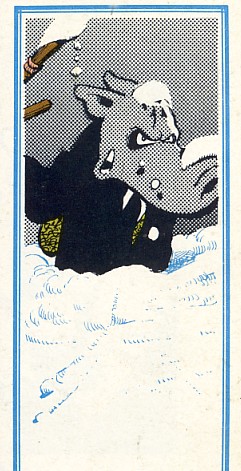
The first snow-themed issue I remember is Cerebus #44, "The Deciding Vote". Fans (or maybe just Sim) later called this the "wuffa-wuffa" issue, after the sound the lead character made when walking with snowshoes. The plot of the issue, Cerebus following an old farmer around in order to solicit the geezer's vote for Prime Minister, took a backseat to the slapstick images of Cerebus trying to navigate his way through snowdrifts and the drunken antics of Sim's superhero parody character The Roach. Y'see, Sim the artist was telling us, Cerebus's attempt to transform himself from barabarian to politician is an uphill battle and even the elements are against him.
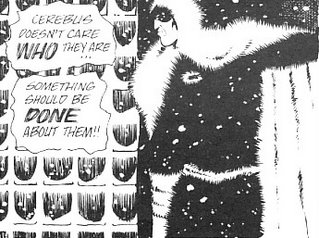
Things only got worse for the character as the book progressed: Cerebus' time in office seemed to take place over the course of one long winter, which meant that the snow hung around. Sim seemed to take great delight in drawing the characters in the midst of blizzards or contrasting the heated conversations of his characters with the serenity and quiet of the outdoors. The story, and Cerebus' political career, culminated with an invasion of the city by barbarians. Sim told the story in a series of long panels, ending with his now-isolated character walking off into the distance into a sea of white.
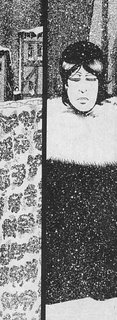
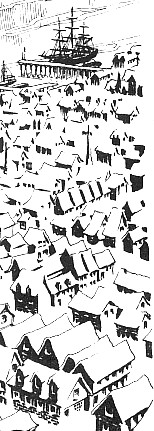
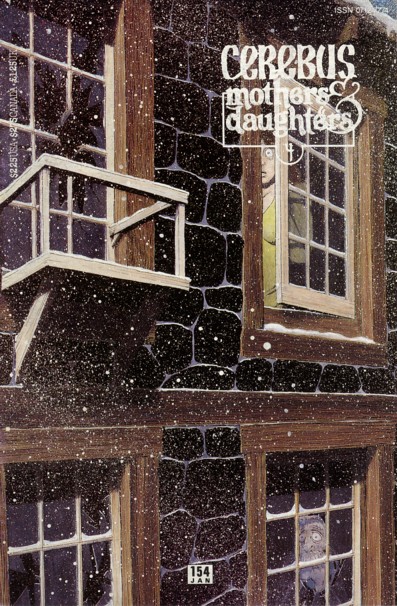
Snow popped up in the next few graphic novels as well. In Church and State, Cerebus becomes Pope, gets thrown off the side of a snow-covered mountain, and has to spend many pages climbing back up. Meanwhile, other characters stand around in the snow, looking pensive and plotting schemes of vast socio-political importance. During this time, Sim's assistant Gerhard really started to make his presence felt in the series, drawing highly-detailed walls, cityscapes, gargoyles, etc, all blanketed in layers of snow.
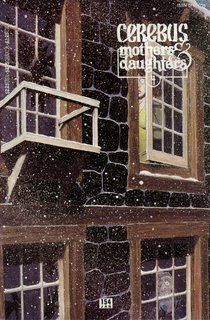
I think that, in part, Sim was initially sort of stuck with the northern fantasy world he had inherited from his pastiche of the world of Robert E. Howard. However, he eventually realized that he could incorporate aspects of this universe into the tale to his advantage, using the weather as a major storytelling tool (and in a black-and-white book, snow makes a nice contrast). As well, the world he was creating was starting to take on more aspects of the real world that he was interested in. I used to imagine that his fictional city state of Iest was a brilliant amalgamation of Kitchener, Ottawa, 1917 St. Petersburg, medieval Europe, Carl Bark's Duckburg, and Conan's D&D fantasyland. At the same time, I sometimes resented the enormous use of white space in Cerebus, an indication I thought of a certain amount of cartoonist laziness. And after awhile, the device takes on a strained air (not unlike the device of using a cartoon aardvark barbarian as the lead character in a 3000 page graphic novel about religion, politics, and gender relations). The depictions of falling snow still are very affecting, as long as one of Sim's gross caricatures is not in the panel, maybe because falling snow is still evocative of a certain sense of nostalgia (childhood, holidays, etc). Overall, and despite the general failings of Sim's project as a whole, I can still appreciate these early Cerebus stories for their modest attempts at depicting the Canadian landscape in graphic novel form. Really, a very sophisticated and sustained, at times subtle use of nature for such a young artform.

Next time: the forecast calls for more snow
Part 2
Part 3