Showing posts with label canon. Show all posts

Thursday, April 11, 2024

R.I.P. Trina Robbins

(Communist dinner table panel from the adaptation of the 1927 novel "Red Love" by Alexandra Kollantai, serialized in Renegade Romance #1-2, 1987.)


by BK Munn

This Trina Robbins dinner table panel sums up every meal my wife and I ever share! R.I.P. Trina Robbins (1938-2024). The great feminist cartoonist and historian broke through into the pantheon with her underground classic It Ain't Me Babe and created the first comic featuring an "out" lesbian in "Sandy Comes Out" in Wimmen's Comix #1. She designed the character Vampirella and was the first woman to draw Wonder Woman for DC Comics. She was such a revolutionary she was actually featured in the first verse of Joni Mitchell's "Ladies of the Canyon." She was a fashion designer, an editor, a muse, a leader, and organizer. Trina herself was a tireless and groundbreaking researcher and comics historian, responsible for a seemingly endless series of history books that studied and popularized the careers of women in comics dating back to the 1800s. She was an amazing spirit and had a legendary life! Rest in Power, Trina!

As a preteen kid, I first encountered her through a page in Les Daniels' history book Comix (found in the Public Library) which reprinted a collaborative comic with her then-partner Kim Deitch announcing the birth of their daughter. One of Trina's panels on that page depicted a who's who of famous women superheroes, alongside Trina's own creation, the half-woman/half-cat Panthera, who tantalizingly went about topless. The first whole comics story I read was her adaptation of Sax Rohmer's "Dope" in the pages of Eclipse Monthly circa 1983. I've collected her comics ever since as well as her history books which have made an immeasurable impact on my understanding of comics history and my knowledge of women cartoonists, and one of the pillars of my own ongoing Comics Canon project. 


Monday, February 01, 2021

What Was the Best Comic of 1961?


by BK Munn

I've seen some press for an upcoming repackaging of Jack Kirby's Fantastic Four #1, the comic book that arguably launched the Marvel brand of superheroes. The new book tries to place FF1 in its historical context by reprinting it alongside the other Marvel/Atlas comics that were published in the same month, presumably to show what a major departure the title was. Of course, comics historians who have studied the period know that the Fantastic Four is not really a major departure for Kirby, being an extension and articulation of several themes from his previous superhero, science fiction, and romance comics work. Far from being revolutionary, there's a case to be made that the Fantastic Four isn't even the most interesting comic book Kirby himself created that year! Sure, its importance in paving the way for the revival of superheroes at Marvel can't be understated, but most would agree it's not the greatest comic book, even for a kids' comic, and it would be awhile before the title of "World's Greatest Comic Magazine" would even be remotely applicable. Which leads me to ask, what was the best comic of 1961?

In the sphere of U.S. children's comic books, there were many contenders in 1961. Dell published all-time classic stories by John Stanley and Carl Barks (Stanley's "Around the Block with Dunc and Loo" premiered the same month as FF #1), and had many good-looking adventure comics like Tarzan. National was cranking out handsome and entertaining comics drawn by the likes of Curt Swan, Joe Kubert, Alex Toth and Carmine Infantino. Archie had Dan DeCarlo and Harry Lucey. The list goes on.
And what about comics intended for an older or more general audience? There weren't many graphic novels published in 1961 (although there were some), but the world of U.S. magazine and newspaper comic strips was having a banner year. Harvey Kurtzman's Help! magazine was going strong in '61 and you could walk into any bookstore and buy a collection of great comics by immortals like Charles Schulz (Peanuts Every Sunday) and Walt Kelly (Pogo a la Sundae). Any daily newspaper was chock-full of masterful soap opera and adventure storylines by greats like Milt Canniff, Frank Robbins, Harold Gray, Chester Gould, and many more. Johnny Hart's "B.C." had just started to hit its stride and Jules Feiffer, a graphic novel pioneer, had just published a new collection of his decidedly-adult Village Voice strips, "Boy, Girl, Boy, Girl." And don't forget, Jack Kirby was winding up his "Sky Masters" sci-fi strip at the same time as FF#1 was hitting the stands.
Looking further afield, Franco-Belgian comics were having a good year. The first Asterix album by Goscinny & Uderzo came out in 1961. Herge was serializing masterwork "The Castafiore Emerald" in his Tintin magazine, having just released the sublime children's classic "Tintin in Tibet" the previous year. Franquin had put out a new Spirou: "Z comme Zorglub." There were also a ton of lush adventure strip albums by the likes of Uderzo, Jijé (assisted by Jean Giraud), Jean Graton, and others. Elsewhere, Argentine artists like Alberto Breccia, Solano Lopez, and Hugo Pratt were breaking new ground in work for various UK and Spanish-language publishers. In Japan, the gekiga movement was underway, with Yoshihiro Tatsumi creating gritty noirish manga in a new style. Hideko Mizuno published her breakthrough shojo manga “Gin no habira” (Silver Petals), Leiji Matsumoto published his first sci-fi epic, "Denko Ozma," and among many other things Tezuka published his "Captain Ozma" (no relation!) in 1961.

Saturday, January 08, 2011

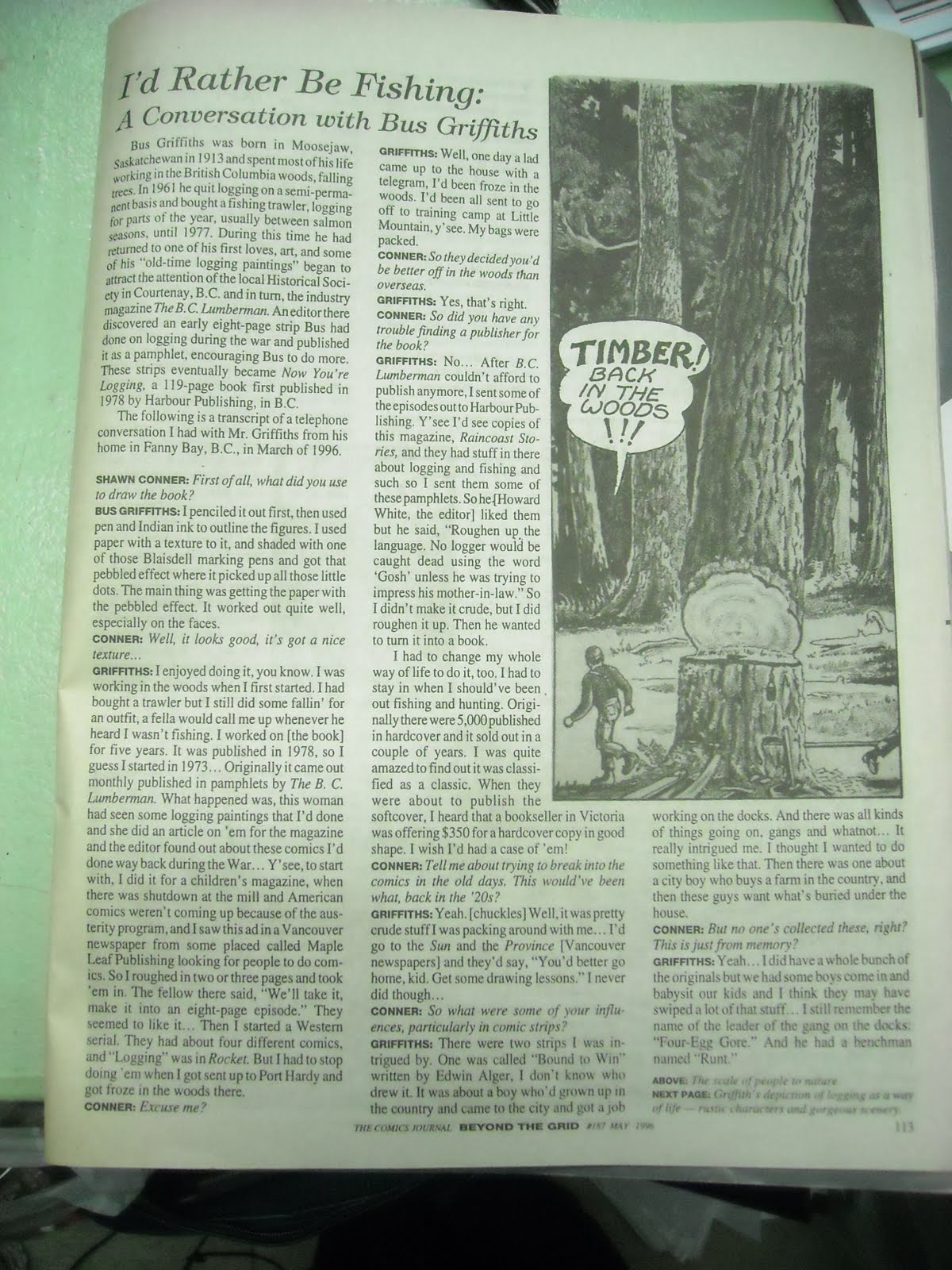
Bus Griffiths Interview CJ 187


For Brad Mackay:

Bus Griffiths is the missing link of Canadian comics history, connecting 1920s comics with the Canadian Whites 1940s comic books, to graphic novels, with his Now Your Logging, as we see here in this classic Comics Journal interview with Shawn Conner.

Griffiths had a great fluid lettering style coupled with that sexy inky outlining and shading technique that made his figures jump out at you, like a sort of porno woodsman icon.


Lots of unanswered questions, like what other comic stories did he have published, what work is still out there (ie, not stole by those damn fool babysitters), and, generally, What the fuck?! is this not the craziest Canadian comic ever????!!!???.

Thursday, March 06, 2008

Canon II


As various bloggers are reporting, a new report says there were over 3,300 graphic novels published in the U.S. and Canada in 2007. That's quite a bit to keep on top of and illustrates quite handily the value of the various awards and critical lists that are now a major pillar of comics culture. Specifically, the job of actually figuring out what is worth reading (vs reading 9 comics a day or just giving up) and what will continue to be worth re-reading in the future, just keeps getting harder. Not to mention the threat of an avalanche of titles actually huurting sales, as Tom Spurgeon mentions in reference to recent events in France. Heck, the latest Comics Journal, featuring the "Best of 2006" articles, listed over 150 books and strips. Too many? Of course, few people ever ask the question, "Are there too many books?"

One of the traditional tools for separating the wheat from the chaff in book terms is the idea of a canon, which has been discussed alot lately. Since the issue seems likely to become a theme of the comics blogosphere, with new posts daily, herewith some more

Notes: On the Comics Canon

We often imagine one of the requisites for canonical status is immortality --specifically the sort of immortality that exists when the work of one artist is given new life though the work of another, down through the generations. In this sense, early caricaturists like Cruikshank, Topffer, Tenniel, and many others have been canonized by their followers. These artists not only created great art; they created great art that continues to inspire the cartoonists of today. As was said of Wilhelm Busch, they have "stumbled into immortality."

18th and 19th Century

"The want of genuine imagination is always proved by caricature." --Wm. Hazlitt

"I have endured to treat my subjects as a dramatic writer, my picture is my stage, my men and women my players, who by means of certain actions and gestures are to exhibit a show�" --William Hogarth

My own preliminary fantasy canon list would include the work of all those artists dug up by David Kunzle and the great old obscure stuff in Seth's 40 Cartoon Books of Interest. Ideally, all comics readers would be miniature Wimbledon Greens, setting aside an hour every night to pore over an old comic book or ancient print by the likes of Daumier, with nothing but a magnifying glass and perfect silence for company.

20th Century

Ana Merino articulates a feminist critic's position on underground comics by women, relative to the canon: "What I am aiming for is the natural and unprejudiced recognition that will widen the thematical canon of comics and allow those written by women to enter more thoroughly, more easily, in greater quantities and to wider recognition and acceptance."

Ray Zone, in a review of the Masters show, sums up the treatment of comics in U.S. galleries and provides a rough guide to what makes a work of sequential art canonical: "reflexive self-awareness that one is producing lasting art with its own set of parameters."

Monday, March 03, 2008

Canon Wars


The Scapegoats of Tomorrow

Pity we poor comics canon-builders. Given the raw materials of some Donald Duck comics, political cartoons, and the violent fantasies of misogynist morons, how are we to construct a critical edifice to withstand the schlongs and marrows of outrageous fan opinion and professorial snobbiness?

Over at the newsarama blog, Chris Mautner returns to the subject of canon formation and the American comics canon (or canons: Mautner sees three separate canons championed by fans of comic strips, superhero comics, and so-called literary comics). The whole thing seems to have started as a response to an article by Jennifer de Guzman about the lack of a comics canon or even critical writing on comics.

The discussion leads a few others to offer their own lists, none of which come close to the grandaddy of all such lists, the Comics Journal's top 100 English-Language Comics of the 20th Century list from 1999. Still a far cry from the 3000 canonical works that make up the Western literary canon that Harold Bloom talks about in his 1994 book, but a good start in terms of a list for talking about what is "good" in the books and strips of the last 108 years, and broader than something like the Masters of American Comics exhibit. The Journal list certainly began a discussion, as Douglas Wolk notes in his new book. In a related turn, John Holbo writes on Wolk's Reading Comics, arguing that, despite Wolk's assertions to the contrary, the book actually functions as part of a larger canon-forming movement among U.S. comics critics, or at least is responding to an already existing canon (but not really "smashing" a canon, as the book's dust-jacket and Wolk both insist).

Outside of the usual academic concerns with canon-building (and Mautner's latest post includes a few paragraphs from David Ball, professor at Dickinson College), and as much as I love lists, I wonder how useful these lists are, especially as currently formulated. Will any of these comics still be considered great 10, 20, 50 or 100 years from now? Does it do any good to look at these things out of context? Shouldn't we consider, at least, cartoon books of the 19th Century? In practical terms, wouldn't a decade-by-decade survey of great U.S. comics, or a list that confined itself to U.S. graphic novels be more edifying? Lumping together open-ended serials, gag-a-day strips, and consolidated narratives really muddies the waters and limits any kind of focus to the most basic formal similarities.

The nature of comics criticism and the general appreciation of comics worldwide has opened up considerably over the last decade, with groundbreaking anthologies like Dan Nadel's Art Out of Time, Todd Hignite's Comic Art, Bart Beatty's Unpopular Culture, and the explosion of translated manga really transforming the way many of us think about comics and comics greatness, but the real "job" of canon formation is really going on in the Academy, in dozens of undergrad introductory courses in "The Graphic Novel" and post-grad seminars in "Sequential Narrative."

While the Academy has canonised many members whose names half a century later are forgotten, or are remembered only to be called up with a smile or a shrug, it has persistently ignored those who have employed the pencil instead of the brush, or have used ink instead of misusing paint. But it is unnecessary to pursue the subject farther; that the names of Keene, Leech, and Tenniel are not on the roll of the Academy is surely far more to the discredit of the institution than of the artists themselves, who presumably, from the Academic point of view, are "no artists." As Mr. du Maurier has pointed out, Punch's artists will have their revenge: "If the illustrator confine himself to his own particular branch, he must not hope for any very high place in the hierarchy of art. The great prizes are not for him! No doubt it will be all the same a hundred years hence—but for this: if he has done his work well, he has faithfully represented the life of his time, he has perpetuated what he has seen with his own bodily eyes; and for that reason alone his unpretending little sketches may, perhaps, have more interest for those who come across them in another hundred years than many an ambitious historical or classical canvas that has cost its painter infinite labour, imagination, and research, and won for him in his own time the highest rewards in money, fame, and Academical distinction. For genius alone can keep such fancy-work as this alive, and the so-called genius of to-day may be the scapegoat of to-morrow." ---The History of Punch by MH Spielmann, 1895