Showing posts with label Jack Kirby. Show all posts

Wednesday, August 02, 2023

DAVE SIM ON KIRBY'S FOURTH WORLD


Dave Sim writing in CANAR #1, 1972:

"KIRBY VIEW --This is to serve as a kind of response to Rick Seiler's Kirby 'opinionations' in this same issue.

I maintain that Kirby has little or no talent. His writing disgusts me even more than the work of early Gerry Conway. His creations seem to be of less than human quality. He is at his best designing a fight sequence, and he knows it. Thus, most of his books become little more than twenty odd pages of villains getting their heads caved in while the hero rants and raves over his cause with no emotion at all. Kirby's characters never seem to come alive. One cannot picture ever seeing an human qualities in Orion. And don't mistake human qualities for qualities found in other Kirby creations (Black Bolt, Silver Surfer, etc.) for they are equally monotonous in their steadfast gazes and intent close-mouthed convictions.

The Fourth World 'epics' failed for one reason. None of the books had anything that could rationally be called a uniting force. What they amounted to was a mish-mash of characters who exist for battle, use the Earth as a battleground and seldom say more tha two words without a) punching b) killing c) disintegrating an opponent who is equally mute. 

Now for some conclusions on this topic. Why do these characters exist? They are Kirby creations and it is a well-known fact that the only way to maintain Jack Kirby as a staff artist is to cater to his wants. One of these wants is total freedom to change, distort, or completely destroy anything in the panel art at DC. He changed Superman into something less than he should be, totally demolished anything it took DC thirty years to build Jimmy Olsen into ... and left both characters when he was through with them. This is somewhat reminiscent of ushering a spoiled child into a room of antique toys, permitting him to smash them at will and guiding him to another room. 

Now, the almighty King demands that he be granted a team of artists at his California headquarters that he might continue his Fourth World Farce. Whom would he take? Neal Adams? Jim Aparo? Joe Kubert? Certainly sacrificing these gentlemen to the pseudo science fiction slop of the Fourth World means nothing ... if the King is satiated by it. "

___

*Dave Sim writing as a 16-year-old fanboy for his friend John Balge's fanzine Comic Art News and Reviews. This early column proves that Sim has always had bad taste and his head up his ass. 


Thursday, December 29, 2022

Cruisin' 1977


"Cruisin' 1977" by Mike Royer (2022, pencil and ink on bristol board). 

My wife Kara and I collect alot of records and along the way somehow we started collecting the Cruisin' series, a nostalgia title that came out in the early Seventies featuring oldies from the 1950s and 60s interspersed with classic radio dj chatter and station ads. The whole collection is made up of 15 records, from 1955 to 1970, and the unique thing about the series is that the cover of each record features the same group of characters in different scenes through the years. The main protagonists are Eddie and Peg, two teenagers in love, who go through many ups and downs, including the Vietnam War and the student revolts of the Sixties, before finally getting married. Each cover was illustrated in classic comic book style, with word balloons and many background details specific to each year. It wasn't until we had collected these records for many years that I realized that the artist who drew these covers was Mike Royer, a cartoonist famous among comic book fans for his association with Jack Kirby, inking and lettering most of Kirby's comics throughout the 1970s, including The New Gods, Black Panther, and The Eternals.

When we sold our record store earlier this year, I got the idea to memorialize our run with some special art, so I contacted Mr. Royer to see about commissioning him to create a version of one of his classic covers as an homage to the Cruisin' series and to our time at Royal Cat Records. I chose his cover to Cruisin' 1967, which takes place in a hippie headshop, and asked him to update it to a record shop in 1977, the year punk broke, and place Kara and myself in the scene. The results were beyond my wildest dreams! I asked local cartoonist Jay Stephens to add colour to the black-and-white masterpiece Mr. Royer created, and I gave the whole package to Kara for Christmas this year.
Thank you Mike and Jay and Merry Christmas from Bryan and Kara!


Thursday, November 11, 2021

Funky is 50!

50 years ago today, the first appearance of Funky Flashman. Funky was Jack Kirby's thinly-veiled parody of his old boss Stan Lee. Kirby had just spent a decade working under Lee at Marvel Comics, having Lee take the writing pay and credit for all the characters and stories Kirby wrote and drew. Before Kirby started working for Lee, Lee was known, if he was known at all, for writing a handful of humour titles at his cousin's comic book company. After Kirby arrived, Lee began applying his gift for chatty dialogue and self-promotion to the line of superhero comics Kirby created, and the rest is history. When Kirby left Marvel to create his New Gods series of titles for DC in 1970, he took with him 10 years of resentment that he poured into the darkly humourous portrait of Funky and Funky's manservant House Roy, a parody of Stan Lee's real life assistant (and current Stan Lee apologist and hagiographer) Roy Thomas. Kirby only used the character once, but the nicknames stuck among fans and comics historians, and other creators revived Funky, off and on, most notably for the aptly-named Secret Society of Supervillains later in the 1970s. Panels from Mr. Miracle #6, published November 11, 1971, written and drawn by Jack Kirby.


Wednesday, May 19, 2021

Book Review: According to Jack Kirby by Michael Hill


"According to Jack Kirby: Insights drawn from interviews with comics' greatest creator"
by Michael Hill
Lulu Books
2021
ISBN 9781667133072

Review by BK Munn

This fascinating new book by Canadian comics scholar Michael Hill documents one of the greatest art crimes of the 20th Century, the billion dollar theft of the Marvel Comics characters, told from the point of view of the artist who created them, Jack Kirby. Many people are familiar with the corporate fiction recounted to this day by Marvel and its parent company Disney, and parroted in every news media article, of how the genius writer Stan Lee dreamed up his super hero universe in the 1960s and spun it into a vast empire of toys, movies, and video games, making Stan Lee a millionaire and leading to his many cameos in the beloved Marvel films. The real story is quite different, and it's the story of how middle-aged cartoonist Jack Kirby, desperate for work because his own comics company had just gone out of business and he had been blacklisted from working at DC Comics (publisher of Superman and Batman), came to work for Stan Lee at the tiny little company that would become Marvel. 

Stan Lee, the cousin of the publisher, had started as an office boy 20 years earlier and now was the sole employee of his cousin's comics company. Despite a downturn in the business, every month he was still responsible for getting a handful of comic books to print, hiring different writers and artists to create the various humour and cowboy stories he published. Stan even wrote a couple comics each month himself, specializing in "dumb blonde" humour titles like "Millie the Model." Jack Kirby was a seasoned pro at this point, with a legendary and varied resume. The co-creator of Captain America and dozens of other super hero, science fiction and adventure titles, he had also invented the entire genre of romance comics before falling on hard times. Kirby pitched a line of superhero comics to Stan, drawing presentation boards of characters, and then returned to his home studio to plot, write and draw the comics. Once a week he'd drop his pencilled pages off at the office and Stan would revise his dialogue, adding captions and word balloons in the jokey, wisecracking, chummy style that would come to be his hallmark, before sending the pages off to be prepared for printing. Because he added the revised dialogue on top of Kirby's already completed stories, and because he occasionally would make suggestions about the direction of the series and ask for art revisions, Stan credited himself as "Writer" and gave himself a paycheque for every comic Kirby turned in, in addition to his salary as editor. Kirby meanwhile was credited only as "Artist" and was paid by the page as a freelancer with no benefits or royalties. This was the working relationship that led to Kirby's creation of The Fantastic Four, Hulk, Thor, Ant-Man, X-Men, Iron Man, etc. (The same "division of labour" was applied when cartoonist Steve Ditko worked on Spider-Man, based originally on another Kirby proposal, and Dr. Strange.) With the rising popularity of the characters, Stan Lee became the voice of Marvel Comics, writing advertising copy and editorials every month about this fun clubhouse of happy artists (most of whom worked from home and never met each other) he rode herd on, churning out the interconnected fantasy tales that the fans loved.

By the end of the 1960s, Ditko and Kirby had finally quit and Stan had to hire a new batch of writers and artists to continue the adventures of their characters. At the same time, Marvel was sold to a bigger company and the new bosses were anxious to secure their ownership of this now valuable intellectual property. Stan kept his job by claiming he was the sole creator of all the characters, signed a document and gave interviews to that effect, and even started writing books recounting his mythic creation stories ("The Origin of Marvel Comics" et al), even though after Kirby left the company Stan never "created" another memorable comic or character again, while Kirby went on to create hundreds more for different publishers.
Michael Hill has written this book as a corrective to the corporate propaganda that fans and journalists alike still repeat every day. He has done this by extensively quoting the interviews Kirby himself gave starting in the early 1960s and by meticulously poking logical holes in every building block of the ridiculous legal fantasy of Stan Lee as the creative force behind the Marvel revolution. Of course, these days you'll see Jack Kirby gets credited as co-creator in some of the movies and comics, in part because his family sued Disney after Kirby died and Disney settled with them before the case got to The Supreme Court, but the myth of loveable Stan Lee is a hard one to give up, especially for fans raised on a diet of the comics and the blockbuster "Marvel Cinematic Universe," but Hill's book goes a long way towards setting the record straight.

Monday, February 01, 2021

What Was the Best Comic of 1961?


by BK Munn

I've seen some press for an upcoming repackaging of Jack Kirby's Fantastic Four #1, the comic book that arguably launched the Marvel brand of superheroes. The new book tries to place FF1 in its historical context by reprinting it alongside the other Marvel/Atlas comics that were published in the same month, presumably to show what a major departure the title was. Of course, comics historians who have studied the period know that the Fantastic Four is not really a major departure for Kirby, being an extension and articulation of several themes from his previous superhero, science fiction, and romance comics work. Far from being revolutionary, there's a case to be made that the Fantastic Four isn't even the most interesting comic book Kirby himself created that year! Sure, its importance in paving the way for the revival of superheroes at Marvel can't be understated, but most would agree it's not the greatest comic book, even for a kids' comic, and it would be awhile before the title of "World's Greatest Comic Magazine" would even be remotely applicable. Which leads me to ask, what was the best comic of 1961?

In the sphere of U.S. children's comic books, there were many contenders in 1961. Dell published all-time classic stories by John Stanley and Carl Barks (Stanley's "Around the Block with Dunc and Loo" premiered the same month as FF #1), and had many good-looking adventure comics like Tarzan. National was cranking out handsome and entertaining comics drawn by the likes of Curt Swan, Joe Kubert, Alex Toth and Carmine Infantino. Archie had Dan DeCarlo and Harry Lucey. The list goes on.
And what about comics intended for an older or more general audience? There weren't many graphic novels published in 1961 (although there were some), but the world of U.S. magazine and newspaper comic strips was having a banner year. Harvey Kurtzman's Help! magazine was going strong in '61 and you could walk into any bookstore and buy a collection of great comics by immortals like Charles Schulz (Peanuts Every Sunday) and Walt Kelly (Pogo a la Sundae). Any daily newspaper was chock-full of masterful soap opera and adventure storylines by greats like Milt Canniff, Frank Robbins, Harold Gray, Chester Gould, and many more. Johnny Hart's "B.C." had just started to hit its stride and Jules Feiffer, a graphic novel pioneer, had just published a new collection of his decidedly-adult Village Voice strips, "Boy, Girl, Boy, Girl." And don't forget, Jack Kirby was winding up his "Sky Masters" sci-fi strip at the same time as FF#1 was hitting the stands.
Looking further afield, Franco-Belgian comics were having a good year. The first Asterix album by Goscinny & Uderzo came out in 1961. Herge was serializing masterwork "The Castafiore Emerald" in his Tintin magazine, having just released the sublime children's classic "Tintin in Tibet" the previous year. Franquin had put out a new Spirou: "Z comme Zorglub." There were also a ton of lush adventure strip albums by the likes of Uderzo, Jijé (assisted by Jean Giraud), Jean Graton, and others. Elsewhere, Argentine artists like Alberto Breccia, Solano Lopez, and Hugo Pratt were breaking new ground in work for various UK and Spanish-language publishers. In Japan, the gekiga movement was underway, with Yoshihiro Tatsumi creating gritty noirish manga in a new style. Hideko Mizuno published her breakthrough shojo manga “Gin no habira” (Silver Petals), Leiji Matsumoto published his first sci-fi epic, "Denko Ozma," and among many other things Tezuka published his "Captain Ozma" (no relation!) in 1961.

Saturday, May 23, 2020

Comics in Film: Top Guns of the West in The Harder They Come (1972)


Comics in Film: The Harder They Come (1972). Top Guns of the West: Super DC Giant #14, 1970.

Reggae star Jimmy Cliff reads a comic about gunfighters in this movie about a wannabe reggae star who finally has a big hit on the radio and the sales charts when he becomes a gunfighting marijuana dealer. This comic is a reprint collection of classic western stories illustrated by well-known superhero artists like Gil Kane, Carmine Infantino, and Joe Kubert (who drew the cover). Also seen in the film, in a scene where Cliff's jealous preacher boss looks through the car, is another 1970 comic book, Two Gun Kid #95, featuring stories by the Holy Trinity of Marvel Comics westerns, John Severin, Dick Ayers, and Jack Kirby. Cliff's character later become something of a "two gun kid" himself when he embarks on his crime spree, killing a bunch of cops with a pair of pistols and then brazenly posing for a set of glamour shots in a photo studio brandishing the same guns like a comic book cowboy. These imported U.S. comics were part of the cultural mileu that ska and reggae emerged out of, along with crime movies and U.S. top 40 pop and jazz. The desperate life of serial unemployment and low-level drug dealing the film documents had a fantasy flipside in the music that could just as easily reference "James Bond" and "Al Capone" as well as romance or Rastafarianism.


Thursday, February 13, 2020

Close Shaves in the Comics, Part 1: Shaving Subby!

by BK Munn

Now it can be told: the terrifying tale of talcum, tufts, and trimming that is shaving in the comics!


Let's talk about some of the most famous and important shaves in the history of comics.


1.  Fantastic Four #4, 1962. The Human Torch shaves The Submariner. 


This has got to be the most electrifying shave of them all! It's an historic shave. It's a shocking shave. It's a shave unique in the history of all media! This is the shave that launched the Silver Age of Comics in the USA! How was it done? What is the science of the thing? What kind of genius mind could invent such a shaving sequence that gives such delight? Only Jack Kirby, The King of Comics,  could have conceived of such a shave.


Just after Jack and Stan reinvigorated American superhero comics with their Fantastic Four, they reintroduced a character from Marvel's 1940s heyday, Prince Namor, The Submariner of Atlantis. Back in the Golden Age, The Submariner (created by Bill Everett) and The Human Torch (created by Carl Burgos) were arch-enemies, constantly fighting each other in the pages of each other's comic books throughout WWII. Fire and water don't mix, and the two characters were a perfect match. Jump forward almost 20 years, and both were almost forgotten. The Human Torch was revived as a totally new character, the teenage hothead Johnny Storm, kid brother of The Invisible Girl, and youngest member of The Fantastic Four. 


In this issue, Johnny wanders into the Bowery district of New York City and encounters a superstrong bearded hobo who looks vaguely familiar. After a quick shave and a dip in the East River, The Submariner is reborn! Having lost his memory, Prince Namor has been living as a Bowery Bum for years, among the other lost men. Once he regains his senses, the mutant Namor renews his war against the humans of the surface world, with a special hate-on for The Fantastic Four (partly because he falls in love with Johnny's sister, Sue, a big problem for her boyfriend and leader of the FF, Reed "Mr. Fantastic" Richards). This great story re-launches Namor as one of the major antiheroes of the comics, a key figure spanning two eras of Marvel history, a liminal figure with one foot in the past and another in the science fiction future.


And look at those panels! Kirby's superhero work is full of action and violence, with tons of jumping, flying and fighting figures zig-zagging at crazy angles, drawn with dynamic perspective, and most of his Fantastic Four work is just like that. Here we have a sequence of panels that are mesmerizing in their simplicity. The Human Torch, exhibiting great control of his flame power, methodically, almost tenderly, shaves off the beard of the nameless vagrant, revealing the regal, slightly alien face of his namesake's greatest enemy, The Submariner. Shocking! Beautiful! Eerie!


The reintroduction of Subby (and of the Torch, in a way) set a precedent for Marvel, leading to one of the most famous returns in comics when Jack Kirby repeated the trick a few years later and brought back his own character Captain America, found in a block of ice in Avengers #4 (1964). Marvel's competitors at DC had pioneered this sort of gimmick when they revamped some of their second-tier characters in the late-50s, kickstarting the so-called Silver Age of superheroes. These DC characters, while bearing the monickers and abilities of older characters, had new alter-egos and costumes, and were eventually explained as weird echoes of heroes from a parallel dimension, called Earth Two. The artists and writers at both companies had hit on a playful way to rejuvenate stale brands and old intellectual property for a new audience, injecting a bit of science fiction and youth into dusty comic books in a move I'm going to call "Shaving the Submariner"...


Monday, January 27, 2020

Kirby Collaborators: John Berendt

by BK Munn

John Berendt, the writer of the 1967 Esquire piece Kirby illo'd about Jack Ruby, one of my favourite Kirby art jobs, was later the bestselling author of "Midnight in the Garden of Good and Evil".  I suspect Kirby and Berendt came together for the first time a year earlier when Jack and Marie Severin did the illustrations for the 1966 Esquire feature on the Marvel Comics phenomenon. At the time of the Kennedy Assassination described in the comic, Berendt, a junior editor at Esquire, was doing a six-month hitch in the U.S. Army, stationed at Fort Polk, Louisiana.You can read Berendt's account of his time in the army, including how he heard about Kennedy and Ruby, here

(Kirby gives credit to Berendt as writer in the famous 1969 Mark Herbert interview, published in the Nostalgia Journal in 1976, reprinted below as well.) 


Tuesday, January 21, 2020

Kirby and Unions: Captain America Comics #4, 1941


UNHOLY LEGION


Here's an interesting sequence from a very early issue of Captain America where Jack Kirby posits a union leader as a bastion of democracy. I've noted before some of Kirby's post-War quotes on unions and the idea of a comics creator Guild, where he seems lukewarm on the subject, to say the least. But here we have an instance of the pre-War Kirby pointing to unionized labor as an important pillar of the anti-fascist fight against Nazis. The story is a great one, wherein Cap and Bucky uncover a Nazi spy and saboteur ring that disguise themselves as beggars. The very atmospheric discovery scene, where the two heroes witness a legless beggar on a dark street suddenly get up and walk in answer to a bell ringing inside the old city hall where the spies gather to unveil themselves in a secret ceremony, is brilliantly grotesque. I wonder if the politics here are entirely Kirby's or influenced partly by Joe Simon? 1941 was a record year for strikes in the U.S. and the left was divided on Roosevelt's efforts to keep a lid on labour troubles. We can see here that not only were the early Caps advocating for what Howard Chaykin's Blackhawk referred to as "premature antifascism" in reference to advocating for American intervention or aid in the war against Germany, but in this instance at least we see Simon and Kirby creating propaganda of a sort for the idea of a post-Depression "labour truce" in the name of the soon-to-come war effort.

The image up top is Kirby's reimagining of the Unholy Legion for the 1960s Captain America #112, a quarter century later.


"In a nearby state tragedy strikes John L. Green, nationally known labor leader. 'And I say again, Labor must unite to advance our defense program.'"


Thursday, January 09, 2020

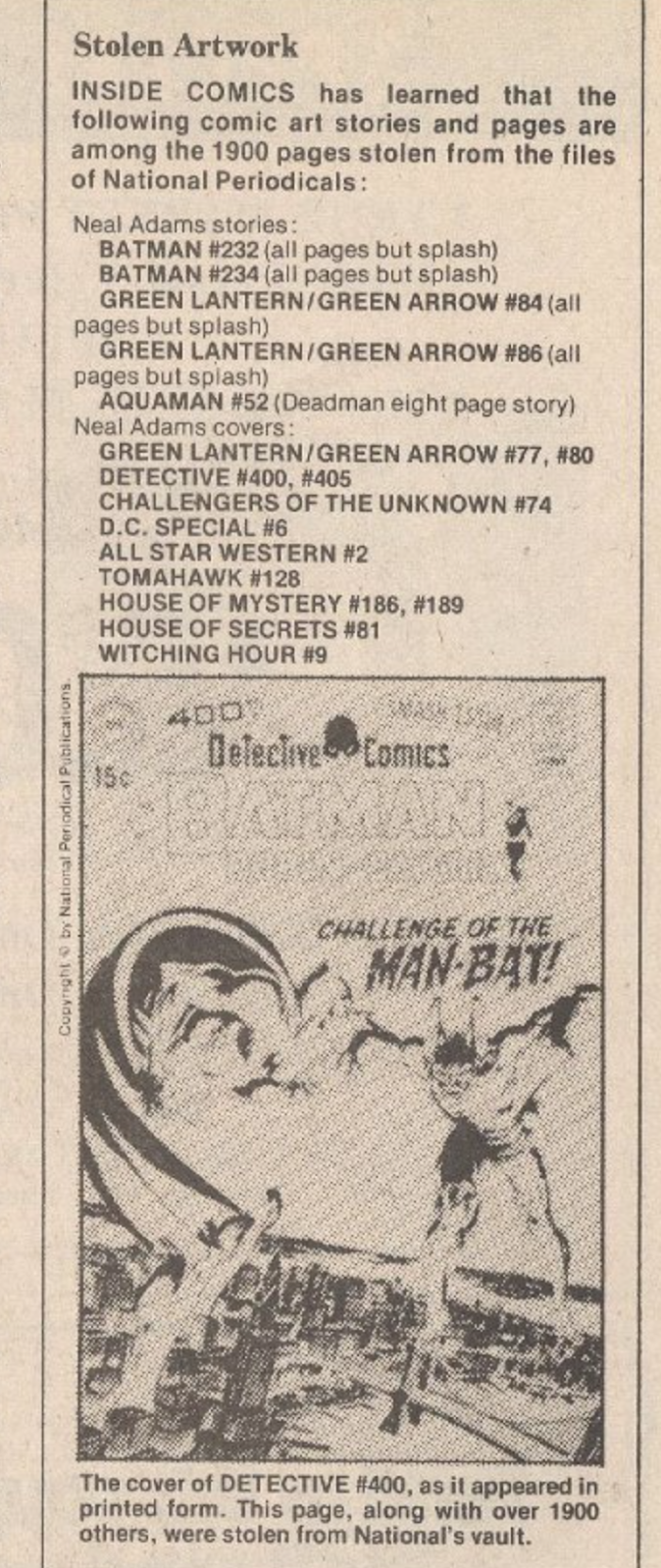
Article on the 1973 DC Original Art Heist


Great investigative article from a 1974 fanzine about the massive theft of (never recovered) original art work from the DC comics offices that took place during the move to the new Warner Bros offices in 1973. Tons of Jack Kirby and Neal Adams art went missing and was dumped into the collectors market during a period when the publisher's legal department was very concerned about keeping original art for copyright reasons, and long before DC changed its policy and started returning art to creators in 1978. (Thanks to Patrick Ford for posting the transcription on Facebook.)


SUPERHEIST: 
The Great Comic Book Rip-Off

By Joe Brancatelli

(Inside Comics #1 - 1974)


My first visit to a comic book house came when I was about 10 years old. When National produced comics from their 575 Lexington Avenue offices, they'd hold organized tours of their operations every Wednesday afternoon. As a dutiful comic book fan, I gathered several friends and traveled all the way to manhattan. There we were, four gawky kids from Brooklyn - smack in the middle of the country's largest comic book house.


A balding man (who I now believe was a harassed-looking Julie Schwartz) took us all on a grand tour. We passed writers and colorists and artists and letterers. Kids asked silly questions - about go-go checks or Johnny DC or something. I remember one kid asking why someone had penciled a bra on the nude girl in the Playboy calendar. During the tour, National gave things away. Color slides of comic book covers, Batman and Penguin posters, comic books, and dozens of other trinkets. And they even gave away original art work. Everybody got a free page.
Everyone except my friend, Kevin Cadger. He got ten pages because he didn't get any Batman posters.
That's why it came as no surprise when word leaked out that over 1900 pages of original art had disappeared from national's files. After all the years of giving it away, or throwing it out, or shredding it up, someone's finally lifted 1900 pages and no one was the wiser. At least for a while.
Original comic art pages have always been treated trashily. Companies never bothered to return them. newspaper syndicates did horrendous things to originals before returning them. But mostly no one cared, especially since comic art wasn't particularly valuable.
Then Jerry Bails started the whole fandom thing. the conventions, the fanzines, the newsletters, trading, selling, buying, and the whole spiel. All of a sudden, comic originals were worth something. And that's when the hassles started. Artists wanted their originals back. Knowing they could supplement their income by selling them, many artists resorted to stealing their originals back. In fact, most of the originals on the market in the early 1960's were stolen.
"One thing I can always remember," one now retired artist said,"was how we always had to sneak into Marvel or DC or Charlton or Warren and steal our own stuff back. After a while, it became a game. Everyone knew we were doing it, but they just said, 'Well, that's the way it is' and laughed a little."

A Pocketful of Art

But things changed. In 1970, National stopped general distribution of original artwork, shocking artists and inflating the collectors market.
"We had long discussions with our legal department on the matter." said Sol Harrison, National's vice president and production manager. "They seemed to feel that we should hold on to all our artwork. They were really frightened that if someone had the originals to a complete story, they would run to South America and print it. We had copyrights to protect, and the legal department felt holding the artwork was the best procedure."
National's policy went generally unchallenged and stock accumulated. "We have had thousands of pages around after a years or two," said harrison. "Eventually, we had to get a storage space, but there was still plenty of art around the offices."
And therein lay the danger. Thousands of pages were just sitting around at National's 909 Third Avenue set-up, waiting for some sharp entrepreneur to make his collection. And being part of the vast Warner Communications conglomerate, which also owned Warner Brothers, Seven Arts, Paperback Library, Warner Books, Atlantic, Electra Asylum, and Atco records, among others, National offices were being moved to the warner Communications Building at 75 Rockefeller Center. After several years of planning, the crosstown move was finally begun in the summer of 1973.
"It was just one giant, f***ing madhouse," one national editor said at the time. There were drawing boards, and desks, and stuff all over the place. And artwork was scattered everywhere."
No one at National was Particularly concerned with the art. it was stacked on skids and tied down with bailing wire. No one thought of taking inventory and thousands of pages, worth several thousand dollars on the fan market was unaccounted for. It was being moved from office to office, waiting to be picked up and moved to the new building.
"In retrospect, of course, it was a dumb move." a national production staffer said. "Had Sol known any better, maybe there would have been an in and out inventory. But nobody gave a sh*t. The art went in and out and no one looked twice."
Except for several sharp eyed young staff members. most of them, lower echelon employees, came up through the fan ranks and knew the value of the unattended artwork. They also,apparently, knew which skids contained the best material.
Another collector who bought some of the purloined material agreed. "The plan was simple," he said. Have a friend on the moving crew 'misplace' a flat of artwork. Later, if it was discovered missing, it could easily be found without getting in trouble. If no one noticed it was missing, it was just taken away later."
"Certain staff members had decided to rip-off some of the pages," the collector said. "And it was an inside job."
Naturally, no one ever missed the 'misplaced' skid and it simply disappeared.
Harrison pleaded total ignorance about the circumstances surrounding the theft. "I'm sure this happened during the move of course. We had breakage and different things. So many hands were touching, but these things can happen." he claimed National knew nothing else.
Yet, the question of whether the theft was an inside job was a sore point. "I don't know. I can't say anything." snapped Harrison. "I don't think it's an inside job, so i don't want to say anything at all." But Harrison wasn't interested in saying too much about any facet of the theft.
A national staffer we spoke to assured us that an inventory had been taken. "Right after Sol found out, he had a complete inventory taken. At first we thought thousands of pages were missing. We finally found out that only 1928 pages were gone." Harrison vehemently denied that he had taken an inventory. "We're in the process of taking inventory right now. But we haven't done anything yet. We don't know how many pages were taken yet."
Harrison's reluctance to address himself to the facts of the theft even extended to a description of what was stolen. "We don't know yet what was taken. We've left that up in the air at the moment. We'll know after inventory comes in."
Harrison's production people disagreed, however. According to one staff member, an exact listing of what was stolen has been in circulation for several months. They think that the material will never surface, however. "It's fantastic stuff," one artist said. "I'd like to have some of the material for my own collection. People who buy it may never sell it." Additionally, much of the stolen material was romance pages which are not big sellers and never appear at conventions anyway. [Inside Comics has uncovered a partial listing of the stolen material. See inset elsewhere.]


Wanna Buy Some Hot Pictures?


After the skid of artwork was misplaced, the thief was forced to unload the material quickly. And since there is no known comic fence, he had to take his material to a convention. His first opportunity to sell the artwork was at New York's August Comic Book marketplace. Unfortunately, most of the city's biggest dealers were missing from this particular fanclave. Scheduled only a week before the larger San Diego convention, larger dealers like Phil Seuling, Al Schuster and Bill Morse weren't in attendance.

"That was really a rough break for the seller," said a collector who now owns some of the stolen material. "He was sitting there with 50-60 thousand dollars worth of stuff and the big guys were out of town."

What the thief eventually did was to unload the artwork at any price. Carrying a few sample pages around the Hotel McAlpin's dealer's room (one collector said two Adams detective coves and a Green lantern Green Arrow page was among the batch), he struck a deal with a small time comic art dealer working out of New Jersey.

Another collector who eventually bought several dozen pages of the stolen art claimed that the dealer "Lacked the wherewithal to swing the deal by himself and worked out a deal with a bigger new York dealer." the New Jersey - New York combine bought the 1900 page stack for about $5000. "A value that I would have loved any day." said one New York City collector who heard the price. "Especially since the stuff had to be worth ten or fifteen times what he got."

The dealer who subsequently bought the artwork may have been small, but he was smart. Knowing National would probably try to trace the art, he limited his sales. According to one purchaser, "this dealer wouldn't sell to anyone for speculation purposes. he sold it only to top-notch, highly reputable collectors. He knew that going to big collectors meant the stuff would stand in the closet - in someone's collection."
About a half dozen well known, highly respected collectors eventually purchased the bulk of the choice material for about $20 a page. The seller dumped the pages at this low price to minimize his risk. With dozens of high quality, much desired Neal Adams and Jack Kirby pages in his possession, the dealer sold the pages at a lower-than-normal price in exchange for a relitive measure of security.

"Before he would even let me look at the stuff," a New Jersey collector said, "I had to promise him that I'd keep the stuff for my own collection. Then he brought out the Adams and Kirby and Wrightson and Kaluta stuff. It was unbelievable the stuff he had. His prices were really cheap. So I shut my mouth and bought about 30 pages."

And while he did sell a goodly amount of the pages, had he not brought the material to san Diego, national might have never discovered the theft.


Better Late Than Never
One of the other guests at the San Diego convention was none other than Sol Harrison. Even though several weeks had passed since the material was purloined, harrison was still unaware of the theft.
"Everything was incredibly hectic during the move," Harrison said. "I was mainly concerned with the orderly transition of the office. Who thought we would have such a chunk stolen?"
Harrison didn't find out about the theft until he happened to drop by the convention's auction. On display for bidding was a Neal Adams drawing for a House of Mystery cover.
Sol told me it was the first time he realized something was fishy," one of his assistance said later. "He just knew that page should have been in the office. That's when Sol finally realized stuff was missing."
returning to his office the next week, Harrison initiated an inventory. he also called in a professional security team to investigate the theft. "It just so happens that Warner Communications now owns a security outfit," said Harrison, "and I had no qualms about going to them. I told them, 'Listen, this stuff is missing, and we want it all back'."
Unfortunately for Harrison and National, the security outfit turned up very little. the dealer had been so careful in selling the material, most of it was buried in private collections.
"The only way i am going to give up my stuff," said one collector, "is if i die. And I am 27, so they've got a long wait."
Besides disclosing that 1928 pages were missing, the only other fact the investigation turned up was a rough idea of the thefts date. While almost everyone concerned agreed it came during the National move, no one could do more than speculate. Luckily, one of the stolen stories had been previously taken.
A Neal Adams story, "Snowbirds Don't Fly," had been lifted by one of National's production people several months before. After publisher Infantino discovered the theft, the staffer returned the material one or two weeks before the National move. When the inventory was taken after the 1900 page theft, however, the story was again missing, and that set the theft right around the time of National's move.
One collector, a close friend of neal Adams, said the story was stolen with the intention of returning it to Adams. It never reached Neal - and he would have returned it if it did - and when it was returned to National, "the collector said it was being held in special care."

We Want Our Material Back
After definitely establishing that the original art work was indeed stolen, National's legal department drafted a letter Harrison said was sent to any place "where art had touched base." The notice first appeared in the sixth issue of Comicscene and later in the Comic Reader #101. Captioned "An Important Notice From National Periodicals." The letter read: "It has come to the Publisher's attention that valuable original artwork representing fictional characters of which Publisher is the copyright owner has been stolen from the Publisher's archives and is currently being offered for sale. PLEASE TAKE NOTICE that any person, firm or corporation who is found to possess this artwork or is found selling or attempting to distribute this artwork will be prosecuted to the full extent of the Federal Copyright Act and all other applicable federal and state statutes. Anyone with the knowledge of the whereabouts of this artwork or the events leading to it's theft from the Publisher is urged to contact Publisher immediately."
The letter was the first public notice about the theft of the artwork, and Harrison was particularly disturbed by the cavalier attitude toward the material. he constantly mentioned that National owned the material and that they were "determined to secure it's return." National was finished playing games.
"This is stolen merchandise," he said, his voice raising to a falsetto. "I thin the industry has become very lax in their conception of what a piece of artwork is. If you don't think of it in terms of a piece of artwork, and think of it in terms of a piece of property, you'll know it's a felony. I's stolen property."
He was insistent in his claim that National would take the case to court. "If anyone peddles stolen property, he becomes accessory to that felony. All I want people to understand is that we're going to prosecute these people. We want to find out who did this. Someone stole our property. " Harrison said again. "We want it back and we're going to prosecute to get it."
There was never any doubt that the theft was a felony, but some lawyers who've seen National's statement disagreed with it's thrust.
Alan M. Carson, consulting partner in the california law firm of helmut, Kline and Stone, is copyright specialist and questioned the letter's legal foundation. "it's certainly conceivable that the owner could sign a complaint against the defendant for larceny and other charges," Carson said, "But I really doubt they can prosecute under the Federal Copyright Act."
Seymore C. Kline, also a copyright specialist in helmut, Kline and Stone, attacked the statement's validity from another legal standpoint.
"It's rare - in fact, I can't cite an example - where one can prosecute under the copyright law unless the copyright has truly been infringed upon. Unless the defendant put the material into print, I doubt the owner can sue under the federal Copyright Act."
Kline said that National had a strong case under larceny and theft statutes, however. "The best line of prosecution, it seems to me, is to try to prove that the defendant sold this material over the state lines. Then it becomes a Federal offense - transporting stolen merchandise over state borders."
Carson said that copyright laws are primarily "civil" statutes in most states and rarely entail anything more than lawsuits. "You can sue on federal copyright laws, but I doubt they could try to hang a theft on him under copyright laws."
Harrison, on the other hand, said that the letter was a document prepared by the company's lawyers. "That letter is a legal document. Our legal department framed that letter and they know what it refers to. They feel it's a violation of copyright. I'm not going to question them on that."
*****
The theft also brought to a boil a question that had already been simmering for some time. Some freelane artists were claiming that national never owned the artwork in the first place. in the 22nd-23rd issue of the ACBA Newsletter, the academy of Comic Book Arts took a rare snipe at National: "If, as the Academy argues, the physical artwork belongs to it's creators, then many artists have suffered a grave injustice at the hands of [National] ... Return the artwork to it's creators. Put aside storage charges, security systems, lack of confidence in employees."
Neal Adams, much of whose work was among the stolen, and Howard Chaykin have stated they will no longer work for national due to the theft.
But Nationals main concern will remain with the artwork itself. they have pressed their efforts to regain the stolen material. And they are serious about prosecuting. According to one National staffer, "All you hear is Sol and carmine talk about how they'd like to get the bastards who stole the stuff."
But, as several collectors who purchased pieces of the stolen material have said, National has to find them first. And that's shaping up as a task even Warner Communications vast network cannot handle.
You might even say that finding the thieves is a job for Superman.


Thursday, November 02, 2017

Jack Kirby on Unions and Efforts to Organize Comic Book Artists


Kirby was very much of his times in the post-War world. Although many of his heroes seek solutions in collective action, many of his early characters were individualists and his themes tended towards the little guy against vast conspiracies... 

From the Comics Journal interview with Gary Groth...


GROTH: Who did you deal with at DC? Did you have an editor that you dealt with directly?
KIRBY: They had several editors. I dealt with Mort Weisinger, Julie Schwartz, and Murray Boltinoff.
GROTH: Can you distinguish between the editors? Did they have different approaches?
KIRBY: They were different personalities certainly, but they were all great to get along with. We’re still good friends. Mort Weisinger is gone. When we first moved to California, Mort Weisinger came to visit us.
GROTH: What kind of man was he? I understand he was a tough taskmaster.
KIRBY: Everybody was a tough taskmaster. Mort Weisinger wasn’t a particularly tough taskmaster. He was trying to do an editor’s job. Comics have a caste system — an editor has to act in a certain way, an artist has to be humble, right? An artist has to be humble, an editor must be officious, and a publisher must be somewhere out in the galaxy enjoying godhood. It was a caste system, pure and simple. And it was accepted that way. Nobody thought of contracts, nobody thought of insisting on better deals.

GROTH: Did you assume when you did a book — any one of the many books you’ve done — did you assume that the publisher owned it? Or did you think about it a little later and think, wait a minute, I did this and I didn’t have a contract, and I don’t see why he should own it 100 percent.
KIRBY: No, I was growing up and becoming aware of those things. Joe Simon knew about those things.
GROTH: At the time you just assumed that the publisher owned it?
KIRBY: Yes. I assumed that he took it, OK? [Laughter.] I assumed that he took it, and I didn’t have the means to get it back. In other words, I didn’t save my money for a lawyer. I was a very young man, and saved my money for having a good time.
GROTH: I understand that sometime in the mid-’50s Bernie Krigstein tried to start a union among comic book creators. Were you aware of that?
KIRBY: I was aware of it. It was something that I knew would fail.
GROTH: But you didn’t go to any meetings?
KIRBY: No, no. Unions almost had the connotation of communism.
GROTH: You were wary?
KIRBY: Everybody was wary. Remember, this was a time when communists marched through the streets, waving flags and shouting. The unions did the same thing so you began to associate them. I’m speaking now as a human being, not as a businessman — the unions are great. The unions are great for the working people because they protect you, but I didn’t see them that way as a young man. First of all, the papers would connect them with thee communists — labor unions were communists.

And Joe Simon on Fighting American, from Wikipedia and the intro to a 1989 Marvel collection: 

Simon said in 1989 that he felt the anti-Communist fervor of the era would provide antagonists who, like the Nazis who fought Captain America during World War II, would be "colorful, outrageous and perfect foils for our hero." He went on to say,
The first stories were deadly serious. Fighting American was the first [C]ommie-basher in comics. We were all caught up in Senator McCarthy's vendetta against the 'red menace.' But soon it became evident that McCarthy ... had gone too far, damaging innocent Americans.... Then, the turnaround, [as] his side became talked of as the lunatic fringe.... Jack and I quickly became uncomfortable with Fighting American's cold war. Instead, we relaxed and had fun with the characters