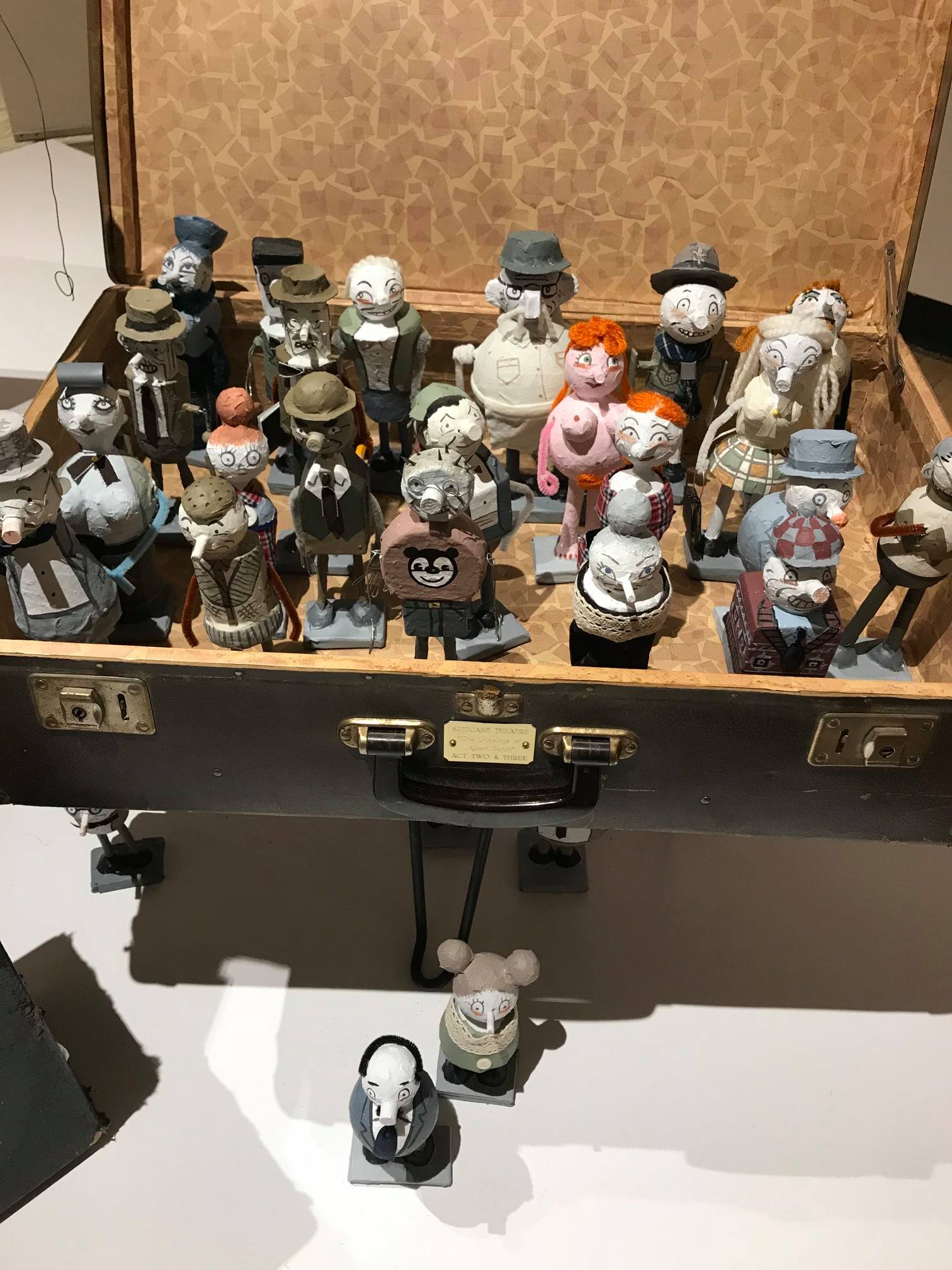
Kara and I had fun seeing the new show of Seth art at the RICA Gallery here in Guelph last night. We also hung out with some other Seth fans and art buyers after the preview/launch and I was really amazed at the diverse group of people who are into his work. Many have come to him through his "non-comics" paintings and sculptures and his gallery agent Renann Isaacs should take a lot of the credit for turning these folks on to the work and hustling to develop a strong local market (although there were collectors from New York and Toronto on hand and I suspect some long-distance/overseas sales as well). I talked to people who are not comics nerds and who couldn't tell an issue of The Comics Journal from Wizard Magazine from Bubbles (in one discussion about contemporary Canadian figurative painters working in a realist style like Kent Monkman and Atilla Lukacs, the idea of studio assistants came up which led to a discussion of comic book assembly-line production techniques, ghost artists, and manga studios, and I had to bite my tongue a bit when the fellow I was talking to said something like, "Is that how Stan Lee drew his comics?"). Wisely, Renann and Seth created a show of small pictures, priced to sell. They are fun little things, very Seth-y, but as the artist admitted, not much thought went into the titles or artist statement (I'm attaching the local news article for some choice Seth quotes). Which is all to say, a good time was had by all. I think the entire show is going to sell out: most of the paintings were sold by the second night, and the show runs until December 23. I didn't take any pictures, so I'm stealing the photos from Renann's Facebook feed for those who aren't friends with her.
Sunday, November 26, 2023
SETH'S POSTCARDS
Thursday, January 09, 2020
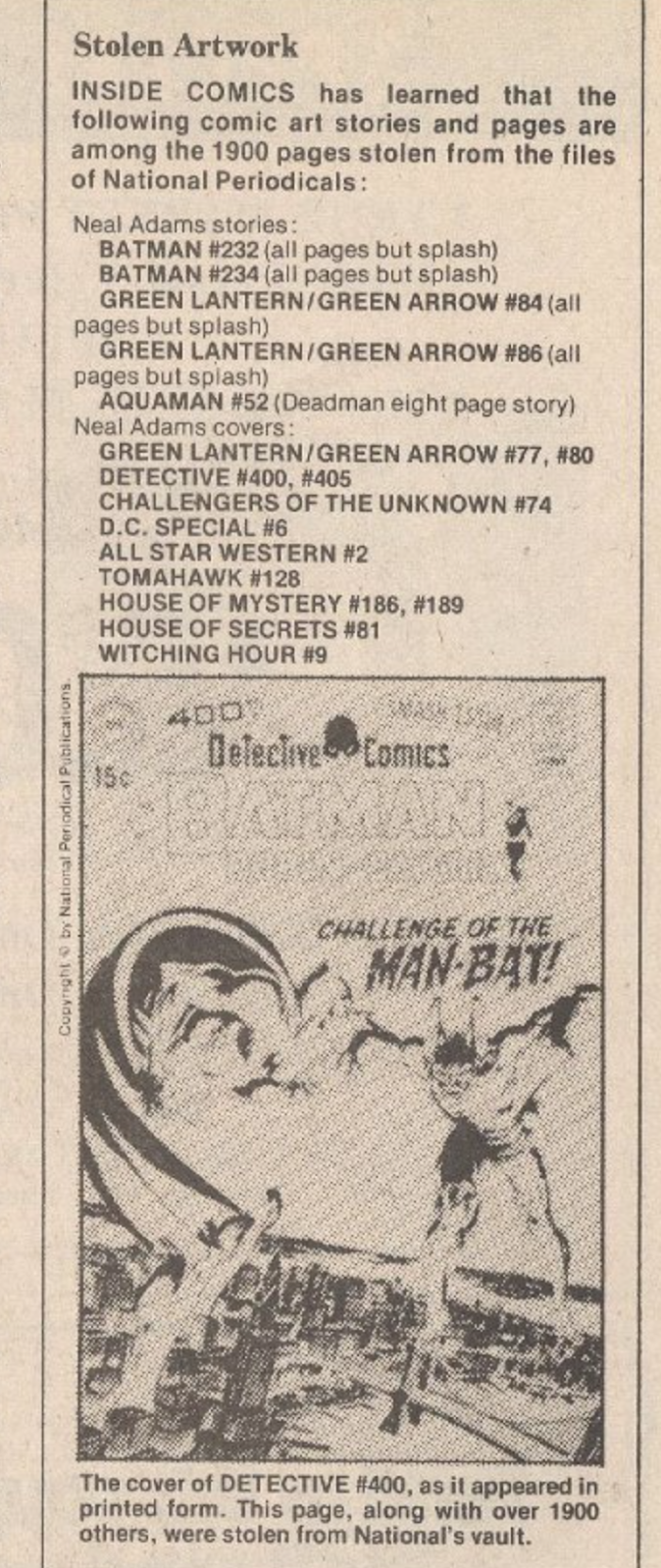
Article on the 1973 DC Original Art Heist

Great investigative article from a 1974 fanzine about the massive theft of (never recovered) original art work from the DC comics offices that took place during the move to the new Warner Bros offices in 1973. Tons of Jack Kirby and Neal Adams art went missing and was dumped into the collectors market during a period when the publisher's legal department was very concerned about keeping original art for copyright reasons, and long before DC changed its policy and started returning art to creators in 1978. (Thanks to Patrick Ford for posting the transcription on Facebook.)
SUPERHEIST:
The Great Comic Book Rip-Off
By Joe Brancatelli
(Inside Comics #1 - 1974)
My first visit to a comic book house came when I was about 10 years old. When National produced comics from their 575 Lexington Avenue offices, they'd hold organized tours of their operations every Wednesday afternoon. As a dutiful comic book fan, I gathered several friends and traveled all the way to manhattan. There we were, four gawky kids from Brooklyn - smack in the middle of the country's largest comic book house.
A balding man (who I now believe was a harassed-looking Julie Schwartz) took us all on a grand tour. We passed writers and colorists and artists and letterers. Kids asked silly questions - about go-go checks or Johnny DC or something. I remember one kid asking why someone had penciled a bra on the nude girl in the Playboy calendar. During the tour, National gave things away. Color slides of comic book covers, Batman and Penguin posters, comic books, and dozens of other trinkets. And they even gave away original art work. Everybody got a free page.
Everyone except my friend, Kevin Cadger. He got ten pages because he didn't get any Batman posters.
That's why it came as no surprise when word leaked out that over 1900 pages of original art had disappeared from national's files. After all the years of giving it away, or throwing it out, or shredding it up, someone's finally lifted 1900 pages and no one was the wiser. At least for a while.
Original comic art pages have always been treated trashily. Companies never bothered to return them. newspaper syndicates did horrendous things to originals before returning them. But mostly no one cared, especially since comic art wasn't particularly valuable.
Then Jerry Bails started the whole fandom thing. the conventions, the fanzines, the newsletters, trading, selling, buying, and the whole spiel. All of a sudden, comic originals were worth something. And that's when the hassles started. Artists wanted their originals back. Knowing they could supplement their income by selling them, many artists resorted to stealing their originals back. In fact, most of the originals on the market in the early 1960's were stolen.
"One thing I can always remember," one now retired artist said,"was how we always had to sneak into Marvel or DC or Charlton or Warren and steal our own stuff back. After a while, it became a game. Everyone knew we were doing it, but they just said, 'Well, that's the way it is' and laughed a little."
A Pocketful of Art
But things changed. In 1970, National stopped general distribution of original artwork, shocking artists and inflating the collectors market.
"We had long discussions with our legal department on the matter." said Sol Harrison, National's vice president and production manager. "They seemed to feel that we should hold on to all our artwork. They were really frightened that if someone had the originals to a complete story, they would run to South America and print it. We had copyrights to protect, and the legal department felt holding the artwork was the best procedure."
National's policy went generally unchallenged and stock accumulated. "We have had thousands of pages around after a years or two," said harrison. "Eventually, we had to get a storage space, but there was still plenty of art around the offices."
And therein lay the danger. Thousands of pages were just sitting around at National's 909 Third Avenue set-up, waiting for some sharp entrepreneur to make his collection. And being part of the vast Warner Communications conglomerate, which also owned Warner Brothers, Seven Arts, Paperback Library, Warner Books, Atlantic, Electra Asylum, and Atco records, among others, National offices were being moved to the warner Communications Building at 75 Rockefeller Center. After several years of planning, the crosstown move was finally begun in the summer of 1973.
"It was just one giant, f***ing madhouse," one national editor said at the time. There were drawing boards, and desks, and stuff all over the place. And artwork was scattered everywhere."
No one at National was Particularly concerned with the art. it was stacked on skids and tied down with bailing wire. No one thought of taking inventory and thousands of pages, worth several thousand dollars on the fan market was unaccounted for. It was being moved from office to office, waiting to be picked up and moved to the new building.
"In retrospect, of course, it was a dumb move." a national production staffer said. "Had Sol known any better, maybe there would have been an in and out inventory. But nobody gave a sh*t. The art went in and out and no one looked twice."
Except for several sharp eyed young staff members. most of them, lower echelon employees, came up through the fan ranks and knew the value of the unattended artwork. They also,apparently, knew which skids contained the best material.
Another collector who bought some of the purloined material agreed. "The plan was simple," he said. Have a friend on the moving crew 'misplace' a flat of artwork. Later, if it was discovered missing, it could easily be found without getting in trouble. If no one noticed it was missing, it was just taken away later."
"Certain staff members had decided to rip-off some of the pages," the collector said. "And it was an inside job."
Naturally, no one ever missed the 'misplaced' skid and it simply disappeared.
Harrison pleaded total ignorance about the circumstances surrounding the theft. "I'm sure this happened during the move of course. We had breakage and different things. So many hands were touching, but these things can happen." he claimed National knew nothing else.
Yet, the question of whether the theft was an inside job was a sore point. "I don't know. I can't say anything." snapped Harrison. "I don't think it's an inside job, so i don't want to say anything at all." But Harrison wasn't interested in saying too much about any facet of the theft.
A national staffer we spoke to assured us that an inventory had been taken. "Right after Sol found out, he had a complete inventory taken. At first we thought thousands of pages were missing. We finally found out that only 1928 pages were gone." Harrison vehemently denied that he had taken an inventory. "We're in the process of taking inventory right now. But we haven't done anything yet. We don't know how many pages were taken yet."
Harrison's reluctance to address himself to the facts of the theft even extended to a description of what was stolen. "We don't know yet what was taken. We've left that up in the air at the moment. We'll know after inventory comes in."
Harrison's production people disagreed, however. According to one staff member, an exact listing of what was stolen has been in circulation for several months. They think that the material will never surface, however. "It's fantastic stuff," one artist said. "I'd like to have some of the material for my own collection. People who buy it may never sell it." Additionally, much of the stolen material was romance pages which are not big sellers and never appear at conventions anyway. [Inside Comics has uncovered a partial listing of the stolen material. See inset elsewhere.]

Wanna Buy Some Hot Pictures?
After the skid of artwork was misplaced, the thief was forced to unload the material quickly. And since there is no known comic fence, he had to take his material to a convention. His first opportunity to sell the artwork was at New York's August Comic Book marketplace. Unfortunately, most of the city's biggest dealers were missing from this particular fanclave. Scheduled only a week before the larger San Diego convention, larger dealers like Phil Seuling, Al Schuster and Bill Morse weren't in attendance.
"That was really a rough break for the seller," said a collector who now owns some of the stolen material. "He was sitting there with 50-60 thousand dollars worth of stuff and the big guys were out of town."
What the thief eventually did was to unload the artwork at any price. Carrying a few sample pages around the Hotel McAlpin's dealer's room (one collector said two Adams detective coves and a Green lantern Green Arrow page was among the batch), he struck a deal with a small time comic art dealer working out of New Jersey.
Another collector who eventually bought several dozen pages of the stolen art claimed that the dealer "Lacked the wherewithal to swing the deal by himself and worked out a deal with a bigger new York dealer." the New Jersey - New York combine bought the 1900 page stack for about $5000. "A value that I would have loved any day." said one New York City collector who heard the price. "Especially since the stuff had to be worth ten or fifteen times what he got."
The dealer who subsequently bought the artwork may have been small, but he was smart. Knowing National would probably try to trace the art, he limited his sales. According to one purchaser, "this dealer wouldn't sell to anyone for speculation purposes. he sold it only to top-notch, highly reputable collectors. He knew that going to big collectors meant the stuff would stand in the closet - in someone's collection."
About a half dozen well known, highly respected collectors eventually purchased the bulk of the choice material for about $20 a page. The seller dumped the pages at this low price to minimize his risk. With dozens of high quality, much desired Neal Adams and Jack Kirby pages in his possession, the dealer sold the pages at a lower-than-normal price in exchange for a relitive measure of security.
"Before he would even let me look at the stuff," a New Jersey collector said, "I had to promise him that I'd keep the stuff for my own collection. Then he brought out the Adams and Kirby and Wrightson and Kaluta stuff. It was unbelievable the stuff he had. His prices were really cheap. So I shut my mouth and bought about 30 pages."
And while he did sell a goodly amount of the pages, had he not brought the material to san Diego, national might have never discovered the theft.
One of the other guests at the San Diego convention was none other than Sol Harrison. Even though several weeks had passed since the material was purloined, harrison was still unaware of the theft.
"Everything was incredibly hectic during the move," Harrison said. "I was mainly concerned with the orderly transition of the office. Who thought we would have such a chunk stolen?"
Harrison didn't find out about the theft until he happened to drop by the convention's auction. On display for bidding was a Neal Adams drawing for a House of Mystery cover.
Sol told me it was the first time he realized something was fishy," one of his assistance said later. "He just knew that page should have been in the office. That's when Sol finally realized stuff was missing."
returning to his office the next week, Harrison initiated an inventory. he also called in a professional security team to investigate the theft. "It just so happens that Warner Communications now owns a security outfit," said Harrison, "and I had no qualms about going to them. I told them, 'Listen, this stuff is missing, and we want it all back'."
Unfortunately for Harrison and National, the security outfit turned up very little. the dealer had been so careful in selling the material, most of it was buried in private collections.
"The only way i am going to give up my stuff," said one collector, "is if i die. And I am 27, so they've got a long wait."
Besides disclosing that 1928 pages were missing, the only other fact the investigation turned up was a rough idea of the thefts date. While almost everyone concerned agreed it came during the National move, no one could do more than speculate. Luckily, one of the stolen stories had been previously taken.
A Neal Adams story, "Snowbirds Don't Fly," had been lifted by one of National's production people several months before. After publisher Infantino discovered the theft, the staffer returned the material one or two weeks before the National move. When the inventory was taken after the 1900 page theft, however, the story was again missing, and that set the theft right around the time of National's move.
One collector, a close friend of neal Adams, said the story was stolen with the intention of returning it to Adams. It never reached Neal - and he would have returned it if it did - and when it was returned to National, "the collector said it was being held in special care."
We Want Our Material Back
After definitely establishing that the original art work was indeed stolen, National's legal department drafted a letter Harrison said was sent to any place "where art had touched base." The notice first appeared in the sixth issue of Comicscene and later in the Comic Reader #101. Captioned "An Important Notice From National Periodicals." The letter read: "It has come to the Publisher's attention that valuable original artwork representing fictional characters of which Publisher is the copyright owner has been stolen from the Publisher's archives and is currently being offered for sale. PLEASE TAKE NOTICE that any person, firm or corporation who is found to possess this artwork or is found selling or attempting to distribute this artwork will be prosecuted to the full extent of the Federal Copyright Act and all other applicable federal and state statutes. Anyone with the knowledge of the whereabouts of this artwork or the events leading to it's theft from the Publisher is urged to contact Publisher immediately."
The letter was the first public notice about the theft of the artwork, and Harrison was particularly disturbed by the cavalier attitude toward the material. he constantly mentioned that National owned the material and that they were "determined to secure it's return." National was finished playing games.
"This is stolen merchandise," he said, his voice raising to a falsetto. "I thin the industry has become very lax in their conception of what a piece of artwork is. If you don't think of it in terms of a piece of artwork, and think of it in terms of a piece of property, you'll know it's a felony. I's stolen property."
He was insistent in his claim that National would take the case to court. "If anyone peddles stolen property, he becomes accessory to that felony. All I want people to understand is that we're going to prosecute these people. We want to find out who did this. Someone stole our property. " Harrison said again. "We want it back and we're going to prosecute to get it."
There was never any doubt that the theft was a felony, but some lawyers who've seen National's statement disagreed with it's thrust.
Alan M. Carson, consulting partner in the california law firm of helmut, Kline and Stone, is copyright specialist and questioned the letter's legal foundation. "it's certainly conceivable that the owner could sign a complaint against the defendant for larceny and other charges," Carson said, "But I really doubt they can prosecute under the Federal Copyright Act."
Seymore C. Kline, also a copyright specialist in helmut, Kline and Stone, attacked the statement's validity from another legal standpoint.
"It's rare - in fact, I can't cite an example - where one can prosecute under the copyright law unless the copyright has truly been infringed upon. Unless the defendant put the material into print, I doubt the owner can sue under the federal Copyright Act."
Kline said that National had a strong case under larceny and theft statutes, however. "The best line of prosecution, it seems to me, is to try to prove that the defendant sold this material over the state lines. Then it becomes a Federal offense - transporting stolen merchandise over state borders."
Carson said that copyright laws are primarily "civil" statutes in most states and rarely entail anything more than lawsuits. "You can sue on federal copyright laws, but I doubt they could try to hang a theft on him under copyright laws."
Harrison, on the other hand, said that the letter was a document prepared by the company's lawyers. "That letter is a legal document. Our legal department framed that letter and they know what it refers to. They feel it's a violation of copyright. I'm not going to question them on that."
*****
The theft also brought to a boil a question that had already been simmering for some time. Some freelane artists were claiming that national never owned the artwork in the first place. in the 22nd-23rd issue of the ACBA Newsletter, the academy of Comic Book Arts took a rare snipe at National: "If, as the Academy argues, the physical artwork belongs to it's creators, then many artists have suffered a grave injustice at the hands of [National] ... Return the artwork to it's creators. Put aside storage charges, security systems, lack of confidence in employees."
Neal Adams, much of whose work was among the stolen, and Howard Chaykin have stated they will no longer work for national due to the theft.
But Nationals main concern will remain with the artwork itself. they have pressed their efforts to regain the stolen material. And they are serious about prosecuting. According to one National staffer, "All you hear is Sol and carmine talk about how they'd like to get the bastards who stole the stuff."
But, as several collectors who purchased pieces of the stolen material have said, National has to find them first. And that's shaping up as a task even Warner Communications vast network cannot handle.
You might even say that finding the thieves is a job for Superman.
Friday, September 13, 2019
Seth: A Life, All Play
by BK Munn
Last night I rolled out of my hammock, shook off my slumbers and attended the opening of the cartoonist Seth’s new show, Seth: A Life, All Play, at the Art Gallery of Guelph. The show is described as an exploration of the artists’ creative process and how his comics-making stems from the playful practices of childhood, and much of what is on display over the three huge rooms of the main floor of this museum space is certainly whimsical and even downright frolicsome in its scope and inventiveness, mimicking as it does a child’s obsessive universe-building and use of simple materials to create stories, games, and fantastic monuments.
![]() |
| Jason Keiffer and Nick Maandag |
Tuesday, October 24, 2017
The Future of (Digital) Collecting?
by BK Munn
The future of collecting? As a marxist grad student in the 90s I was obsessed with comics/the commodification of art and wrote a bit about simulacra and the then-new phenomenon of eBay and slabbing (encasing old comic books in plastic to protect their condition and "grade"). As I recall, Baudrillard had something to do with it all., but the point was that people had really stopped collecting actual physical objects and were instead bidding on the "idea" of the object, virtual alienated labour, or some such. I was not then and am not now very good at expressing these ideas... Most non-rich, non-artist people still don't collect capital 'A' art, and even the kind of industrial production culture I like to collect, like original comic book art, may soon disappear as cartoonists make more and more of their work digitally and not on paper with ink and pencils. Instead of buying antiques and collectibles, most of us are content to curate photos of them on Pinterest and Instagram. Can we now say that collecting has entered a new phase?
From an article by McKenzie Wark:
To think about digital objects as collectable, it may help to start by asking what it is that is actually collected. We tend to think that what is collected is a rare object. But what makes it rare? Perhaps there is more than one way to make an object rare. To make a digital object rare, it can be “locked” in various ways. Take for example The Clock (2010) by Christian Marclay. It is only supposed to be seen in specially designed installations where it runs for twenty-four hours, although apparently the artist’s wishes about that did not stop the hedge-fund manager Steven A. Cohen from using his copy as a screen saver or his gallerist Jay Jopling from screening it for a party.1
Attempting to lock the information in the digital work to some material form or situation may create more problems than it solves. As Cory Doctorow has argued, relying on digital locks does not really empower the artist or the owner. It empowers the makers of digital locks. And in any case it takes away some of the special qualities of a digital object if its form merely imitates the kind of objects that collections already collect.
What might be more interesting is to consider how the very properties of spreadability that characterize digital objects can be turned to advantage to make them collectable as well.2 Paradoxically, an object whose image is very widely spread is a rare object, in the sense that few objects have their images spread widely. This can be exploited to create value in art objects that are not in the traditional sense rare and singular. The future of collecting may be less in owning the thing that nobody else has, and more in owning the thing that everybody else has.
The artwork is not what it used to be. Perhaps one could think of three stages in the evolution of the artwork, each of which has its own kind of rarity and collectability. The first stage we now think of as that of the old masters. The second stage is that of modern art. The third stage begins with what we call contemporary art, but is perhaps only now starting to reveal its true form.
[...]
The third stage is something else. It corresponds to the period in which information becomes the key to value in both the wider economy and also in art.3 The artwork is no longer a special kind of commodity as it was in the modern-art period. The artwork is now a special kind of financial instrument. The artwork is now a special kind of derivative.4 The collectable artwork is now less about being an object that stores value because of its special qualities as a rare thing made by a special kind of worker, the artist. The artwork is now collectible because it is a financial instrument in a portfolio that manages and hedges risk.
The key is the role of information about the artwork. The information about the artwork is actually the most important thing about it. What establishes the value of the work is that people talk about it, write about it, circulate (unauthorized) pictures of it. The more it circulates, the more value it has. The actual work is a derivative of the value of its simulations.