Showing posts with label class. Show all posts

Tuesday, January 21, 2020

Kirby and Unions: Captain America Comics #4, 1941


UNHOLY LEGION


Here's an interesting sequence from a very early issue of Captain America where Jack Kirby posits a union leader as a bastion of democracy. I've noted before some of Kirby's post-War quotes on unions and the idea of a comics creator Guild, where he seems lukewarm on the subject, to say the least. But here we have an instance of the pre-War Kirby pointing to unionized labor as an important pillar of the anti-fascist fight against Nazis. The story is a great one, wherein Cap and Bucky uncover a Nazi spy and saboteur ring that disguise themselves as beggars. The very atmospheric discovery scene, where the two heroes witness a legless beggar on a dark street suddenly get up and walk in answer to a bell ringing inside the old city hall where the spies gather to unveil themselves in a secret ceremony, is brilliantly grotesque. I wonder if the politics here are entirely Kirby's or influenced partly by Joe Simon? 1941 was a record year for strikes in the U.S. and the left was divided on Roosevelt's efforts to keep a lid on labour troubles. We can see here that not only were the early Caps advocating for what Howard Chaykin's Blackhawk referred to as "premature antifascism" in reference to advocating for American intervention or aid in the war against Germany, but in this instance at least we see Simon and Kirby creating propaganda of a sort for the idea of a post-Depression "labour truce" in the name of the soon-to-come war effort.

The image up top is Kirby's reimagining of the Unholy Legion for the 1960s Captain America #112, a quarter century later.


"In a nearby state tragedy strikes John L. Green, nationally known labor leader. 'And I say again, Labor must unite to advance our defense program.'"


Thursday, January 09, 2020

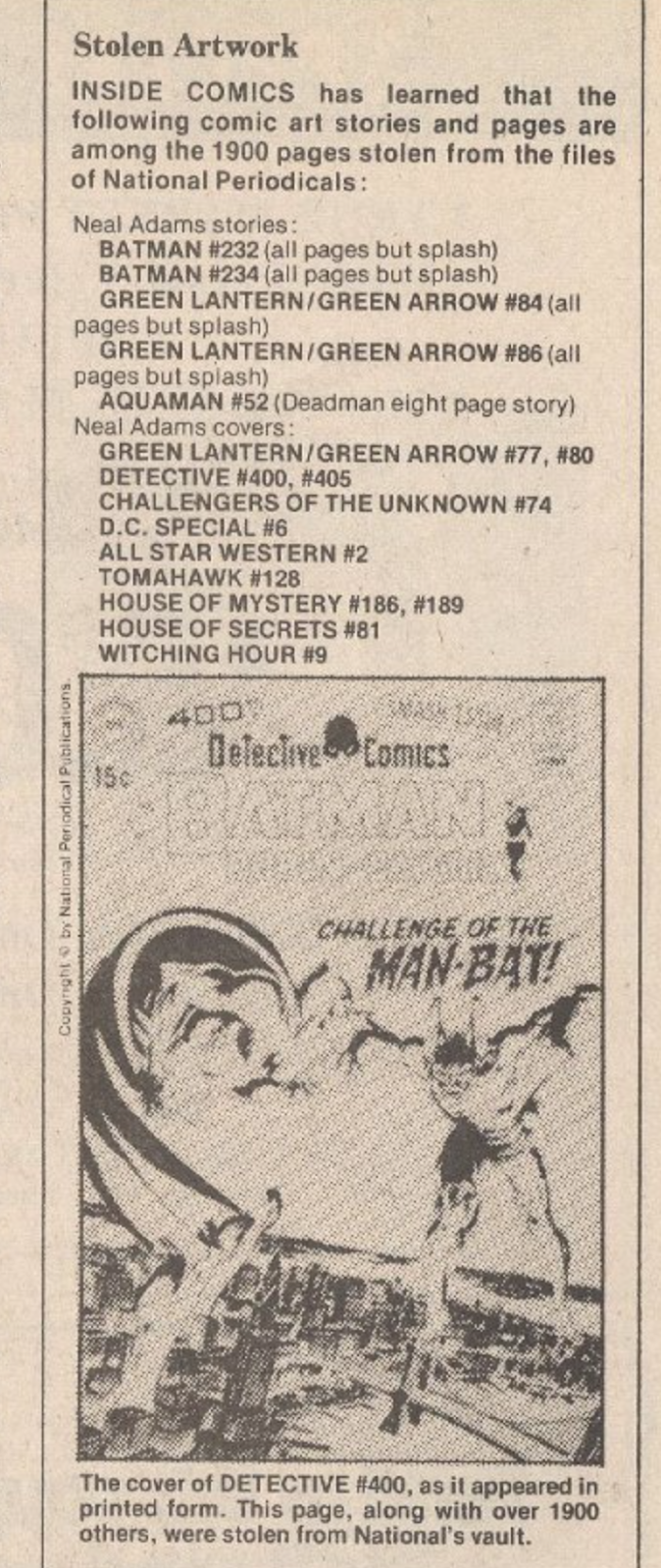
Article on the 1973 DC Original Art Heist


Great investigative article from a 1974 fanzine about the massive theft of (never recovered) original art work from the DC comics offices that took place during the move to the new Warner Bros offices in 1973. Tons of Jack Kirby and Neal Adams art went missing and was dumped into the collectors market during a period when the publisher's legal department was very concerned about keeping original art for copyright reasons, and long before DC changed its policy and started returning art to creators in 1978. (Thanks to Patrick Ford for posting the transcription on Facebook.)


SUPERHEIST: 
The Great Comic Book Rip-Off

By Joe Brancatelli

(Inside Comics #1 - 1974)


My first visit to a comic book house came when I was about 10 years old. When National produced comics from their 575 Lexington Avenue offices, they'd hold organized tours of their operations every Wednesday afternoon. As a dutiful comic book fan, I gathered several friends and traveled all the way to manhattan. There we were, four gawky kids from Brooklyn - smack in the middle of the country's largest comic book house.


A balding man (who I now believe was a harassed-looking Julie Schwartz) took us all on a grand tour. We passed writers and colorists and artists and letterers. Kids asked silly questions - about go-go checks or Johnny DC or something. I remember one kid asking why someone had penciled a bra on the nude girl in the Playboy calendar. During the tour, National gave things away. Color slides of comic book covers, Batman and Penguin posters, comic books, and dozens of other trinkets. And they even gave away original art work. Everybody got a free page.
Everyone except my friend, Kevin Cadger. He got ten pages because he didn't get any Batman posters.
That's why it came as no surprise when word leaked out that over 1900 pages of original art had disappeared from national's files. After all the years of giving it away, or throwing it out, or shredding it up, someone's finally lifted 1900 pages and no one was the wiser. At least for a while.
Original comic art pages have always been treated trashily. Companies never bothered to return them. newspaper syndicates did horrendous things to originals before returning them. But mostly no one cared, especially since comic art wasn't particularly valuable.
Then Jerry Bails started the whole fandom thing. the conventions, the fanzines, the newsletters, trading, selling, buying, and the whole spiel. All of a sudden, comic originals were worth something. And that's when the hassles started. Artists wanted their originals back. Knowing they could supplement their income by selling them, many artists resorted to stealing their originals back. In fact, most of the originals on the market in the early 1960's were stolen.
"One thing I can always remember," one now retired artist said,"was how we always had to sneak into Marvel or DC or Charlton or Warren and steal our own stuff back. After a while, it became a game. Everyone knew we were doing it, but they just said, 'Well, that's the way it is' and laughed a little."

A Pocketful of Art

But things changed. In 1970, National stopped general distribution of original artwork, shocking artists and inflating the collectors market.
"We had long discussions with our legal department on the matter." said Sol Harrison, National's vice president and production manager. "They seemed to feel that we should hold on to all our artwork. They were really frightened that if someone had the originals to a complete story, they would run to South America and print it. We had copyrights to protect, and the legal department felt holding the artwork was the best procedure."
National's policy went generally unchallenged and stock accumulated. "We have had thousands of pages around after a years or two," said harrison. "Eventually, we had to get a storage space, but there was still plenty of art around the offices."
And therein lay the danger. Thousands of pages were just sitting around at National's 909 Third Avenue set-up, waiting for some sharp entrepreneur to make his collection. And being part of the vast Warner Communications conglomerate, which also owned Warner Brothers, Seven Arts, Paperback Library, Warner Books, Atlantic, Electra Asylum, and Atco records, among others, National offices were being moved to the warner Communications Building at 75 Rockefeller Center. After several years of planning, the crosstown move was finally begun in the summer of 1973.
"It was just one giant, f***ing madhouse," one national editor said at the time. There were drawing boards, and desks, and stuff all over the place. And artwork was scattered everywhere."
No one at National was Particularly concerned with the art. it was stacked on skids and tied down with bailing wire. No one thought of taking inventory and thousands of pages, worth several thousand dollars on the fan market was unaccounted for. It was being moved from office to office, waiting to be picked up and moved to the new building.
"In retrospect, of course, it was a dumb move." a national production staffer said. "Had Sol known any better, maybe there would have been an in and out inventory. But nobody gave a sh*t. The art went in and out and no one looked twice."
Except for several sharp eyed young staff members. most of them, lower echelon employees, came up through the fan ranks and knew the value of the unattended artwork. They also,apparently, knew which skids contained the best material.
Another collector who bought some of the purloined material agreed. "The plan was simple," he said. Have a friend on the moving crew 'misplace' a flat of artwork. Later, if it was discovered missing, it could easily be found without getting in trouble. If no one noticed it was missing, it was just taken away later."
"Certain staff members had decided to rip-off some of the pages," the collector said. "And it was an inside job."
Naturally, no one ever missed the 'misplaced' skid and it simply disappeared.
Harrison pleaded total ignorance about the circumstances surrounding the theft. "I'm sure this happened during the move of course. We had breakage and different things. So many hands were touching, but these things can happen." he claimed National knew nothing else.
Yet, the question of whether the theft was an inside job was a sore point. "I don't know. I can't say anything." snapped Harrison. "I don't think it's an inside job, so i don't want to say anything at all." But Harrison wasn't interested in saying too much about any facet of the theft.
A national staffer we spoke to assured us that an inventory had been taken. "Right after Sol found out, he had a complete inventory taken. At first we thought thousands of pages were missing. We finally found out that only 1928 pages were gone." Harrison vehemently denied that he had taken an inventory. "We're in the process of taking inventory right now. But we haven't done anything yet. We don't know how many pages were taken yet."
Harrison's reluctance to address himself to the facts of the theft even extended to a description of what was stolen. "We don't know yet what was taken. We've left that up in the air at the moment. We'll know after inventory comes in."
Harrison's production people disagreed, however. According to one staff member, an exact listing of what was stolen has been in circulation for several months. They think that the material will never surface, however. "It's fantastic stuff," one artist said. "I'd like to have some of the material for my own collection. People who buy it may never sell it." Additionally, much of the stolen material was romance pages which are not big sellers and never appear at conventions anyway. [Inside Comics has uncovered a partial listing of the stolen material. See inset elsewhere.]


Wanna Buy Some Hot Pictures?


After the skid of artwork was misplaced, the thief was forced to unload the material quickly. And since there is no known comic fence, he had to take his material to a convention. His first opportunity to sell the artwork was at New York's August Comic Book marketplace. Unfortunately, most of the city's biggest dealers were missing from this particular fanclave. Scheduled only a week before the larger San Diego convention, larger dealers like Phil Seuling, Al Schuster and Bill Morse weren't in attendance.

"That was really a rough break for the seller," said a collector who now owns some of the stolen material. "He was sitting there with 50-60 thousand dollars worth of stuff and the big guys were out of town."

What the thief eventually did was to unload the artwork at any price. Carrying a few sample pages around the Hotel McAlpin's dealer's room (one collector said two Adams detective coves and a Green lantern Green Arrow page was among the batch), he struck a deal with a small time comic art dealer working out of New Jersey.

Another collector who eventually bought several dozen pages of the stolen art claimed that the dealer "Lacked the wherewithal to swing the deal by himself and worked out a deal with a bigger new York dealer." the New Jersey - New York combine bought the 1900 page stack for about $5000. "A value that I would have loved any day." said one New York City collector who heard the price. "Especially since the stuff had to be worth ten or fifteen times what he got."

The dealer who subsequently bought the artwork may have been small, but he was smart. Knowing National would probably try to trace the art, he limited his sales. According to one purchaser, "this dealer wouldn't sell to anyone for speculation purposes. he sold it only to top-notch, highly reputable collectors. He knew that going to big collectors meant the stuff would stand in the closet - in someone's collection."
About a half dozen well known, highly respected collectors eventually purchased the bulk of the choice material for about $20 a page. The seller dumped the pages at this low price to minimize his risk. With dozens of high quality, much desired Neal Adams and Jack Kirby pages in his possession, the dealer sold the pages at a lower-than-normal price in exchange for a relitive measure of security.

"Before he would even let me look at the stuff," a New Jersey collector said, "I had to promise him that I'd keep the stuff for my own collection. Then he brought out the Adams and Kirby and Wrightson and Kaluta stuff. It was unbelievable the stuff he had. His prices were really cheap. So I shut my mouth and bought about 30 pages."

And while he did sell a goodly amount of the pages, had he not brought the material to san Diego, national might have never discovered the theft.


Better Late Than Never
One of the other guests at the San Diego convention was none other than Sol Harrison. Even though several weeks had passed since the material was purloined, harrison was still unaware of the theft.
"Everything was incredibly hectic during the move," Harrison said. "I was mainly concerned with the orderly transition of the office. Who thought we would have such a chunk stolen?"
Harrison didn't find out about the theft until he happened to drop by the convention's auction. On display for bidding was a Neal Adams drawing for a House of Mystery cover.
Sol told me it was the first time he realized something was fishy," one of his assistance said later. "He just knew that page should have been in the office. That's when Sol finally realized stuff was missing."
returning to his office the next week, Harrison initiated an inventory. he also called in a professional security team to investigate the theft. "It just so happens that Warner Communications now owns a security outfit," said Harrison, "and I had no qualms about going to them. I told them, 'Listen, this stuff is missing, and we want it all back'."
Unfortunately for Harrison and National, the security outfit turned up very little. the dealer had been so careful in selling the material, most of it was buried in private collections.
"The only way i am going to give up my stuff," said one collector, "is if i die. And I am 27, so they've got a long wait."
Besides disclosing that 1928 pages were missing, the only other fact the investigation turned up was a rough idea of the thefts date. While almost everyone concerned agreed it came during the National move, no one could do more than speculate. Luckily, one of the stolen stories had been previously taken.
A Neal Adams story, "Snowbirds Don't Fly," had been lifted by one of National's production people several months before. After publisher Infantino discovered the theft, the staffer returned the material one or two weeks before the National move. When the inventory was taken after the 1900 page theft, however, the story was again missing, and that set the theft right around the time of National's move.
One collector, a close friend of neal Adams, said the story was stolen with the intention of returning it to Adams. It never reached Neal - and he would have returned it if it did - and when it was returned to National, "the collector said it was being held in special care."

We Want Our Material Back
After definitely establishing that the original art work was indeed stolen, National's legal department drafted a letter Harrison said was sent to any place "where art had touched base." The notice first appeared in the sixth issue of Comicscene and later in the Comic Reader #101. Captioned "An Important Notice From National Periodicals." The letter read: "It has come to the Publisher's attention that valuable original artwork representing fictional characters of which Publisher is the copyright owner has been stolen from the Publisher's archives and is currently being offered for sale. PLEASE TAKE NOTICE that any person, firm or corporation who is found to possess this artwork or is found selling or attempting to distribute this artwork will be prosecuted to the full extent of the Federal Copyright Act and all other applicable federal and state statutes. Anyone with the knowledge of the whereabouts of this artwork or the events leading to it's theft from the Publisher is urged to contact Publisher immediately."
The letter was the first public notice about the theft of the artwork, and Harrison was particularly disturbed by the cavalier attitude toward the material. he constantly mentioned that National owned the material and that they were "determined to secure it's return." National was finished playing games.
"This is stolen merchandise," he said, his voice raising to a falsetto. "I thin the industry has become very lax in their conception of what a piece of artwork is. If you don't think of it in terms of a piece of artwork, and think of it in terms of a piece of property, you'll know it's a felony. I's stolen property."
He was insistent in his claim that National would take the case to court. "If anyone peddles stolen property, he becomes accessory to that felony. All I want people to understand is that we're going to prosecute these people. We want to find out who did this. Someone stole our property. " Harrison said again. "We want it back and we're going to prosecute to get it."
There was never any doubt that the theft was a felony, but some lawyers who've seen National's statement disagreed with it's thrust.
Alan M. Carson, consulting partner in the california law firm of helmut, Kline and Stone, is copyright specialist and questioned the letter's legal foundation. "it's certainly conceivable that the owner could sign a complaint against the defendant for larceny and other charges," Carson said, "But I really doubt they can prosecute under the Federal Copyright Act."
Seymore C. Kline, also a copyright specialist in helmut, Kline and Stone, attacked the statement's validity from another legal standpoint.
"It's rare - in fact, I can't cite an example - where one can prosecute under the copyright law unless the copyright has truly been infringed upon. Unless the defendant put the material into print, I doubt the owner can sue under the federal Copyright Act."
Kline said that National had a strong case under larceny and theft statutes, however. "The best line of prosecution, it seems to me, is to try to prove that the defendant sold this material over the state lines. Then it becomes a Federal offense - transporting stolen merchandise over state borders."
Carson said that copyright laws are primarily "civil" statutes in most states and rarely entail anything more than lawsuits. "You can sue on federal copyright laws, but I doubt they could try to hang a theft on him under copyright laws."
Harrison, on the other hand, said that the letter was a document prepared by the company's lawyers. "That letter is a legal document. Our legal department framed that letter and they know what it refers to. They feel it's a violation of copyright. I'm not going to question them on that."
*****
The theft also brought to a boil a question that had already been simmering for some time. Some freelane artists were claiming that national never owned the artwork in the first place. in the 22nd-23rd issue of the ACBA Newsletter, the academy of Comic Book Arts took a rare snipe at National: "If, as the Academy argues, the physical artwork belongs to it's creators, then many artists have suffered a grave injustice at the hands of [National] ... Return the artwork to it's creators. Put aside storage charges, security systems, lack of confidence in employees."
Neal Adams, much of whose work was among the stolen, and Howard Chaykin have stated they will no longer work for national due to the theft.
But Nationals main concern will remain with the artwork itself. they have pressed their efforts to regain the stolen material. And they are serious about prosecuting. According to one National staffer, "All you hear is Sol and carmine talk about how they'd like to get the bastards who stole the stuff."
But, as several collectors who purchased pieces of the stolen material have said, National has to find them first. And that's shaping up as a task even Warner Communications vast network cannot handle.
You might even say that finding the thieves is a job for Superman.


Sunday, November 11, 2018

Sleepin' Lena by Erich F.T. Schenk

My new favourite comic book character is Sleepin' Lena, the anthropomorphic lady cat afflicted with hypersomnia. Lena was written and drawn by Erich F.T. Schenk, an American journeyman cartoonist who worked for a variety of publishers in the 1940s, and also for the Fleisher animation studio, where he provided surreal background paintings for Popeye and Betty Boop cartoons. Lena appeared in only a handful of stories in different titles. In each story, Lena gets a new job but falls asleep and has a dreamlike adventure before getting fired. I love the character especially because of this story where she is hired as a soda jerk in a candy store, just like my store! A truly weird character at the intersection of race and gender. The comics historian Cheryl Spoehr has posited that Lena is a literary "type" based on stereotypes of people of colour, especially broken down maids, found in popular American books and other media of the early 20th Century. Perhaps the name is borrowed from Lena Horne, who was at the height of her early success in the 1940s?
(from Merry-Go-Round Comics 1945, nn --only issue, published by American Comics Group) 


Thursday, September 27, 2018

Batman as Capitalist Security Guard by Zach Weinersmith

by BK Munn

I've often written about superheroes as the enemies of the working class and the paucity of actual "working class heroes" in the history of comic books. The working class characters in comics are most often pegged as villains, or, if they are particularly troublesome, "supervillains":

"We search in vain for examples of the working class superhero. With few exceptions, he is nowhere to be found. In his place, everywhere we find the figure of the superhero working on the side of the bosses, whether as an ideological footsoldier in the armies of the mass media (the Daily Planets and Bugles, WHIZ's and WXYZ's), as a representative of the Repressive State Apparatus (the police and armed forces), or even as the boss himself: we need not enumerate how many capitalists seem to moonlight as masked vigilantes, erstwhile Robin Hoods reduced to acting as night watchmen over the money bins of their fellow billionaires.

Ah, but who do they guard against? Who appears to play the role of Beagle Boy opposite the concerted efforts of these super-powered Scrooge McDucks? The superhero's triumphalist rhetoric of truth, justice, and the American Way must not remain unchallenged --nor can the use of force continue to be monopolized by a single comic book class. At last, a dim figure steps forward to take up its historic role of class antagonism.

Enter the supervillain, shambling leftward onto the world-historic stage. As an expression of class anxiety, he is unparalleled in art. From his secret origins as the stepchild of the mustache-twirling Oil Can Harry of melodrama and the grand-guignol grotesques of Dick Tracy, the comic book villain embodies all of the perceived threats to the capitalist utopias envisioned by the comic book creator, a world of shiny metropolises, lorded over by masonic fraternities of top-hatted magicians, fetishistic playboys, and patriarchal circus strongmen."

Cartoonist Zach Weinersmith has made the observation explicit with this humourous rant from billionaire Bruce Wayne aka Batman, who enlightens his ward Robin the Boy Wonder about true role of the superhero. Weinersmith's webcomic Saturday Morning Breakfast Cereal is very funny and (dare I say it?) highly intellectually stimulating.


Thursday, November 02, 2017

Jack Kirby on Unions and Efforts to Organize Comic Book Artists


Kirby was very much of his times in the post-War world. Although many of his heroes seek solutions in collective action, many of his early characters were individualists and his themes tended towards the little guy against vast conspiracies... 

From the Comics Journal interview with Gary Groth...


GROTH: Who did you deal with at DC? Did you have an editor that you dealt with directly?
KIRBY: They had several editors. I dealt with Mort Weisinger, Julie Schwartz, and Murray Boltinoff.
GROTH: Can you distinguish between the editors? Did they have different approaches?
KIRBY: They were different personalities certainly, but they were all great to get along with. We’re still good friends. Mort Weisinger is gone. When we first moved to California, Mort Weisinger came to visit us.
GROTH: What kind of man was he? I understand he was a tough taskmaster.
KIRBY: Everybody was a tough taskmaster. Mort Weisinger wasn’t a particularly tough taskmaster. He was trying to do an editor’s job. Comics have a caste system — an editor has to act in a certain way, an artist has to be humble, right? An artist has to be humble, an editor must be officious, and a publisher must be somewhere out in the galaxy enjoying godhood. It was a caste system, pure and simple. And it was accepted that way. Nobody thought of contracts, nobody thought of insisting on better deals.

GROTH: Did you assume when you did a book — any one of the many books you’ve done — did you assume that the publisher owned it? Or did you think about it a little later and think, wait a minute, I did this and I didn’t have a contract, and I don’t see why he should own it 100 percent.
KIRBY: No, I was growing up and becoming aware of those things. Joe Simon knew about those things.
GROTH: At the time you just assumed that the publisher owned it?
KIRBY: Yes. I assumed that he took it, OK? [Laughter.] I assumed that he took it, and I didn’t have the means to get it back. In other words, I didn’t save my money for a lawyer. I was a very young man, and saved my money for having a good time.
GROTH: I understand that sometime in the mid-’50s Bernie Krigstein tried to start a union among comic book creators. Were you aware of that?
KIRBY: I was aware of it. It was something that I knew would fail.
GROTH: But you didn’t go to any meetings?
KIRBY: No, no. Unions almost had the connotation of communism.
GROTH: You were wary?
KIRBY: Everybody was wary. Remember, this was a time when communists marched through the streets, waving flags and shouting. The unions did the same thing so you began to associate them. I’m speaking now as a human being, not as a businessman — the unions are great. The unions are great for the working people because they protect you, but I didn’t see them that way as a young man. First of all, the papers would connect them with thee communists — labor unions were communists.

And Joe Simon on Fighting American, from Wikipedia and the intro to a 1989 Marvel collection: 

Simon said in 1989 that he felt the anti-Communist fervor of the era would provide antagonists who, like the Nazis who fought Captain America during World War II, would be "colorful, outrageous and perfect foils for our hero." He went on to say,
The first stories were deadly serious. Fighting American was the first [C]ommie-basher in comics. We were all caught up in Senator McCarthy's vendetta against the 'red menace.' But soon it became evident that McCarthy ... had gone too far, damaging innocent Americans.... Then, the turnaround, [as] his side became talked of as the lunatic fringe.... Jack and I quickly became uncomfortable with Fighting American's cold war. Instead, we relaxed and had fun with the characters

Friday, October 27, 2017

Working Class Heroes: Humphrey Bogart and the Steel Fist


I have to thank Humphrey Bogart for helping me find out about another working class superhero. Here's Bogey reading a copy of Blue Circle Comics #3, published in the Summer of 1944. It is cover dated September and has a great image of the mermaid superhero Aquamarie punching an octopus who looks like Hitler. 
At the time, Bogey had just met Lauren Bacall on the set of To Have and Have Not and was starting his whirlwind affair with her. The movie came out in October 1944 and Bogey & Bacall were married in the Spring of '45. I'm assuming the photo was taken sometime around then, but I haven't been able to find a source or date for it. 
It's a great comic, published by one of the smaller comics publishers of the time, and only lasting for a handful of issues. The main draw for me today is a strip by HC  Kiefer featuring The Steel Fist, a crime-fighting factory worker . His secret origin is that Nazis try to blow up the steel plant where he works and when he gets in their way, they stick his hand in a vat of molten slag. The spirit of Justice appears (she looks like the Statue of Liberty) and magically makes his steel hand fully useable. Naturally, he puts on a dumb costume and goes around smashing spy rings and beating up saboteurs, and in this issue he gets a taxi driver side-kick who hits people with a thermos.
As I've discussed before, actual working class superheroes are pretty rare. Most superheroes are millionaires or royalty or work for the government. But not Tim Slade, the Steel Fist! Thanks Bogey!

Read the whole comic Bogart is reading here.

Read The Steel Fist's origin here.


Friday, December 16, 2016

Prole Art Threat: The Gong, Time, Work-Discipline, and the Revolt Against Industrial Capitalism in Batman #55


The Guides, the Wardens of our faculties, 
And Stewards of our labour, watchful men 

And skilful in the usury of time,
Sages, who in their prescience would controul 

All accidents and to the very road
Which they have fashion'd would confine us down
Like engines...

 (Wordsworth, The Prelude)

by BK Munn

The origin of Ed Peale, alias The Gong. He’s shaped like a bell! Comic book supervillains were originally working class rebels, of course. Let's see how millionaire Bruce Wayne teams up with the cops to discipline The Gong’s revolt in ‘The Bandit of the Bells!’ (Batman #55, reprinted in Batman #198) –art by Charles Paris, 1949.

I've written before about how the villains are the only truly revolutionary --or even proletarian-- figures in superhero comic books, and here is another great example.

Here we have a supervillain after my own heart, a rebel against the false industrial time-disciplines of the school and factory punch-clock; an autodidact scholar and historian who schemes to befuddle millionaire do-gooders, banks, and the forces of order. And here we see the delicious class conflict at work within the industrial structure of DC comic book sweatshop production as well. The uncredited writer (probably the great Bill Finger) and artist Charles Paris --both working as "ghosts" for Batman creator Bob Kane, who's signature is on the title page of the story but who had nothing to do with the day-to-day creation of the comics by his "studio"-- are clearly engaging in a bit of fun with their own deadline-controlled world. The ticking clock and figurative bells of all sorts make great villains and what young reader hasn't chafed against their restrictions as against Dickens' Gradgrind? 

But the battle between student/worker goes beyond the schoolyard. The Marxist historian E.P. Thompson wrote eloquently on this conflict, in an essay called "Time, Work-Discipline, and Industrial Capital":

"In all these ways - by the division of labour; the supervision of labour; fines; bells and clocks; money incentives; preachings and schoolings; the suppression of fairs and sports —.new labour habits were formed, and a new time-discipline was imposed.) It sometimes took several generations (as in the Potteries), and we may doubt how far it was ever fully accomplished: irregular labour rhythms were perpetuated (and even institutionalized) into the present century, notably in London and in the great ports.

Throughout the nineteenth century the propaganda of time-thrift continued to be directed at the working people, the rhetoric becoming more debased, the apostrophes to eternity becoming more shop-soiled, the homilies more mean and banal. In early Victorian tracts and reading-matter aimed at the masses one is choked by the quantity of the stuff. But eternity has become those never-ending accounts of pious death-beds (or sinners struck by lightning), while the homilies have become little Smilesian snippets about humble men who by early rising and diligence made good. The leisured classes began to discover the "problem" (about which we hear a good deal today) of the leisure of the masses. A considerable proportion of manual workers (one moralist was alarmed to discover) after concluding their work were left with
"several hours in the day to be spent nearly as they please. And in what manner ... is this precious time expended by those of no mental cultivation . . . We shall often see them just simply annihilating those portions of time. They will for an hour, or for hours together ... sit on a bench, or lie down on a bank or hillock ... yielded up to utter vacancy and torpor ... or collected in groups by the road side, in readiness to find in whatever passes there occasions for gross jocularity; practising some impertinence, or uttering some jeering scurrility, at the expense of persons going by ... "
 This, clearly, was worse than Bingo: non-productivity, compounded with impertinence. In mature capitalist society all time must be consumed, marketed, put to use; it is offensive for the labour force merely to "pass the time". "

These sound like some of the same critiques levelled by Wertham against the hooky clubs of juvenile delinquents who spent time away from school reading comics books!

Thompson wraps up with a glorious, utopian vision of so-called leisure time and the revolt aginst a puritan view of time-keeping:

"And there is a sense, also, within the advanced industrial countries, in which this has ceased to be a problem placed in the past. For we are now at a point where sociologists are discuss- ing the "problem" of leisure And a part of the problem is: how did it come to be a problem ? Puritanism, in its marriage of convenience with industrial capitalism, was the agent which converted men to new valuations of time; which taught children even in their infancy to improve each shining hour; and which saturated men's minds with the equation, time is money.128. One recurrent form of revolt within Western industrial capitalism, whether bohemian or beatnik, has often taken the form of flouting the urgency of respectable time- values. And the interesting question arises: if Puritanism w a s a necessary part of the work-ethos which enabled the industrialized world to break out of the poverty-stricken economies of the past, will the Puritan valuation of time begin to decompose as the pressures of poverty relax ? Is it decomposing already ? Will men begin to lose that restless urgency, that desire to consume time purposively, which most people carry just as they carry a watch on their wrists ? 

If we are to have enlarged leisure, in an automated future, the problem is not "how are men going to be able to consume all these additional time-units of leisure ?" but "what will be the capacity for experience of the men who have this undirected time to live ?" If we maintain a Puritan time-valuation, a commodity-valuation, then it is a question of how this time is put to use, or how it is exploited by the leisure industries. But if the purposive notation of time-use becomes less compulsive, then men might have to re-learn some of the arts of living lost in the industrial revolution: how to fill the interstices of their days with enriched, more leisurely, personal and social relations; how to break down once more the barriers between work and life. And hence would stem a novel dialectic in which some of the old aggressive energies and disciplines migrate to the newly- industrializing nations, while the old industrialized nations seek to rediscover modes of experience forgotten before written history begins."

Heady stuff for a children's Batman comic book, but this is the genius of The Gong!


Sunday, November 27, 2016

Umberto Eco On Fascism and His Introduction to U.S. Comics, or, "Is Dick Tracy Fascist or Not?"


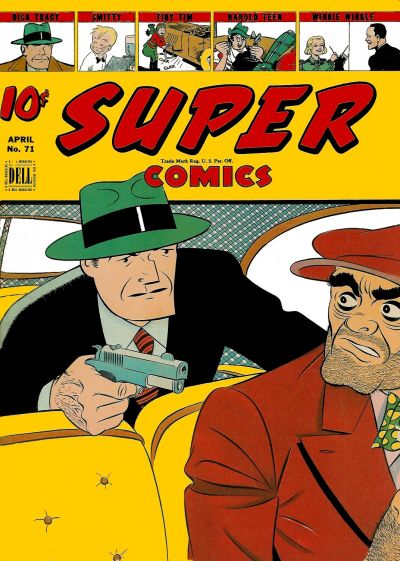
Dick  Tracy on the cover of Super Comics #71, April 1944

by BK Munn

I recently came across this great concise summary of Umberto Eco's list of 14 characteristics of fascism. When you follow the links, you get the full original essay from The New York Review of Books, in which Eco talks a bit about growing up in Italy in the '40s under Mussolini and the liberation of his small town by partisan rebels and U.S. soldiers: 

"A few days later I saw the first American soldiers. They were African Americans. The first Yankee I met was a black man, Joseph, who introduced me to the marvels of Dick Tracy and Li’l Abner. His comic books were brightly colored and smelled good."

Chester Gould's Dick Tracy comic strip was translated to comic books many times. During the years of World War II it was reprinted in Dell's Super Comics alongside other funny pages cohorts like Little Orphan Annie. Perhaps this is how Eco first encountered the strip? Likewise, Al Capp's L'il Abner was a regular feature in Tip Top Comics during the same period. 

I wonder, by mentioning them here, is Eco hinting at the weird right-wing politics of Gould and Capp and their comic strip tough-guy counterparts? Or is he simply conflating his budding awareness of the wonders of U.S. pop culture with this primal example of the democratic nature of post-Fascist society?  As usual with Eco and his playful essays, there is probably a lot more going on than it seems on the surface. 

Is Tracy fascist? Eco starts his piece by wondering why the Italian "Fascist" became the default term for describing any and all varieties of totalitarian strongman, from dictator or president right on down the line to your friendly neighbourhood cop on the beat.   


"During World War II, the Americans who took part in the Spanish war were called “premature anti-fascists”—meaning that fighting against Hitler in the Forties was a moral duty for every good American, but fighting against Franco too early, in the Thirties, smelled sour because it was mainly done by Communists and other leftists. … Why was an expression like fascist pig used by American radicals thirty years later to refer to a cop who did not approve of their smoking habits? Why didn’t they say: Cagoulard pig, Falangist pig, Ustashe pig, Quisling pig, Nazi pig?"

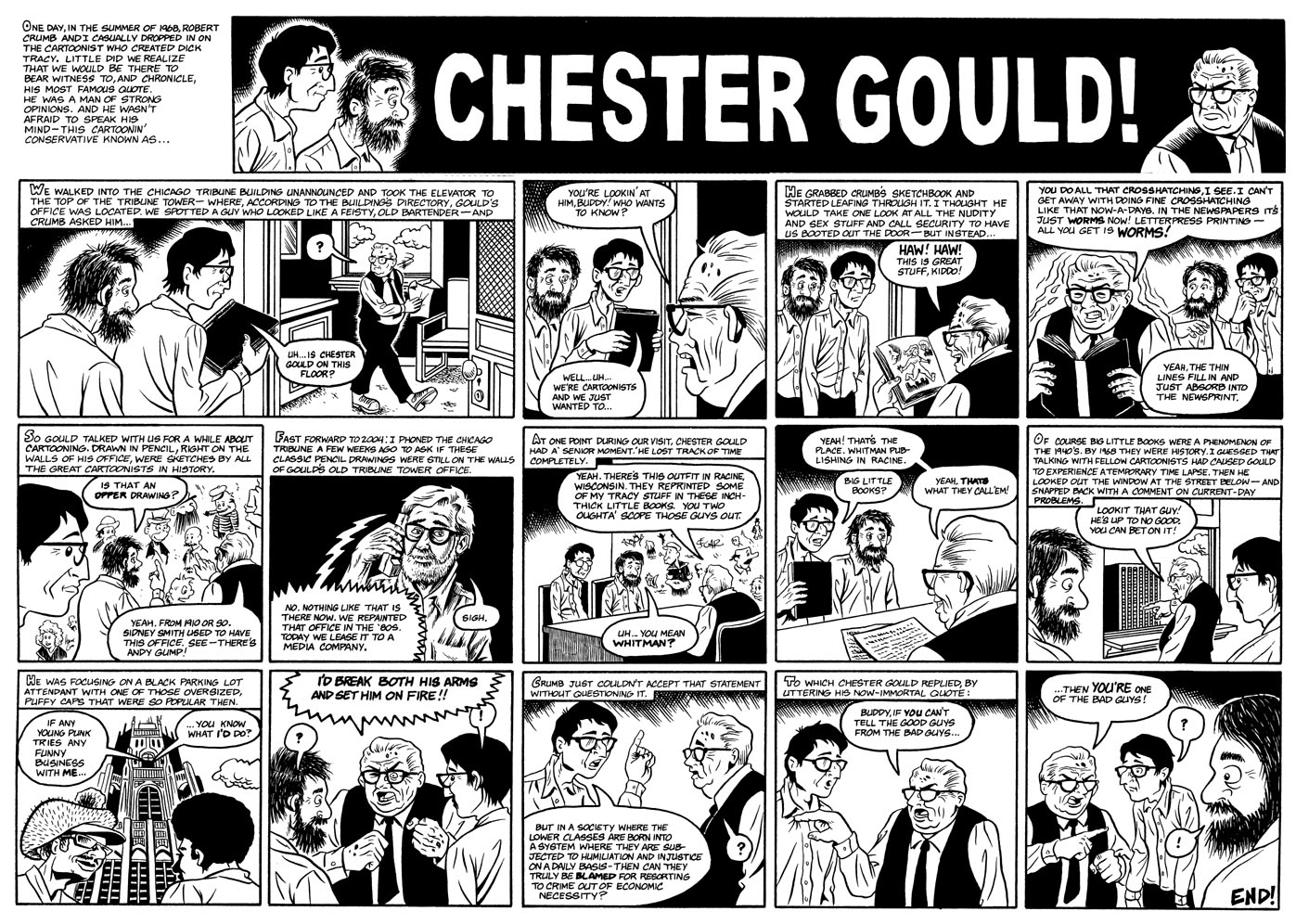
Tracy is a cop, and his tough-guy, decades-long merciless war on crime was calcified and largely out of favour by the time the late-60s counter-culture was in full bloom (although it didn't stop Underground cartoonists like Jay Lynch and Robert Crumb from seeking an audience with Gould in his Herald-Tribune office in 1968). Cantankerous conservatives Gould and the acerbicly satiric Al Capp (think of Capp vs John Lennon and Yoko Ono), and the comics they created, were labeled fascist by 60s observers, just like 80% of the mainstream culture of the time. But it's a big leap from "asshole" to "fascist" and so much of this seeming cultural change can be explained away as adolescent posturing and inter-generational iconoclasm. But the shift in tenor on both right and left during the Cold War was also very much a reality. Outside of an increasing graphic/artistic weirdness, and the occasional patronising stab at "with-it" trendiness, Tracy and Gould were out of step with their surrounding culture. (This was true of the Underground vs Mainstream dialectic everywhere. For left-wing intellectuals like Art Speigelman in the 60s and 70s, it didn't matter that the Jewish creator of Captain America had personally shot Nazis during the War.  1960s Captain America had turned to fighting communism in the comics and in the era of Vietnam and the draft, that made Kirby and Marvel the enemy.)


This was not always the case. 1940s Tracy in the comic strips was a big supporter of the U.S. war effort and, as part of the frontline of comic strip propagandists, fought his fair share of Nazis, most notably in a well-known continuity begun in 1944 and featuring The Brow, an Axis spy who bedevils Tracy and the gang for months, escaping a variety of the usual Gould-ian deathtraps (and even a romance with Gravel Gertie!) before finally being impaled on a flagpole flying the U.S. flag.


Eco wraps up his famous essay with a plea for vigilance, noting that "Ur-Fascism is still around us, sometimes in plainclothes." What comics fan doesn't remember that the name of Gould's strip was originally "Plainclothes Tracy" until it was changed by the publisher Captain  Joseph Patterson to the tougher, slang-ier-sounding "Dick Tracy"? Certainly the past few years have seen a reassessment of our relationship with police of all stripes, in popular culture and in real life, and we can only wonder what having actual neo-Nazis (Bannon, et al) in the White House will mean for this horrible trend.

"We must keep alert, so that the sense of these words will not be forgotten again. Ur-Fascism is still around us, sometimes in plainclothes. It would be so much easier, for us, if there appeared on the world scene somebody saying, “I want to reopen Auschwitz, I want the Black Shirts to parade again in the Italian squares.” Life is not that simple. Ur-Fascism can come back under the most innocent of disguises. Our duty is to uncover it and to point our finger at any of its new instances—every day, in every part of the world. Franklin Roosevelt’s words of November 4, 1938, are worth recalling: “I venture the challenging statement that if American democracy ceases to move forward as a living force, seeking day and night by peaceful means to better the lot of our citizens, fascism will grow in strength in our land.” Freedom and liberation are an unending task."


Anyway, here's the shortened list from the article mentioned above. Some of these track to Tracy, but there is more Trump here than Chester Gould:


While Eco is firm in claiming “There was only one Nazism,” he says, “the fascist game can be played in many forms, and the name of the game does not change.” Eco reduces the qualities of what he calls “Ur-Fascism, or Eternal Fascism” down to 14 “typical” features. “These features,” writes the novelist and semiotician, “cannot be organized into a system; many of them contradict each other, and are also typical of other kinds of despotism or fanaticism. But it is enough that one of them be present to allow fascism to coagulate around it.”


1. The cult of tradition. “One has only to look at the syllabus of every fascist movement to find the major traditionalist thinkers. The Nazi gnosis was nourished by traditionalist, syncretistic, occult elements.”
2. The rejection of modernism. “The Enlightenment, the Age of Reason, is seen as the beginning of modern depravity. In this sense Ur-Fascism can be defined as irrationalism.”
3. The cult of action for action’s sake. “Action being beautiful in itself, it must be taken before, or without, any previous reflection. Thinking is a form of emasculation.”
4. Disagreement is treason. “The critical spirit makes distinctions, and to distinguish is a sign of modernism. In modern culture the scientific community praises disagreement as a way to improve knowledge.”
5. Fear of difference. “The first appeal of a fascist or prematurely fascist movement is an appeal against the intruders. Thus Ur-Fascism is racist by definition.”
6. Appeal to social frustration. “One of the most typical features of the historical fascism was the appeal to a frustrated middle class, a class suffering from an economic crisis or feelings of political humiliation, and frightened by the pressure of lower social groups.”
7. The obsession with a plot. “The followers must feel besieged. The easiest way to solve the plot is the appeal to xenophobia.”
8. The enemy is both strong and weak. “By a continuous shifting of rhetorical focus, the enemies are at the same time too strong and too weak.”
9. Pacifism is trafficking with the enemy. “For Ur-Fascism there is no struggle for life but, rather, life is lived for struggle.”
10. Contempt for the weak. “Elitism is a typical aspect of any reactionary ideology.”
11. Everybody is educated to become a hero. “In Ur-Fascist ideology, heroism is the norm. This cult of heroism is strictly linked with the cult of death.”
12. Machismo and weaponry. “Machismo implies both disdain for women and intolerance and condemnation of nonstandard sexual habits, from chastity to homosexuality.”
13. Selective populism. “There is in our future a TV or Internet populism, in which the emotional response of a selected group of citizens can be presented and accepted as the Voice of the People.”
14. Ur-Fascism speaks Newspeak. “All the Nazi or Fascist schoolbooks made use of an impoverished vocabulary, and an elementary syntax, in order to limit the instruments for complex and critical reasoning.”


(Super Comics #74, July 1944)


(Tip Top Comics #106, April 1945)