Showing posts with label comic strips. Show all posts

Thursday, March 20, 2025

TOONERVILLE TROLLEY IN NEWFOUNDLAND

by BK Munn

During WWII, Newfoundland, and especially the airfields at Gander, was the centre of the universe, and there was a heavy Allied presence in the area. This 1945 article from the Atlantic Guardian details the construction of a railway for moving troops and supplies to Ernest Harmon Air Force Base, a U.S. base that existed from 1941 to 1966 and is now the Stephenville International Airport. Toonerville Trolley was a long-running U.S. comic strip by Fontaine Fox that ran from 1905-1955. Also known as Toonerville Folks, the strip centred on a small-town streetcar operated by the grizzled Skipper who interacted with a cast of eccentric local characters. The popular strip was adapted into silent movies and a series of 1930s animated cartoons produced by The Van Beuren studio. Between 1927 and 1934, a series of short Our Gang-styled comedies set in Toonerville and starring a young Mickey Rooney as the titular Mickey McGuire, a character from the comic strip, were produced in Hollywood. 


Sunday, January 05, 2025

Comics in Film: Our Man in Havana (1958)


Comics in Film: Our Man in Havana (1958).

by BK Munn

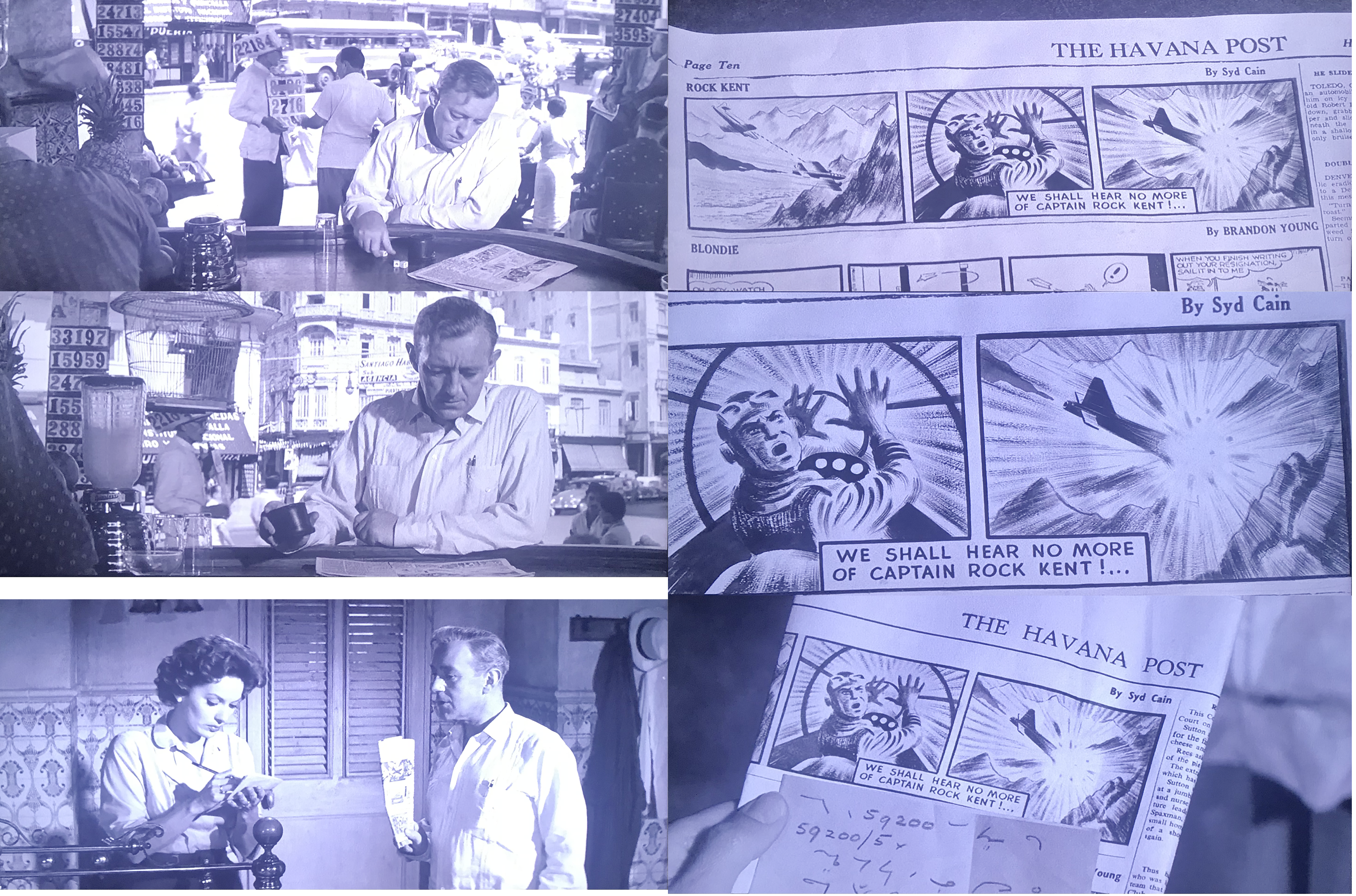
Vacuum cleaner salesman James Wormold (Alec Guinness) is inspired by the fictional comic strip "Rock Kent" to claim one of his non-existent agents, a pilot, has been killed. Wormold has been randomly recruited by the British Government to create a spy network in Cuba, but having neither the inclination or imagination for espionage, he simply makes up the network based on items he stumbles across and submits false reports to his superiors. Thus, a list of members at his country club becomes the spy network, the design of a vacuum cleaner becomes the model for a drawing of a secret weapon installation, and this comic strip becomes the explanation for why he can't provide actual photos to London. Unfortunately the plan backfires, and the Cuban police kill a real pilot after intercepting his coded message, dictated here to his secretary Beatrice (Maureen O'Hara). "Rock Kent" is meant to be similar to other Cold War aviation strips of the period like "Buzz Sawyer" and "Steve Canyon." The Havana Post was a real newspaper and you can see the top of Blondie, a real comic, in one of the close-ups. The bar location was real, too: it was actually shot on the streets of Havana right after the Castro Revolution overthrew the corrupt Batista regime, represented in the film by the amorous torturer Captain Segura (Ernie Kovacs), and Castro reportedly visited the set during filming.


Saturday, February 11, 2023

SPLIT-FACE vs. TWO-FACE: A TALE OF TWO VILLAINS FROM BATMAN AND DICK TRACY

Just saw the first Dick Tracy movie (1945) on TCM. The villain is Split-Face, played by the great Mike Mazurki. He's a new creation for the movie, not from the comic strip, created by the screenwriter Eric Taylor, author of many B-movie crime pictures. The Batman villain Two-Face debuted in 1942. In a shocking twist, it looks like Dick Tracy is taking a page from Batman. In another shocking twist, Bob Kane is actually credited with his creation (although Bill Finger of course wrote the first appearance in Detective Comics #66). In a twist that will surprise nobody, Kane stole the idea for Two-Face from this poster for the 1941 Dr. Jekyll and Mr. Hyde starring Spencer Tracy


Sunday, January 15, 2023

WEDNESDAY, SEASON ONE

WEDNESDAY, SEASON 1 (2022)

review by BK MUNN

When I was a kid, like everybody I watched reruns of The Addams Family on tv. In retrospect, it’s amazing that the show existed at all, a family sitcom based on some macabre, downright antisocial and perverse cartoons printed in the high-toned New Yorker magazine, but in the context of the times it doesn’t seem out of place. The post-Kennedy, post-Cuban Missile crisis 1960s was a time of high-concept tv shows with increasingly fantastical premises (and The Munsters premiered at the same time, for Christ’s sake). As a show, it still holds up as a goofy, only partly moronic example of 60s culture. They made some good logical decisions, shoe-horning Charles Addams’ disconnected cartoons into a network format, essentially bowdlerizing it for a mainstream audience (not that The New Yorker isn’t mainstream, but you know what I mean). It’s no smarter than Gilligan’s Island or Hogan’s Heroes, and it’s not without its own boring, repetitive schticks and annoying tics, but it lucked out with a few things, like a catchy theme song, great casting, and some creative characterizations that paid off. And for better or for worse, sixty years later the tv show is still the basis for a massive pop culture enterprise. 

As an adult I think of the work of Charles Addams, including the roughly 150 cartoons and drawings he did that can be at least tangentially identified as “Addams Family” cartoons, as something like a holy text, my Bible or Shakespeare, and in many ways the epitome of comics art. I have to admit I’m a bit snobbish about them, and hold them close to my heart (I’m sure Addams was much less precious and, like Charles Schulz, was happy to cash any checks for prostituting his creations). These days, I think of the tv shows and movies as, at best, easily-forgettable aspects of the Addams legacy and, at worst, as something like a hideous boil on the face of the Mona Lisa (maybe like something you’d find in the Addams Family portrait gallery?). That being said, I’m still able to think about the original drawings and their ancillary spinoffs as separate things, and have even watched parts of the movie franchises over the years with a clean conscience (as a kid I also liked the Hanna-Barbera Saturday morning animated show!). 

Like all pop-culture properties, The Addams Family has been seized on as something endlessly franchise-able, to be mined and re-imagined and transformed into a myriad of formats and genres; a universe (dare I say multiverse?) unto itself. Our modern sophisticated tastes demand more than some Boomer artifact, and so we have this new Wednesday show, which takes one of the least-developed, most projected-upon, parts of the universe, essentially a blank slate, and posits her as a teen heroine in a sort of Harry Potter meets Nancy Drew milieu, as a goth Hermione, if you will, in one of these now stereotypical fantasy private schools. The slow addition of *actual* supernatural aspects to the "mythos", above and beyond Addams’ bedrock surrealism, placed front and center, is the novelty here, giving some kind of superpowers to all members of the clan, and special precognitive witchiness to both Morticia and Wednesday, etc. (The full scale “magic-ization” I think very clearly takes away from what made the original concepts unique, but whatever.)  I turned off most of my grumpy critical nitpicking and enjoyed this (almost too long) short series. The casting was mostly good, the plots not too moronic (gleefully full of plot-holes, lacunae, and “traveling at the speed of plot” tv tropes), and overall those things I expected to dislike (dancing to The Cramps, Fred Armisen as Uncle Fester) instead were almost charming. It’s for kids but I’m adult enough to admit I’m basically a big baby and we live in an infantile society. Tim Burton, who has been making shit like this his entire career, had a hand in production and development, and directs half the episodes (the poster says this conglomeration of cliches and half-assed plots comes "from the imagination of Tim Burton" which is quite the self-own but also, which part?), and I can’t really say I hate it.

Tuesday, October 11, 2022

First Doug Wright's Family in The Canadian, 1967


Originally published in the nationally syndicated magazine Weekend (originating in the Montreal Standard but included as an insert in different papers across the country), the comic strip "Doug Wright's Family" moved to upstart competitor The Canadian in 1967. Here's the first strip from The Canadian, printed with a short article trumpeting their new acquisition, with a great photo of Doug Wright, pictured with his eldest son. Both magazines were general interest publications with features for the whole family, from political news, to sports, fashion, celebrity profiles, and weird Cold War fantasies like the one pictured here. The two magazines merged 10 years later.


Friday, August 20, 2021

CR-A-A-A-S-H-! DOUG WRIGHT'S 1967 CAR-TOONS

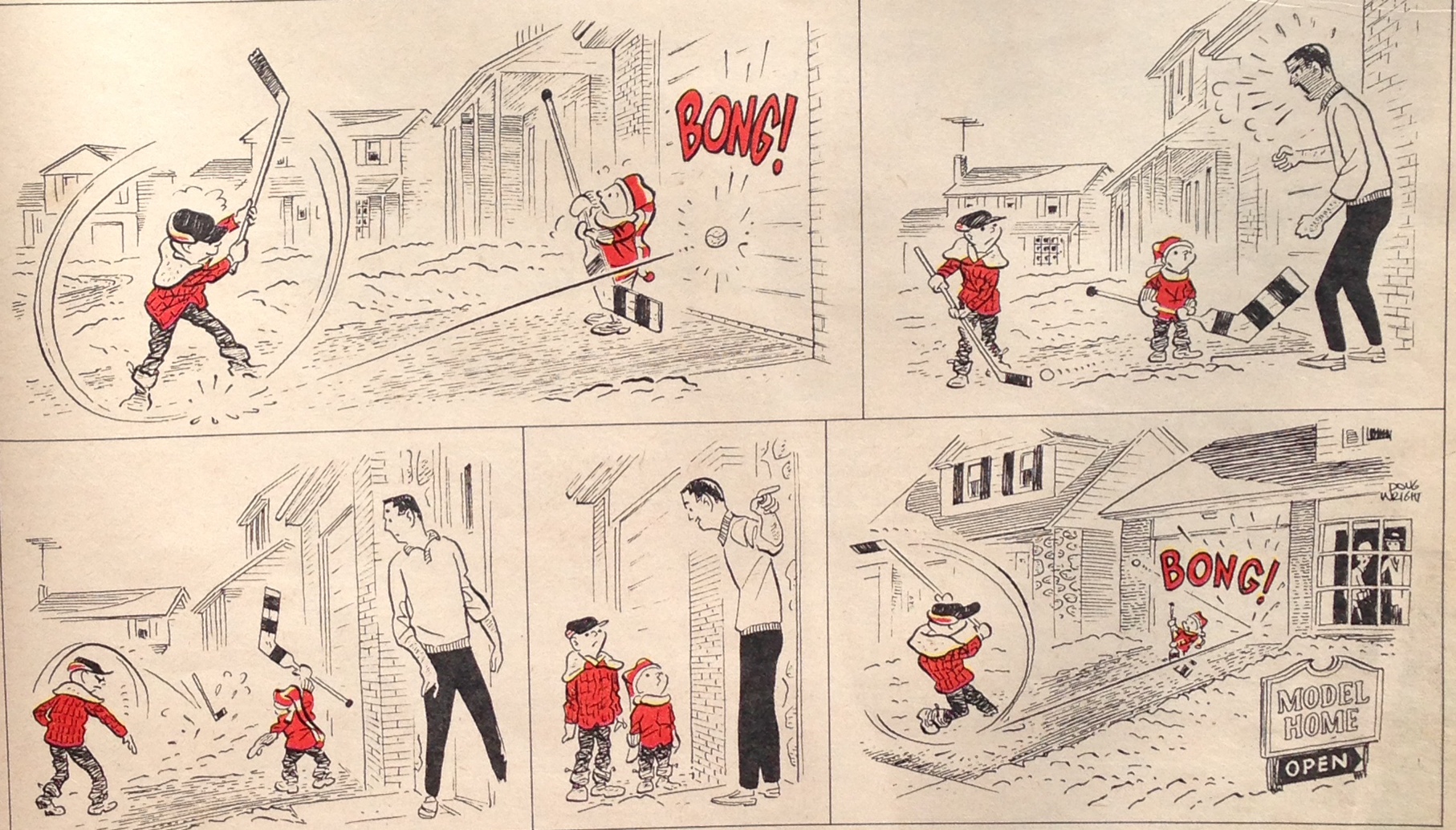
Some CAR-toons by Doug Wright, from Star Weekly magazine, Sept 30, 1967. The mechanical-minded cartoonist Doug Wright was a natural when it came to delineating automobiles and other machines and this one-pager has the look of a new strip "pitch" designed to highlight these skills, in contrast to the domestic slapstick of his regular weekly gig with the Star, the beloved "Doug Wright's Family" strip. It doesn't look like this ever turned into anything, but what a glimpse into "what might have been..."


Saturday, March 28, 2020

Comics in Film: Breathless


by BK Munn

Comics in Film: Jean-Paul Belmondo reads a September 1959 edition of the newspaper France-Soir while spying on his character's girlfriend (played by Jean Seberg) being questioned by the Paris police in Jean-Luc Godard's Breathless (1960). Belmondo is on the run for killing a cop, and his face is on the front page of every newspaper in town, so of course he goes straight to a newsstand and buys a paper. On view are two comics, the U.S. strip "The Heart of Juliette Jones" by Stan Drake, and "13 rue de l'Espoir" by writers Jacques and François Gall and cartoonist Paul Gillon. Both strips are soap operas with female, "career girl" leads. If you squint, it's possible to read the chic Seberg character, a young American woman trying to land a job as a reporter in France and torn between two boyfriends, as a combination of Juliette Jones and Françoise Morel, the star of the French strip.  "13 rue de l'Espoir" ran for 13 years in France-Soir and was collected in two albums by Les Humanoïdes in the 1980s. Gillon (1926-2011) had a long career in bande dessinée, collaborating with Jean-Claude Forest on several series and creating a multitude of other books, Including The History of Socialism in France.


Sunday, February 02, 2020

Charles Schulz's Extramarital Affair, In Dog Form


(July 15, 1970) - Snoopy initially meets the "girl-beagle" in the strip the previous week, when he goes back to the Daisy Hill Puppy Farm to give a speech and a riot breaks out. (She isn't actually shown in the strip, due to a cloud of tear gas.)

From this 2012 article in Vanity Fair.


Monday, April 22, 2019

Rudolph Dirks Anticipates the Group of Seven


by BK Munn

Rudolph Dirks took the characters of his Katzenjammer Kids strip around the world many times before they more or less settled down on a tropical island, and one of their earliest adventures was a search for the North Pole. As part of this epic 1907 quest, the trio of The Captain, Hans and Fritz travelled through the arctic, battling polar bears and meeting other northern inhabitants, including racist caricatures of Inuit people who speak in gibberish. The Captain, like Dirks himself, just wants to travel and paint pictures, but is constantly pranked by the kids. In the sequence below, he likens the painting of a pine tree to poetry, echoing Robert Service’s "The Pines” and presaging both Joyce Kilmer’s famous poem “Trees” (“I think that I shall never see/a poem lovely as a tree...”) and the paintings of Tom Thompson and the Group of Seven, notably Thompson’s “The Jack Pine”. Dirks was a fellow traveller of The Ashcan School of painters and was one of the cartoonists who exhibited in the Armoury Show of 1913.


Sunday, December 09, 2018

Little King Comics

I think the consensus is that the Little King comics published by Dell were written and thumbnailed by John Stanley of Little Lulu fame. The Little King is one of the most iconic of comic strips and its creator, Otto Soglow, was a great cartoonist, beloved of little children and adult intellectuals alike (Salvador Dali was his biggest fan). The Dell comic book adaptations, signed by Soglow but not by him, are also great. These comics are playful and actually funny, with a great graphic aspect that echoes the comic strip in its use of geometric shapes, contrast and wonderful compositions. Just beautiful.

These panels are from "The Statue" (Four Color #597: The Little King, 1954)


Thursday, August 02, 2018

Little Lulu Billboard in Times Square (with Tubby!)

I was wondering why Tubby, the second-greatest American comic book character of all time after Little Lulu, didn't have his own Wikipedia page, when I stumbled over the following amazing fact on Lulu's page. I have many examples of Kleenex advertising featuring Lulu, but somehow was unaware of this: "Little Lulu was widely merchandised, and was the first mascot for Kleenex tissues; from 1952 to 1965 the character appeared in an elaborate animated billboard in Times Square in New York City."


Sunday, November 27, 2016

Umberto Eco On Fascism and His Introduction to U.S. Comics, or, "Is Dick Tracy Fascist or Not?"


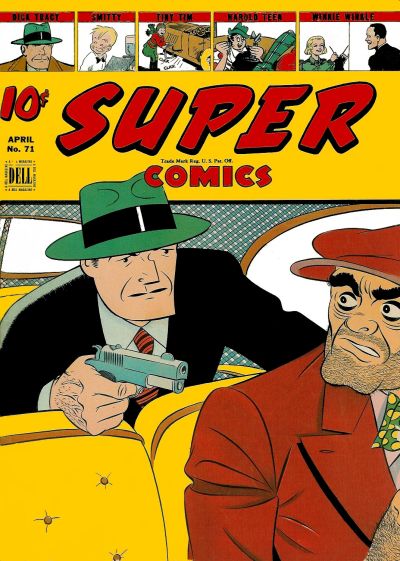
Dick  Tracy on the cover of Super Comics #71, April 1944

by BK Munn

I recently came across this great concise summary of Umberto Eco's list of 14 characteristics of fascism. When you follow the links, you get the full original essay from The New York Review of Books, in which Eco talks a bit about growing up in Italy in the '40s under Mussolini and the liberation of his small town by partisan rebels and U.S. soldiers: 

"A few days later I saw the first American soldiers. They were African Americans. The first Yankee I met was a black man, Joseph, who introduced me to the marvels of Dick Tracy and Li’l Abner. His comic books were brightly colored and smelled good."

Chester Gould's Dick Tracy comic strip was translated to comic books many times. During the years of World War II it was reprinted in Dell's Super Comics alongside other funny pages cohorts like Little Orphan Annie. Perhaps this is how Eco first encountered the strip? Likewise, Al Capp's L'il Abner was a regular feature in Tip Top Comics during the same period. 

I wonder, by mentioning them here, is Eco hinting at the weird right-wing politics of Gould and Capp and their comic strip tough-guy counterparts? Or is he simply conflating his budding awareness of the wonders of U.S. pop culture with this primal example of the democratic nature of post-Fascist society?  As usual with Eco and his playful essays, there is probably a lot more going on than it seems on the surface. 

Is Tracy fascist? Eco starts his piece by wondering why the Italian "Fascist" became the default term for describing any and all varieties of totalitarian strongman, from dictator or president right on down the line to your friendly neighbourhood cop on the beat.   


"During World War II, the Americans who took part in the Spanish war were called “premature anti-fascists”—meaning that fighting against Hitler in the Forties was a moral duty for every good American, but fighting against Franco too early, in the Thirties, smelled sour because it was mainly done by Communists and other leftists. … Why was an expression like fascist pig used by American radicals thirty years later to refer to a cop who did not approve of their smoking habits? Why didn’t they say: Cagoulard pig, Falangist pig, Ustashe pig, Quisling pig, Nazi pig?"

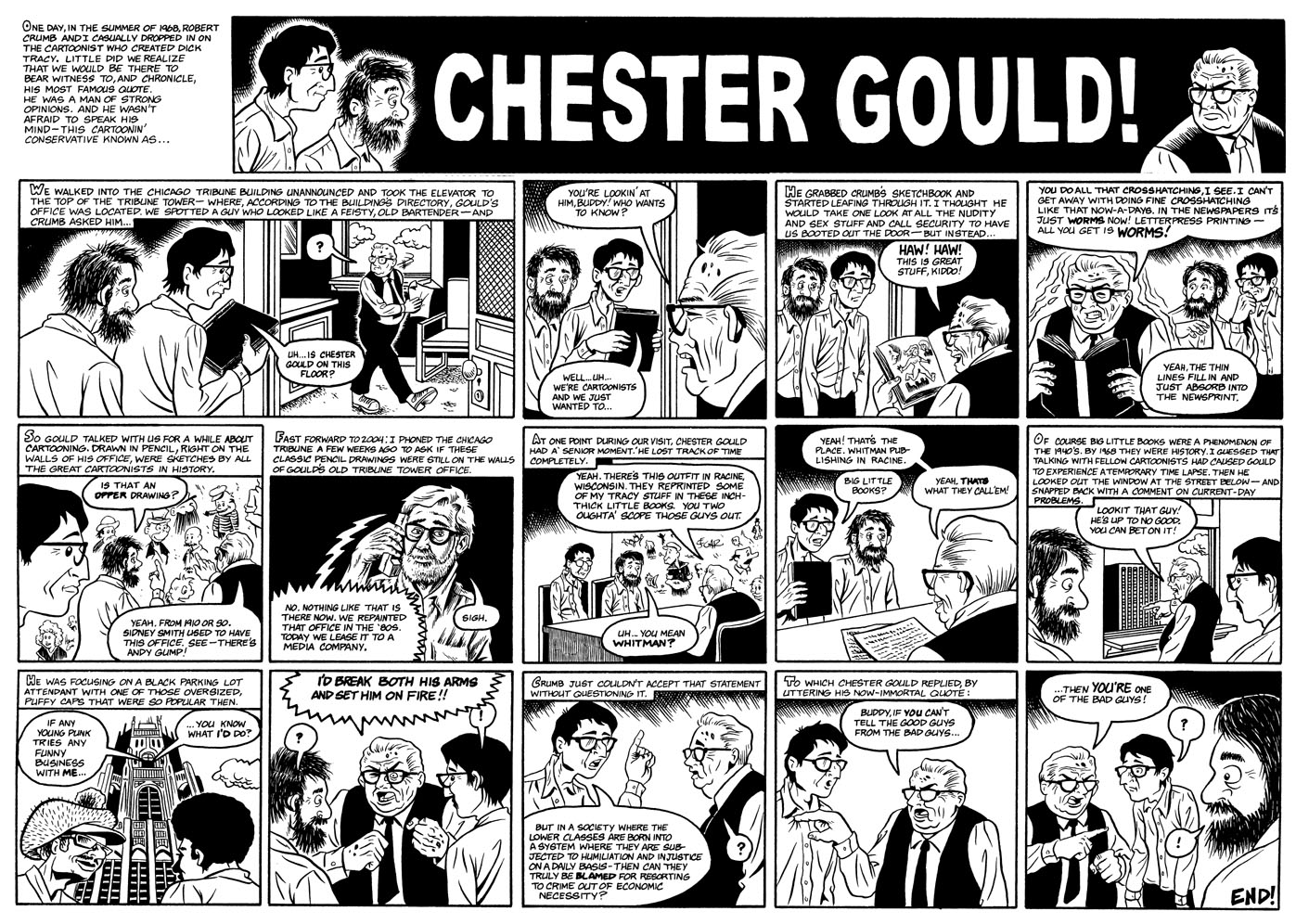
Tracy is a cop, and his tough-guy, decades-long merciless war on crime was calcified and largely out of favour by the time the late-60s counter-culture was in full bloom (although it didn't stop Underground cartoonists like Jay Lynch and Robert Crumb from seeking an audience with Gould in his Herald-Tribune office in 1968). Cantankerous conservatives Gould and the acerbicly satiric Al Capp (think of Capp vs John Lennon and Yoko Ono), and the comics they created, were labeled fascist by 60s observers, just like 80% of the mainstream culture of the time. But it's a big leap from "asshole" to "fascist" and so much of this seeming cultural change can be explained away as adolescent posturing and inter-generational iconoclasm. But the shift in tenor on both right and left during the Cold War was also very much a reality. Outside of an increasing graphic/artistic weirdness, and the occasional patronising stab at "with-it" trendiness, Tracy and Gould were out of step with their surrounding culture. (This was true of the Underground vs Mainstream dialectic everywhere. For left-wing intellectuals like Art Speigelman in the 60s and 70s, it didn't matter that the Jewish creator of Captain America had personally shot Nazis during the War.  1960s Captain America had turned to fighting communism in the comics and in the era of Vietnam and the draft, that made Kirby and Marvel the enemy.)


This was not always the case. 1940s Tracy in the comic strips was a big supporter of the U.S. war effort and, as part of the frontline of comic strip propagandists, fought his fair share of Nazis, most notably in a well-known continuity begun in 1944 and featuring The Brow, an Axis spy who bedevils Tracy and the gang for months, escaping a variety of the usual Gould-ian deathtraps (and even a romance with Gravel Gertie!) before finally being impaled on a flagpole flying the U.S. flag.


Eco wraps up his famous essay with a plea for vigilance, noting that "Ur-Fascism is still around us, sometimes in plainclothes." What comics fan doesn't remember that the name of Gould's strip was originally "Plainclothes Tracy" until it was changed by the publisher Captain  Joseph Patterson to the tougher, slang-ier-sounding "Dick Tracy"? Certainly the past few years have seen a reassessment of our relationship with police of all stripes, in popular culture and in real life, and we can only wonder what having actual neo-Nazis (Bannon, et al) in the White House will mean for this horrible trend.

"We must keep alert, so that the sense of these words will not be forgotten again. Ur-Fascism is still around us, sometimes in plainclothes. It would be so much easier, for us, if there appeared on the world scene somebody saying, “I want to reopen Auschwitz, I want the Black Shirts to parade again in the Italian squares.” Life is not that simple. Ur-Fascism can come back under the most innocent of disguises. Our duty is to uncover it and to point our finger at any of its new instances—every day, in every part of the world. Franklin Roosevelt’s words of November 4, 1938, are worth recalling: “I venture the challenging statement that if American democracy ceases to move forward as a living force, seeking day and night by peaceful means to better the lot of our citizens, fascism will grow in strength in our land.” Freedom and liberation are an unending task."


Anyway, here's the shortened list from the article mentioned above. Some of these track to Tracy, but there is more Trump here than Chester Gould:


While Eco is firm in claiming “There was only one Nazism,” he says, “the fascist game can be played in many forms, and the name of the game does not change.” Eco reduces the qualities of what he calls “Ur-Fascism, or Eternal Fascism” down to 14 “typical” features. “These features,” writes the novelist and semiotician, “cannot be organized into a system; many of them contradict each other, and are also typical of other kinds of despotism or fanaticism. But it is enough that one of them be present to allow fascism to coagulate around it.”


1. The cult of tradition. “One has only to look at the syllabus of every fascist movement to find the major traditionalist thinkers. The Nazi gnosis was nourished by traditionalist, syncretistic, occult elements.”
2. The rejection of modernism. “The Enlightenment, the Age of Reason, is seen as the beginning of modern depravity. In this sense Ur-Fascism can be defined as irrationalism.”
3. The cult of action for action’s sake. “Action being beautiful in itself, it must be taken before, or without, any previous reflection. Thinking is a form of emasculation.”
4. Disagreement is treason. “The critical spirit makes distinctions, and to distinguish is a sign of modernism. In modern culture the scientific community praises disagreement as a way to improve knowledge.”
5. Fear of difference. “The first appeal of a fascist or prematurely fascist movement is an appeal against the intruders. Thus Ur-Fascism is racist by definition.”
6. Appeal to social frustration. “One of the most typical features of the historical fascism was the appeal to a frustrated middle class, a class suffering from an economic crisis or feelings of political humiliation, and frightened by the pressure of lower social groups.”
7. The obsession with a plot. “The followers must feel besieged. The easiest way to solve the plot is the appeal to xenophobia.”
8. The enemy is both strong and weak. “By a continuous shifting of rhetorical focus, the enemies are at the same time too strong and too weak.”
9. Pacifism is trafficking with the enemy. “For Ur-Fascism there is no struggle for life but, rather, life is lived for struggle.”
10. Contempt for the weak. “Elitism is a typical aspect of any reactionary ideology.”
11. Everybody is educated to become a hero. “In Ur-Fascist ideology, heroism is the norm. This cult of heroism is strictly linked with the cult of death.”
12. Machismo and weaponry. “Machismo implies both disdain for women and intolerance and condemnation of nonstandard sexual habits, from chastity to homosexuality.”
13. Selective populism. “There is in our future a TV or Internet populism, in which the emotional response of a selected group of citizens can be presented and accepted as the Voice of the People.”
14. Ur-Fascism speaks Newspeak. “All the Nazi or Fascist schoolbooks made use of an impoverished vocabulary, and an elementary syntax, in order to limit the instruments for complex and critical reasoning.”


(Super Comics #74, July 1944)


(Tip Top Comics #106, April 1945)