Showing posts with label floppies. Show all posts

Thursday, April 09, 2026

REVIEW: PALOOKAVILLE #25 BY SETH


Palookaville #25

by Seth

(Drawn & Quarterly, April 2026)

review by BK Munn

The new issue of Palookaville is a master class in comics page design, pacing, and letting a story breathe. The latest issue of this long running hardcover "comic book" from Seth features another gorgeous chapter of the graphic memoir "Nothing Lasts" and a new short story about forgotten painter, "Owen Moore," originally serialized in The Walrus magazine, presented here along with the prelim sketch version of the story from Seth's notebooks; a rare glimpse behind the covers! More process stuff includes a middle section of photographs and drawings detailing the creation of his life-size sculpture "Living Room Suite" which I drive by everyday outside the Art Gallery of Guelph. Fascinating!

I talked with Seth recently about comics page design and he compared the narratively driven, almost stream-of-consciousness/speed-of-thought panel transitions of Kirby to those of Kurtzman's more laboured, thoughtful triptychs balanced with single long panels, praising both, but noting his own approach to rhythm and beats hews closer to Kurtzman's. He joked about a  frequent Joe Matt maxim ("The next panel could be anything!") and talked about his own formal conservatism and dedication to page design and thinking about the page (and double pages) as a storytelling unit, in comparison to both Matt and Chester Brown, noting that Brown still draws each panel individually and pastes them down, with seemingly only the vaguest design in mind. Seth also contrasted Chris Ware's information dense pages with Dan Clowes' Ditko-esque simplicity and grids, and confessed that the pure cartoonist ideal of "show, don't tell" that Chester still sticks to has slowly given way in his own work to more and more exposition and narrative text. All very interesting comments to keep in mind when reading "Nothing Lasts" which is a heady, mesmerizing combination of attacks: time jumps, silent panels, wordy panels, narration, differently-sized panels, and a relaxed decompressed rhythm that lets the pages breathe. Really, a master-class in the potentials of comics page design.


Wednesday, March 13, 2019

The Dr. Strange-George Costanza Connection: From Master of the Mystic Arts to Master of His Domain


by BK Munn

There's an interesting echo of the origin of Steve Ditko’s Dr. Strange in one of the more famous episodes of Seinfeld, 1993’s “The Puffy Shirt”. In the episode, written by Larry David, sad sack George rockets to the top of the hand model game, but just as he feels his life is turning around, his brief career is cut short when his hubris is rewarded with inevitable destiny in the form of a carelessly-placed clothes iron.


George’s vanity is reminiscent of that displayed by high-flying surgeon Stephen Strange, who destroys his precious hands in a car accident and subsequently wanders the world searching for a cure that can restore his skill and dexterity, until he eventually winds up at the hidden Himalyan monastary of the Ancient One who trains him in the mystic arts.

George’s doom is foreshadowed by the tale of a hand model whose story is eerily similar to Stephen Strange’s and also contains a callback to another famous Seinfeld ep, “The Contest”. At his first (and last) photo shoot, George learns of the mysterious “Ray McKigney” who had “the most exquisite hands you've ever seen.” 

As the unnamed hand model agent tells it, McKigney fell victim to self-love:

MAN: Tragic story, I'm afraid. He could've had any woman in the world.. but none could match the beauty of his own hand.. and that became his one true love..
(Long pause)
GEORGE: You mean, uh..?
MAN: Yes. he was not.. master of his domain.
GEORGE: (Makes a gesture saying he understands. The man nods) But how.. uh..?
MAN: (Quick, to the point) The muscles.. became so strained with.. overuse, that eventually the hand locked into a deformed position, and he was left with nothing but a claw. (Holds hand up, displaying a claw-like shape) He traveled the world seeking a cure.. acupuncturists.. herbalists.. swamis.. nothing helped. Towards the end, his hands became so frozen the was unable to manipulate utensils, (Visibly disgusted by this last part) and was dependent on Cub Scouts to feed him. I hadn’t seen another pair of hands like Ray McKigney's.. until today. You are his successor. (George looks down at his hands) I.. only hope you have a little more self-control.
GEORGE: (Smiling to himself) You don't have to worry about me. (Nodding, gloating) I won a contest.

The egotistical Ayn Randian superman who is humbled and must painfully learn the lessons of true heroism is a Marvel Comics mainstay, from Peter Parker to Tony Stark to Dr. Strange, and the story of a professional man who suffers the loss of his hands must have had a special resonance for a cartoonist, but the Stephen Strange/Ray McKigney story has other precedents in popular culture. “The Hands of Orlac” is a 1923 silent film that popularized the medieval legend of The Hand of Glory --the disembodied body part of a dead criminal endowed with magical powers. In the film, a concert pianist loses his hands in an accident and has the hands of a murderer grafted on by an experimental surgeon. The film was remade many times, with two versions appearing just before the origin of Dr. Strange was published in Strange Tales #115 in 1963:  1960's “The Hands of Orlac” (with Mel Ferrer as Orlac and Christopher Lee as the magician “Nero”), and 1962’s “Hands of a Stranger”. It’s entirely possible that Ditko and/or his editor Stan Lee saw or read some version of this story before penning the Dr. Strange story. The film was even remade by Oliver Stone in 1981 as “The Hand”, with Michael Caine as a cartoonist (!) who loses his drawing hand in a car accident, only to have the hand return to haunt him as a murderous appendage. The cartoonist’s art in the film was supplied by real-life Marvel veteran Barry Windsor-Smith. Did Larry David encounter any of these iterations before concocting his tale of the masturbating hand model? Who can say...


Tuesday, January 29, 2019

ROMA IS LIT!

by BK Munn
Saw Roma (2018) last night. Beautiful film. I think I know the secret to its success: a hidden cameo by Nancy and Sluggo in the film’s final minutes. Part of the film’s metacommentary on movies and childhood, the issue is Periquita #200 (Periquita and Tito were the Spanish-language Nancy and Sluggo), one of several comics seen fleetingly in Roma. I think this issue is an anachronism from 1975  OR 1976 (the movie is set in 1971 around the Corpus Christi massacre in Mexico City). Published by Editorial Novaro, it appears to be reprints of the U.S. Dell comics series, with John Stanley stories. There is a great line in the film when a young couple is about to go to the movies for a make-out session, and the young woman says “I prefer to play in the dark.”


The monthly series began publication in 1960 and each issue consisted of 32 full-colour pages. The dimensions of the comics changed beginning in March 1975 due to the rise in the cost of paper, forcing the publisher to reduce the size of its comics by almost half to 19.5 x 13.5 cm from 25 x 17 cm (this is when the "Eagle Series" logo appears). Some stories may have been written and drawn by Mexican creators.


Sunday, December 09, 2018

Little King Comics

I think the consensus is that the Little King comics published by Dell were written and thumbnailed by John Stanley of Little Lulu fame. The Little King is one of the most iconic of comic strips and its creator, Otto Soglow, was a great cartoonist, beloved of little children and adult intellectuals alike (Salvador Dali was his biggest fan). The Dell comic book adaptations, signed by Soglow but not by him, are also great. These comics are playful and actually funny, with a great graphic aspect that echoes the comic strip in its use of geometric shapes, contrast and wonderful compositions. Just beautiful.

These panels are from "The Statue" (Four Color #597: The Little King, 1954)


Friday, November 30, 2018

Antique Show Comics, part 1: Canadian Red Ryder Comics

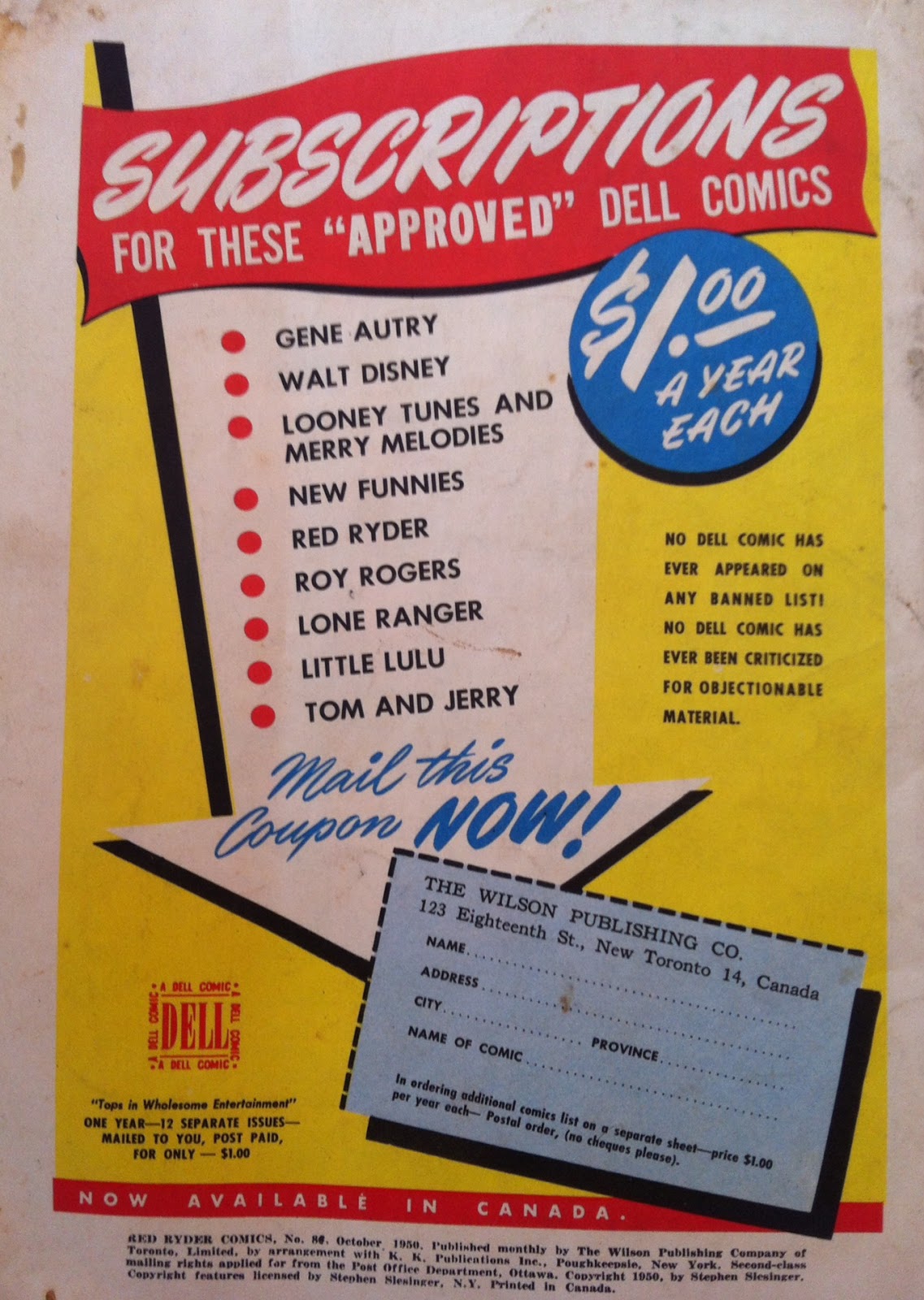
I bought this from a toy vendor this weekend not because I like these comics but because I don't have any of this particular type. You hardly see these Canadian editions of Dell Comics (I wish it was a Little Lulu!). Less pages than the U.S. issues and blank inside covers. Subscription coupon on the back cover. Published by The Wilson Publishing Company, 123 Eighteenth Street, New Toronto. Established during the WECA embargo on U.S. comics, the company kept chugging along until I believe the Comics Code came along.

More on this postwar period of comics publishing in Canada.


Sunday, November 11, 2018

Sleepin' Lena by Erich F.T. Schenk

My new favourite comic book character is Sleepin' Lena, the anthropomorphic lady cat afflicted with hypersomnia. Lena was written and drawn by Erich F.T. Schenk, an American journeyman cartoonist who worked for a variety of publishers in the 1940s, and also for the Fleisher animation studio, where he provided surreal background paintings for Popeye and Betty Boop cartoons. Lena appeared in only a handful of stories in different titles. In each story, Lena gets a new job but falls asleep and has a dreamlike adventure before getting fired. I love the character especially because of this story where she is hired as a soda jerk in a candy store, just like my store! A truly weird character at the intersection of race and gender. The comics historian Cheryl Spoehr has posited that Lena is a literary "type" based on stereotypes of people of colour, especially broken down maids, found in popular American books and other media of the early 20th Century. Perhaps the name is borrowed from Lena Horne, who was at the height of her early success in the 1940s?
(from Merry-Go-Round Comics 1945, nn --only issue, published by American Comics Group) 


Tuesday, September 18, 2018

Notes on Guelph Comics History, Part Two: Tales of a Guelphite

Well, here's Tales of a Guelphite #1, which publisher David J Knight tells me he is planning to turn into a continuing comics anthology. The first issue has no comics but covers some aspects of comics culture in Guelph, and includes my article detailing the secret history of Tragedy Strikes Press. I'm happy that some of this history is now in print, and mostly in the words of some of my favourite cartoonists (thank you: Nick Craine, Jay Stephens, and Dylan Horrocks). It was quite a thrill to be a comic book nerd living in Guelph when these cool underground comics were being published here, and even more of a thrill to talk with the creators who published them, all these years later. A much longer version of this history may appear online in the future, as I had to do quite a bit of trimming to fit the wordcount, and several other interviews didn't make it into the article, but for now you can pick up a copy of the zine at Royal Cat Records.


Friday, June 15, 2018

Investigating Comic Books in Canada: Maclean's Magazine, 1948

I finally picked up a physical copy of this Maclean's Magazine article from 1948. The 5-page article "What About the Comics?" by Sidney Katz appeared in the December 1st issue and for its time was a quite thorough look at the moral panic over so-called "crime comics". For the article, Katz corresponded with the New York psychiatrist Fredric Wertham, author of the anti-comics diatribe Seduction of the Innocent, and quotes an armload of other thinkers on early childhood education including Dr. Spock. The article also touches on the crusade to have the sale of crime comics criminalized, and looks at the use of religious and educational comics in the classroom, mentioning many of the then-popular U.S. comic book titles and features along the way. The article is one of the earliest published in the international "mainstream" media to treat with this subject, and comes across as fairly balanced (Katz went on to specialize in award-winning journalism with a focus on psychology and mental illness). The article is well-documented and often-cited in the study of anti-comics literature, and is even still available on the Maclean's site to subscribers, but it's nice to have my own original copy. The best part is the staged photo of the kids reading the comics in front of a Maclean's newsstand. I like to imagine this was photographed in the lobby of the Maclean's building at 481 University Ave in Toronto, perhaps using the well-dressed children of the photographer. The sale of crime comics was criminalized in Canada in 1949 as a result of The Fulton Bill.


Wednesday, May 23, 2018

Notes on Guelph Comics History, Part One

I'm starting to do a little bit of research into my hometown's hidden comics history as preparation for writing about our homegrown comic book company, the late, lamented, Tragedy Strikes Press.  Below we have two images from the Guelph Mercury newspaper archives, housed at the Guelph Public Library. The first is a gathering of kids trading (mostly coverless?) comics at the library in 1976. It looks like that may be a Superboy comic face up on the table, but I can't identify anything else. The second photo was taken at the first comic shop I remember going to in town, Card N Comics (located on the same street I have a business on today!), and one of the principles in Tragedy Strikes Press, co-owner Fiona Kenny. What a wonderful random sampling of the early-80s comics culture on display in that shop!


Caption: "Comic Swap Serious Business"
Notaton: "This photograph shows Sean McCarthy, Sean Hayes, Dafydd Waters, and Derek Booth taking part in a comic book trade at the Guelph Public Library."
Guelph Mercury, November 24, 1976


Caption: "Spidey, Old Buddy"
Notation: "This picture shows Fiona Kenny of Card N Comics, putting an affectionate arm around Spider Man."
Guelph Mercury, January 7, 1984.

Friday, October 18, 2013

Early Dr. Strange Inspirations


EARLY DOCTOR STRANGE INSPIRATIONS
Peter Wyngarde as Prof. Norman Taylor in Burn, Witch, Burn (1962) looks like Steve Ditko’s Dr. Stephen Strange as seen here in “The Origin of Doctor Strange” (Strange Tales #115, 1963).
I wonder if Ditko saw this movie?
Do you believe?


Friday, October 26, 2012

Hardboiled Comics Critics


"Two privates appeared from nowhere, pale in their uniforms like young ghosts trapped by reality. I got out and followed them across Main and into a magazine shop near the corner. The unlit neon sign of Tom's Cafe was almost directly across the street. Beer on Tap. Steam Beer. Try Our Spaghetti Special. The soldiers were inspecting a rack of comic books with the air of connoisseurs. They selected half a dozen each, paid for them and left. 'Milk sops,' the clerk said. He was a gray-headed man with smeared spectacles. 'They draft them in didees these days. Cradle to grave in one jump. '" 
--Ross Macdonald, The Ivory Grin, 1952.

Wednesday, December 22, 2010

INTERVIEW: THE COMMUNIST MANIFESTO (ILLUSTRATED)

THE COMMUNIST MANIFESTO:

Chapter One: Historical Materialism

Karl Marx and Friedrich Engels

Edited by: George S. Rigakos

Illustrated by: Red Viktor.

(ISBN: 978-0-9812807-2-1 Paperback, 32pp)


Just in time for the Christmas shopping season from new imprint Red Quill Books, the first volume of The Communist Manifesto (Illustrated), a four part graphic novel treatment of the little book by Karl Marx and Fredric Engels that started it all way back in 1848.

by Bryan Munn

According to the series’ author and Carleton University professor George Rigakos, the book re-imagines the Manifesto as a heroic narrative, “a story about villains, victims and heroes,” says Rigakos. “The original work of Marx and Engels focused on the bourgeoisie, the proletariat and their heroes – the Communists, which will each constitute separate comic books in the series.”

Sequential caught up with Rigakos for the low-down on the project.

Sequential: You say in the Carleton press release that the comics approach will “engage more students.” Do you think the format is more engaging than something like film, lectures, or even the text itself? The youtube preview of the book is very filmic, for instance.

George Rigakos: There is something personal and enveloping about a comic book or graphic novel that you simply cannot get in any other format. It’s true that, historically, this has been a youth oriented industry. Personally, I used to love Daredevil. My friends and I would also rush to the comic book store to pick up the latest issue of Alpha Flight. Remember them? We couldn’t wait to see crossovers with other Marvel superheroes. But I still read graphic novels now. They’re powerful. Before this project I was reading through Maus by Spiegelman and the more recent Logicomix on the life and works of the logician Bertrand Russell. These are exciting reads for me. They can be just as powerful and stirring now as when, as a kid, I read Electra being killed by Bullseye. That panel is permanently etched on my brain.

I don’t know where I’ve read it but it seems true to me that the graphic novel is the ultimate artistic expression–if you put together the world’s greatest artist with the world’s greatest writer, they’re going to make a graphic novel.

Sequential: Can you talk a bit about the artist for the project, Red Victor? What is his or her real name? How did you come to collaborate and what was that process like? Did you write a script?

George Rigakos: Okay, I can tell you now that his real name is Victor Serra. Up until yesterday both he and the studio were reticent about using anything other than a pseudonym. He is an Argentinian artist who works for the illustration studio “Enroc” in Buenos Aires. I think he’s amazing. I was specifically looking for someone that did what I would consider to be a superhero or Marvel or DC comic book art. There are, of course, a number of excellent artists who work in this genre but they are almost all inevitably working for large comic book companies and are not able to work on a project like this. it seemed to me at the time that many of the artists who were politically motivated and able to work on this project also did not operate in this more commercial style. So, I actually had quite a difficult time getting anyone to agree to do this as a collaborative effort. I think they may have been a little suspicious about the fact that I was an academic. In any case, it worked out for the best because Victor was awesome.

The process consisted of my sending him panel descriptions with the accompanying caption boxes that were directly from the text of the Manifesto. I decided to stick with the conventional comic book format and break up the manifesto into four smaller parts. The original manifesto also had four chapters so this wasn’t as difficult as it seems. Most of the time Victor exceeded my expectations by doing even better than what was in my mind’s eye. In other cases, such as when I wanted to build an iconic representation of historical materialism through a human pyramid of battling classes over history this required tremendous back and forth.The most difficult part was using my own years of engagement with Marxist literature to try to distill from the Manifesto the most salient parts because you simply cannot put the entire text into a comic book. The goal was to make the manifesto as relevant today as it was in the middle of the 19th century; to try to match up the words of Engels and Marx with contemporary images that would not only resonate with readers but rattle them.

So that was a major creative liberty on my part that some orthodox Marxists may not like. The other indulgence was to create a prologue for each of the four chapters that also told a story. For example, in chapter one called “historical materialism” we begin with the scene of an old revolutionary trudging through a downpour in modern-day Highgate Cemetery. It’s a reckoning of sorts that I think almost all revolutionaries and leftists secretly fantasize about. So, I made it happen.

Sequential: What is the structure of the book? How can you make a manifesto that is equal parts history lesson, economic analysis, and call to arms into a sequential narrative?

George Rigakos: It’s actually not that difficult. The manifesto lends itself to this type of organization. Not necessarily on a panel to panel story-line basis but definitely on a thematic or grand narrative level. The history of civilization is the history of class struggle. The bourgeoisie are only the most recent oppressors. The proletarians are cheated and immiserated. The communists will rescue us all… Of course, I am simplifying but it is such a romantic text. Anyone who reads through it will understand why it is so useful for despotic and totalitarian regimes. They legitimized themselves on the back of people’s aspirations for a better tomorrow. They co-opted the future.

Sequential: Why Marxism? How do you identify politically yourself? Marxist, communist, socialist? Are you active politically as a part of a group/how would you characterize your praxis? What aspects of the Manifesto do you think should or do resonate the most today in our lives?

George Rigakos: Well I’m a trained sociologist. As a sociologist you can’t do science without understanding Marx. It would be like a physicist disavowing Newton. So, I am as much a Marxist as I am a Foucauldian or a Baudrillardian, etc… I consider myself first a scholar which means Marx can be very wrong. He is fallible. It just turns out that when you test his analysis of capitalism he’s mostly right. His theories still explain more than contemporary economics.

But if you’re asking me how I’d identify myself politically I’d say “socialist” which means a commitment to create a space for collective resistance to power by undermining the material and cultural forces of domination. I hope that Red Quill and our work can be a vehicle for this resistance.

Sequential: What do you think you can add to the field of non-fiction comics treatments of Marxism, considering that some big names like Robert Crumb, Spain Rodriguez, Rius have dealt with aspects of marxism, Marx and his work?

George Rigakos: I think stylistically, the superhero style and the comic book format is a key difference. This manifesto uses accessible imagery and popular art — what is a clearly identifiable hegemonic comic book style — to undermine accepted sensibilities. Alternative or oppositional politics often produce alternative or oppositional art which is not as readily accessible. While this oppositional art can indeed be very powerful and rich I wanted the look of the Manifesto instead to be like a commercial Marvel or DC comic book. Can you imagine if discussions of communism were as culturally embedded as Superman or Batman?


[interview originally published on Sequentialpulp.ca]


Thursday, June 26, 2008

Super Mom

by BK Munn

In honour of the 70th anniversary of the appearance of the Superman character in comic books, Mystery Hoard presents the first in a series of reflections on the Superman influence in comics.

"Richie Rich, the Poor Little Rich Boy in Super Mom"
Richie Rich Millions #45
January 1971


I bought this comic as part of a small Mystery Hoard at a local antique mall. Antique malls are an interesting source of Hoards --it is rare to find a large selection of comics in such places. Rather, small collections are usually offered by individual dealers, as found, more or less in the beat up, random state they were discovered at an estate sale or auction. I suspect this is the situation under which I found a small selection of Harvey Comics titles recently, as I browsed through the mall, with one eye peeled for old Little Dot comics. The Dot comics were intended as a joke birthday gift for a relative who had fond memories of the character from childhood. Imagine my pleasure, then, when I discovered this collection, which contained among other things an issue of Little Dot's Uncles and Aunts. As well, the collection contained this issue of Richie Rich Millions, featuring the titular character and a hodgepodge of his fellow Harvey "stars" like Little Lotta, Dot, and Wendy, the Good Little Witch.

Every Richie Rich story is the story of hyper-capitalism gone wrong. Richie, "the poor little rich boy," is the freakish, hypercephalic hero of a fantasy world that combines the kid adventure scenarios of Little Lulu and Casper with a nightmarish, Dick Sprang-like parody of Scrooge McDuck-style wealth. In Richie's world, people fly around in solid gold helicopters and eat off of disposable dishes made of giant diamonds. Parodied successfully in Dan Clowes' wonderful "Playful Obsession" strip of some years back, these stories represent a childish or pre-capitalist conception of wealth and power: the child reader for whom 25 cents represents a small fortune sees in the "money to burn" universe of Richie Rich a reflection of their own dream of mobility, power and adulthood.


"Super Mom" is a typical Richie Rich outing in that it involves the core members of the Rich clan, including Richie's father and mother (missing is the family butler Cadbury) in a short adventure that takes place in the Rich mansion. The story combines the standard Richie Rich plot device of staggering displays of cartoon wealth with a minor mystery and a punchline "payoff", also involving a joke on wealth or money. Where this story deviates from the norm is in its Oedipal theme and in the presence of the superhero plot device.

Richie's opening salutation to his mother, who is clad in a supergirl costume for a costume party, reads like dialog out of an adult film and we can't help but notice along with Richie, perhaps for the first time, that the voluptuous curves of Mrs. Rich do seem to lend themselves to the wearing of superhero tights (and that Richie's thick-ankled go-go boots look much more fetching on a woman). Nor can we help but notice the impish glee Richie evinces at the sight of his mother's rapidly retreating, yet still magnificent, blue bikini-clad buttocks.


While the creepiness of Richie Rich is legendary, the sexual aspect of the character is the least often acknowledged, although the obvious phallic nature of his monumental obsessions and his overcompensating, moronic displays of wealth and gestures of charity all combine to form a picture of Freudian perversion.


The essential plot of "Super Mom" is similar to typical mystery stories involving iterations of the classic Superman and Superboy characters. Very often, members of the Superman family would develop superpowers or engage in what appear to be superheroic feats, only to have the hero figure out that there is a completely logical explanation. Thus, Ma Kent might be compelled to act as a costumed bankrobber until Superboy figures out she is being controlled by gangsters, etc. In a sense, this Scooby-Doo style plot is the basic premise of most children's mystery comics.


Although Richie was to appear as a superhero in later adventures, this seems to be the only instance of his mother exhibiting super-powers. Her abilities are never mentioned again, even after, in the story's denouement, it is revealed that she has developed super-strength through the constant, life-long wearing of heavy jewelry (were children ever amused by this?).