This weekend’s antique market find: some Dan Clowes “shut-ups” from Cracked Digest #4, 1987.
Saturday, January 26, 2013
Halifax Hoarder/Heister Has Hefty Hoard of History
Were the RCMP tipped off about this fellow John Mark Tillmann, maybe because he was trying to sell the Gen. Wolfe letter? Very interesting Mystery Hoard of Canadiana, rare print, antiques confiscated in Halifax. Some hilights from the story: a cop with a history degree and a Nova Scotian archivist named Mooseberger:
Suit of armour, Gen. Wolfe letter among stolen items stashed in Halifax home
By Melanie Patten, The Canadian Press
HALIFAX - An evidence tag hangs from the clunky top half of a suit of armour. Next to it is a handwritten letter penned two centuries ago by British Gen. James Wolfe that sits in protective plastic.
They are part of an illicit and eclectic collection of antiques, rare books, historical documents and paintings that the RCMP allege were brazenly stolen from across Atlantic Canada over 20 years and stashed in a suburban Halifax home until last week.
On Friday, the Mounties held a show-and-tell featuring some of the nearly 1,300 items seized from the two-storey home in Fall River, believed to be from universities, libraries, museums, antique dealers and private collections and worth more than $500,000.
There's a spear. A gas mask. A glass lantern. Early editions of Daniel Defoe's 1719 classic "Robinson Crusoe." A fishing net. A model canoe. Paintings depicting centuries-old scenes. A brass telescope.
"There are some items that I would say aren't historically significant, but are of value to the people who owned them," said Sgt. Colin MacLean.
"But the vast majority are antiques, historical items that form parts of collections that just can't be replaced."
The small sampling put on display for reporters ranged from the outlandish to the sentimental.
The suit of armour, which was a prop from a movie, was pinched from an antique dealer in Nova Scotia's Annapolis Valley.
Another item — a red wooden chair — was snatched from a local senior citizen within the last year.
"It may not be one of the most valuable items here, but as a family heirloom, to be able to return that to this gentleman is very significant to him," said MacLean.
John Mark Tillmann, 51, faces several counts of possession of stolen property and is due in court Feb. 27 for a bail hearing. Police say additional charges are pending. RCMP say their investigation began when officers pulled over a car last July and allegedly found the letter written by Wolfe. The one-of-a-kind note, dated 1758, had disappeared from Dalhousie University's archives years ago.
Dalhousie archivist Mike Moosberger said staff realized the letter was missing after completing an inventory in 2009, but no one knew for sure whether it had been stolen or merely misplaced.
Moosberger was reunited with the letter Friday at the RCMP detachment, but said he was upset to see that it had been torn and is missing some writing as a result.
"It's obviously going to impact on the value because it's not a complete letter and it's damaged now," he said.
Similar Wolfe letters have fetched US$18,000 at auction, he said.
When the one-of-a-kind note is eventually returned to Dalhousie, Moosberger said there are no plans to keep it under permanent lock and key.
"It doesn't do anyone any good if we've got this material and it's shuttered away or kept in a safe somewhere, and nobody's going to have access to it. Then it might as well have been destroyed," he said.
"You have to see people using it. You have to see the reaction that you get from researchers when they see the original materials. It's really exciting."
MacLean, a history buff who holds a degree in the subject, said the police investigation was far from over. A couple hundred more items believed to be connected to the same case were found earlier this week in Halifax.
"We believe it's going to take us several months to work through all the exhibits, determine where they came from, locate the victims, the owners," he said.
MacLean said police are also working with authorities in the United States to determine whether some items were sold, including a first edition of Charles Darwin's "The Origin of Species."
Suit of armour, Gen. Wolfe letter among stolen items stashed in Halifax home
By Melanie Patten, The Canadian Press
HALIFAX - An evidence tag hangs from the clunky top half of a suit of armour. Next to it is a handwritten letter penned two centuries ago by British Gen. James Wolfe that sits in protective plastic.
They are part of an illicit and eclectic collection of antiques, rare books, historical documents and paintings that the RCMP allege were brazenly stolen from across Atlantic Canada over 20 years and stashed in a suburban Halifax home until last week.
On Friday, the Mounties held a show-and-tell featuring some of the nearly 1,300 items seized from the two-storey home in Fall River, believed to be from universities, libraries, museums, antique dealers and private collections and worth more than $500,000.
There's a spear. A gas mask. A glass lantern. Early editions of Daniel Defoe's 1719 classic "Robinson Crusoe." A fishing net. A model canoe. Paintings depicting centuries-old scenes. A brass telescope.
"There are some items that I would say aren't historically significant, but are of value to the people who owned them," said Sgt. Colin MacLean.
"But the vast majority are antiques, historical items that form parts of collections that just can't be replaced."
The small sampling put on display for reporters ranged from the outlandish to the sentimental.
The suit of armour, which was a prop from a movie, was pinched from an antique dealer in Nova Scotia's Annapolis Valley.
Another item — a red wooden chair — was snatched from a local senior citizen within the last year.
"It may not be one of the most valuable items here, but as a family heirloom, to be able to return that to this gentleman is very significant to him," said MacLean.
John Mark Tillmann, 51, faces several counts of possession of stolen property and is due in court Feb. 27 for a bail hearing. Police say additional charges are pending. RCMP say their investigation began when officers pulled over a car last July and allegedly found the letter written by Wolfe. The one-of-a-kind note, dated 1758, had disappeared from Dalhousie University's archives years ago.
Dalhousie archivist Mike Moosberger said staff realized the letter was missing after completing an inventory in 2009, but no one knew for sure whether it had been stolen or merely misplaced.
Moosberger was reunited with the letter Friday at the RCMP detachment, but said he was upset to see that it had been torn and is missing some writing as a result.
"It's obviously going to impact on the value because it's not a complete letter and it's damaged now," he said.
Similar Wolfe letters have fetched US$18,000 at auction, he said.
When the one-of-a-kind note is eventually returned to Dalhousie, Moosberger said there are no plans to keep it under permanent lock and key.
"It doesn't do anyone any good if we've got this material and it's shuttered away or kept in a safe somewhere, and nobody's going to have access to it. Then it might as well have been destroyed," he said.
"You have to see people using it. You have to see the reaction that you get from researchers when they see the original materials. It's really exciting."
MacLean, a history buff who holds a degree in the subject, said the police investigation was far from over. A couple hundred more items believed to be connected to the same case were found earlier this week in Halifax.
"We believe it's going to take us several months to work through all the exhibits, determine where they came from, locate the victims, the owners," he said.
MacLean said police are also working with authorities in the United States to determine whether some items were sold, including a first edition of Charles Darwin's "The Origin of Species."
Friday, June 01, 2012
Mystery Hoard: Herman
Posted a note about the passing of cartoonist Jim Unger the other day and later was talking with a group of friends about the "Herman legacy" when one suggested that any nostalgia we might feel for early period Unger cartoons will easily be satiated by walking into any thrift store on the planet where the Herman treasuries could surely be found in abundance. Sure enough, six hours later I wandered into just such a store and stumbled upon the Mystery Hoard you see gingerly clutched in my hot little hands in this photo. Of course, I didn't buy the things since everyone knows that 98% of all Herman books have spent the bulk of their existence in people's bathrooms and are the greatest repositories of mildew, feces, and E. Coli bacteria known to man, outside of the executive boardrooms of Marvel and DC Comics.
Monday, April 16, 2012
The Munn Wired Envelope Company

I think I've found my new business card.
(thanks to cartoonist Ethan Rilly for sending me this image. Check out Rilly's delightful new comic book, Pope Hats #2)
The Munn Wired Envelope Company
manufacturers of the Munn Envelope
(patented)
133-135-137 Mulberry Street, New York
Artemas Ward, President
Frank E. Munn, Vice-President
William Gow, treasurer and secretary
I love how the company is located on Mulberry Street, site of so many amazing spectacles in the world of that notorious socialist, Dr. Seuss.
Sunday, April 08, 2012
Tuesday, February 21, 2012
Mystery of Hoard Solved

or, Uncle Billy's Whiz-Bang
Heritage is auctioning one of those once in a lifetime finds. Collectors will groan at the pure innocence of the man who found this hoard of extremely valuable comics in his aunt's closet.
You can see the auction house's own press release here. Other items in the auction but not the same collection, include Robert Crumb's cover for The People's Comix, estimated at $30,000 --as well as other art by Kirby, Ditko, Barks, Frank Miller, Wood, and more. Check out the full listing here.
I wonder if the Hernandez Bros know this guy?
Rorrer, 31, of Oxnard, Calif., discovered his great uncle Billy Wright's comics neatly stacked in a basement closet while helping clear out his great aunt's Martinsville, Va., home a few months after her death. He said he thought they were cool but didn't realize until months later how valuable they were.
Rorrer, who works as an operator at a plant where oil is separated from water, said he was telling a co-worker about Captain America No. 2, a 1941 issue in which the hero bursts in on Adolf Hitler, when the co-worker mused that it would be something if he had Action Comics No. 1, in which Superman makes his first appearance.
"I went home and was looking through some of them and there it was," said Rorrer, who then began researching the collection's value in earnest.
He found out that his great uncle had managed as a boy to buy a staggering array of what became the most valuable comic books ever published.
"This is just one of those collections that all the guys in the business think don't exist anymore," said Lon Allen, the managing director of comics for Heritage Auctions, the Dallas-based auction house overseeing the sale.
The collection includes 44 of The Overstreet Comic Book Price Guide's list of top 100 issues from comics' golden age.
"The scope of this collection is, from a historian's perspective, dizzying," said J.C. Vaughn, associate publisher of Overstreet.
Once Rorrer realized how important the comics were, he called his mother, Lisa Hernandez, 54, of League City, Texas, who had divided them into two boxes. She sent one to him and kept the other one at her house for his brother. Rorrer and his mother then went through their boxes, checking comic after comic off the list.
"I couldn't believe what I had sitting there upstairs at my house," Rorrer said.
Hernandez, who works as an operator in a chemical plant, said it really hit her how valuable the comics were when she saw the look on Allen's face after he came to her house to look through the comics she had there.
"It was kind of hard to wrap my head around it," Allen said.
Rorrer said he only remembers his aunt making the fleeting reference to the comics when she learned that he and his brother, Jonathan Rorrer, now 29 of Houston, liked comic books. He said his great uncle, who died in 1994 at age 66, never mentioned his collection.
The Action Comics No. 1 - which Wright bought when he was about 11 - is expected to sell for about $325,000. A Detective Comics No. 27, the 1939 issue that features the first appearance of Batman, is expected to get about $475,000. And the Captain America No. 2 with Hitler on the cover that had caught Rorrer's eye? That's expected to bring in about $100,000.
Allen, who called the collection "jaw-dropping," noted that Wright "seemed to have a knack" for picking up the ones that would be the most valuable and managed to keep them in good condition. The core of his collection is from 1938 to 1941.
Wednesday, September 14, 2011
Unknown Canadian Cartoonists: Jay Work

Just bought a small pile of old Maclean's magazines from the 1930s and 40s, only to discover a new cartoonist I've never heard of and can find no reference to. The single gag panel appears in the February 15, 1949 issue of Maclean's and is entitled "Wilfie" by Jay Work. The name sounds like a pseudonym, but who knows? The strip appears to be a continuing feature, along the lines of James Simpkins' Jasper, an early example of which appears a few pages earlier in the same issue. Simpkins' strip ran every week in the magazine for decades, beginning in the late 1940s, and I can only assume that Wilfie followed the same formula, with the same character appearing in different situations. Wilfie looks like a Caspar Milquetoast or Crockett Johnson's "The Little Man With the Eyes-type character. Work's style is definitely sketchier than Simpkins', whose washes and versatility of line helped propel the fish-out-of-water anthropomorphics of Jasper through several incarnations. The hockey subject-matter of the panel makes me think Canadian, as well. Other highlights of this issue, besides noting that Pierre Berton is listed as copy editor on the masthead, are cartoons by anti-fascist artist Len Norris.


Sunday, June 26, 2011
Gene Colan: How Do I Make Him Love Me?

by BK Munn
Imagine my surprise this afternoon, just days after learning of the death of comic book artist Gene Colan, to be offered for sale by a total stranger a small pile of books and magazines including exactly one comic, My Love #13, published in 1970 by Marvel Comics with cover by John Buscema and Frank Giacoia and a lead story illustrated by Colan, "How Do I Make Him Love Me?" I bought the lot based on the Colan story alone, thinking the coincidence too significant to ignore.

Along with Our Love Story, the My Love title was part of Marvel's re-entry into the romance comics market in the late-1960s and early-1970s. These titles were made up of new stories plotted and scripted by Stan Lee and his small stable of writers and co-plotted/illustrated by the Marvel Bullpen of artists from the regular superhero/action side of the company, including John Buscema and John Romita. Most issues also featured reprints of earlier Marvel romance work (often updated by artist Marie Severin) as well as the "Suzan Says" advice column penned by Marvel secretary and "Girl Friday" Suzan Pasternak (aka Suzan Loeb). These 70s romance comics are fascinating in part because they offer us a glimpse of these popular artists creating more adult, less fantasy-oriented material for a female audience, while at the same time they reveal the degree to which the Marvel comics of the time had become dominated by romance tropes in terms of both story and visuals, the classic Marvel soap-opera style of plotting that emphasized strong female supporting characters and continuing erotic entanglements for the hero. The classic examples of this peak period are the John Romita-illustrated Spider-Man, with characters like Peter Parker's girlfriend Mary Jane Watson, and the Gene Colan-illustrated Daredevil, featuring the sexy super-spy and Matt Murdock love-interest, The Black Widow.

Despite this genre crossover, the romance comics represent a separate comics reality and allow the artists to flex different muscles. Although shorter than the superhero adventures of the time (most are between 6 and 8 pages long), these anthology stories by their nature devote more space to the subtle emotional states of their protagonists and are interior, domestic, and humanly-scaled where the superhero comics are often focused on gargantuan public spectacle and violent expressions of emotion. The artists respond to this different subject matter with a more varied approach, using more filmic and comic strip-y techniques like montage, atmospheric shading and colour, and lots of close-ups and medium two-shots.

The Gene Colan story in My Love #13 is a fairly sedate example of this approach, a 6-page tale of a young woman learning how not to scare away her boyfriend by seeming to be overly bold, needy, or desperate (the moral: quit calling him and try playing a little hard to get). In "How Do I Make Him Love Me,” written (or at least “dialogued”) by Stan Lee, Colan's art serves the script with economy and clear cartooning, with pages laid out in more-or-less conventional 5, 6, and 7-panel grids that give equal weight to each panel beat or scene. Frequent collaborator Bill Everett's fine, woodcut-style inking perhaps mitigates any variation in line and shadow that may have been present in Colan's original pencils, rendering everything with a well-lit clarity although there still are one or two shadowy panels and a moody urban night scene (and the story's protagonist seems to morph facially between a Susan Dey-style hippie and an arched-eyebrow Atlantean princess).

Throughout, Colan demonstrates his skill at depicting realistic street scenes, gesture, and facial expression, augmented by cartoon devices, camera angles, and caricature. In one panel, even the young lovers' bell-bottom jeans seem to share in their carefree experience of a fun day at the amusement park, splaying out wildly like a fashionable version of Dr. Strange's animated cape. In other panels, the extremely dramatic angles highlight the importance of the telephone to the plot.

Saturday, November 06, 2010
The Stan Lee Hoard

The Mystery Hoard to end all Mystery Hoards!
Rumours today that Stan Lee has a giant storage unit full of Silver Age Marvel Comics art, possibly including Jack Kirby pages.
Stan may have been holding out on us.
Stan Lee has always had a central, if quizzical role to play in the controversy over creator rights and the fight for Jack Kirby's original art. Maybe he bought these things from reputable dealers at conventions over the years. Surely he didn't steal them from the Marvel offices or claim the pages as his own even though they were drawn by Jack Kirby and others?
Thursday, May 13, 2010
Superman Mystery

I knew this was a story I had to link to thru Mystery Hoard because it has Superman and Mystery in its title. It's about a Superman painting in a library which is the original for the giant Superman treasury from the 70s.
It turns out the painting is the
first official full-length portrait of Superman, commissioned to promote the Superman radio show that went on the air in 1940 — an image for a medium you cannot see.
The painting’s provenance was a surprise to officials at Lehman College, in Bedford Park, the Bronx.
“I don’t think any of us realized what it was,” said Janet Munch, the reference librarian and college historian. “We knew who it was.”
It all began as Mr. Saunders prepared a biography of the illustrator who painted it, H.J. Ward, who had studied with the prolific painter N.C. Wyeth and also created portraits of the Lone Ranger and the Green Hornet. Mr. Saunders knew about the Superman painting because it had been reproduced on Page 45 of “Superman: The Complete History, the Life and Times of the Man of Steel” (Chronicle, 1998). But where was the painting itself?
The author of the book, Les Daniels, said last week that it was not in DC Comics’ offices when he was working on the book. “We used a photograph,” he said.
Martin Pasko, an author of “The Essential Superman Encyclopedia,” which will be published by Del Rey in August, was puzzled.
Thursday, March 18, 2010
Mystery Hoard: Dried-Up Superheroes
Received a small Mystery Hoard of 1970s-80s comic books yesterday. The person who brought them into the shop is an acquaintance of mine who works in the waste management industry and the books are a little crispy, as if they were once moist or among moist garbage and then dried-out under a lamp or something, but they don't have any smell besides that nostalgic old paper aroma.
Captain Marvel #58 (1978) An issue of one of those second-string superhero comics from 70s Marvel, illustrated by Pat Broderick. This is the kind of cartoonist I used to be dismissive of, but now see he has an interestingly dynamic approach to panel design and figures. Awkward-seeming but vigorous, if you know what I mean. Inventive. Lush inks, by Bob McLeod, that nicely highlight the tight, well-muscled buttocks of the protagonists --when Mar-Vel fights Drax the Destroyer it looks like two oily seals frolicking in the ocean. The book also has some nice colour effects which I've just checked and discovered are by "F. Mouly" --who I assume is RAW magazine founder and Toon Books editor Francoise Mouly so that explains that. The story by Doug Moench is a boring slugfest redeemed by a few panels of typical "70s Marvel-style" soul-searching involving Capt Marvel wandering around Denver, Colorado in a leather jacket.
Invaders #32 (1978) Classic Jack Kirby cover featuring Hitler and Thor wraps up an adventure of Roy Thomas' retro superteam, with art from the team of Alan Kupperberg and Frank Springer. Great sketchy, anxious-looking cartooning with figures composed of angles and planar surfaces. Characters squat and twist to fit into the panels. Lots of leiber gotts, etc. Bonus: a surprise appearance by Josef Stalin. The Invaders have to protect the mass-murderer from Russia from their future ally, the God of Thunder. A weird pop political artifact.
Thor #281 (1979) Totally forgettable story of Thor fighting the Space Phantom in limbo, trying to find his hammer, and then getting stuck in one of those time/space nexus thingies. Post-Buscema art by Keith Pollard and Pablo Marcos. Lame dialogue sample: "The fool has fallen into the trap as planned --baited with my lies about his hammer. His immortal body will serve as a timeless cork --plugging the hole from real-time into limbo..." I think this might be the philosophy behind the upcoming Kenneth Branagh Thor movie.
Fantastic Four #210 (1979) I actually read these FFs when they came out! They haven't aged well. 210 is a by-the-numbers space-opera actioner by Wolfman/Byrne/Sinnott --"The Search for Galactus!" featuring B.E.M.s, a M.I.L.F., and H.E.R.B.I.E.
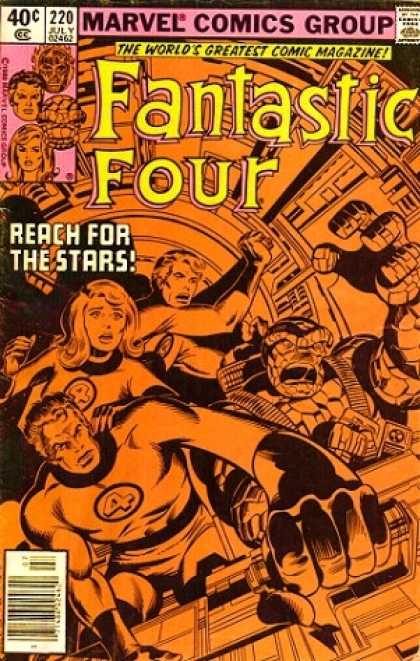
Fantastic Four #220 (1980) One of the early "all-Byrne" issues, 220 has a dramatic red and black (and pink and yellow and white) cover. Very undramatic storytelling from Byrne does little to enhance a plot about a mysterious alien invasion and crystalline structures, interspersed with slice-of-life vignettes of the first family of superheroes shopping, etc, in the nostalgic Lee-Kirby vein. Questionable highlight: the team flies to the North Pole with a cameo from Byrne creation Guardian, the Canadian superhero.
Fantastic Four #224 (1980) The FF go back to the North Pole and encounter more crystals housing a lost city of vikings, in a horrible story by Doug Moench illustrated in a boring pedestrian post-Adams style by a young Bill Sienkiewicz.
Marvel Two-in-One King-Size Annual #3 (1978) An epic issue of the Thing team-up title guest-starring "The Man Called Nova" in another bland story (plot and dialogue by Marv Wolfman) about an alien invasion. Lots of repetition in this Hoard. The art is by the majestic Sal Buscema, one of my favourite oddball 70s artists. His weirdness is kind of damped down here, unfortunately due to the uninspiring material and deadline, I'm sure. Some nice green aliens and women with pointy breasts (not as banana-shaped and pointy as Infantino breasts, though). Sal cranked-out 33 pages of layouts for this annual which were then inked without love by Dave Hunt and Frank Giacoia. I thought I would like this the most, but it's kind of a disappointing waste.
Tuesday, September 23, 2008
Superboy Fan Letters Will Blow Your Mind
I accidentally left a copy of Superboy #185, a giant-size 100 page anthology comic from 1972, lying on the kitchen table earlier tonight. For some reason, Kara picked it up and started thumbing through it. I came across her several minutes later. She was sitting abjectly, in something resembling a catatonic state, the letters page from the issue open before her. The cause of her apparent stroke? A letter from Gary Skinner of Columbus, Ohio:
Dear Mr. Bridwell,
It may be a whole year before I can regain my honor, but I have new evidence which will at least allow us to share the blame, with neither of us the loser. The subject is my letter in the Giant Superboy #174. I knew darn well that more had been done to the Kents in the story of their deaths than the elimination of their glasses and the altering of their hair color. They were definitely changed to look more youthful and the change was an artistic one. I looked through the original story in Superman #161, and the difference was there, miniscule though it was. In the reprint, the Kents' necks had been redrawn to be slim, whereas the original had portrayed them as old people with husky, fat necks. I lose in my assumption that Al Plastino himself had redrawn the, but you lose also , because in rejuvenating them, you definitely redrew them, as I maintained. I am exonerated.
By the way, you blew something else on the same letter page. You are supposed to be the authority on the Superman family and all details thereof, but you forgot something concerning the the enlarging of Kandor. Although I cannot quote the magazine or issue from which I got my information, I recall that Brainiac built his shrinking ray in a special way, in combination with his own design of enlarging ray. Such are the conditions that only Brainiac's own ray can enlarge the city to normal without side-effects. Superman himself hasn't been able to duplicate that ray exactly, and even though Brainiac has been disassembled, so sophisticated a computer was he that the memories within his brain are locked there in defiance of any probing ray that might try to extract them. The secret is his alone, and until Superman can get around that little obstacle, the city of Kandor will be dinky as ever. Too bad.
I guess I've henpecked you enough for one day. And at the risk of sounding sarcastic, keep up the good work.
The lesson here is twofold: old Superboy comics have a Kryptonite-like effect on those unfamiliar with the minutiae of the Silver Age mythos and the fannish compulsion to know all. As well, we learn that the fan culture of 1972, as fostered by uber-fan E. Nelson Bridwell, was as vibrant and probing as any in existence today, whether obsessing over the age of Jonathan and Martha Kent --rejuvenated in 1968 (Superboy #145)-- or the nature of Brainiac's nefarious technology.
A final note: Al Plastino lives!
Monday, August 04, 2008
Radio Humour

Is it a Mystery Hoard if there is only one item in the hoard?
I found this magazine in the store around the corner, among an assorted batch of old magazines and newspapers. The owner of the store wanted to give it to me, but I eventually talked him up to $2.
This issue of Radio Craft, dated December 1944, was published and edited by Hugo Gernsback, the so-called "godfather of American science fiction." Gernsback was an early fan of radio and a very early adopter of television, as the cover to this issue attests. The Gernsback-penned cover feature outlines "the technique of a remote controlled robot machine gun," designed to address "the desire of all military authorities of the belligerent armies to conserve human life as much as possible" --this in the middle of WWII! The great cover graphic is perhaps one of the first visual representations of a video game precursor (or is it drone warfare?).
This issue also includes several how-to articles written for the radio hobbyist and professional, with special attention given to military issues. There are many wiring and circuit diagrams that confound me.

The best feature of the magazine, from my point of view, are the two radio-themed cartoons by Frank Beaven, a New Yorker and Humorama contributor and sometime writer. Both cartoons manage to ring fairly lame changes on rather trite stock situations from the cartoonists' gag bag. The first cartoon, showcasing the standard offensively racist "captured by African natives" scenario, is delightfully obscure. Adding to the wonder, the gag is credited to Ed Marles of Chilliwack, BC --making this entry eligible for inclusion in the Canadian Comic Fan Project.

The rest of this issue of Radio Craft is filled out with some wonderful Second World War ads with excellent illustrations, like the inside-front-cover ad for the first cell phone that paints a hellish picture of war by throwing in everything but the kitchen sink and stars a Henry-Fonda-type dogface GI barking into one of those great old Motorola walkie-talkies. The second ad, hawking the Echophone EC-1 radio, is a highly-stylized episode in the adventures of Hogarth, the pop-eyed radio nerd and Echophone spokes-cartoon. World War Two was really a golden age!

Thursday, June 26, 2008
Super Mom
by BK Munn
In honour of the 70th anniversary of the appearance of the Superman character in comic books, Mystery Hoard presents the first in a series of reflections on the Superman influence in comics.
"Richie Rich, the Poor Little Rich Boy in Super Mom"
Richie Rich Millions #45
January 1971

I bought this comic as part of a small Mystery Hoard at a local antique mall. Antique malls are an interesting source of Hoards --it is rare to find a large selection of comics in such places. Rather, small collections are usually offered by individual dealers, as found, more or less in the beat up, random state they were discovered at an estate sale or auction. I suspect this is the situation under which I found a small selection of Harvey Comics titles recently, as I browsed through the mall, with one eye peeled for old Little Dot comics. The Dot comics were intended as a joke birthday gift for a relative who had fond memories of the character from childhood. Imagine my pleasure, then, when I discovered this collection, which contained among other things an issue of Little Dot's Uncles and Aunts. As well, the collection contained this issue of Richie Rich Millions, featuring the titular character and a hodgepodge of his fellow Harvey "stars" like Little Lotta, Dot, and Wendy, the Good Little Witch.
Every Richie Rich story is the story of hyper-capitalism gone wrong. Richie, "the poor little rich boy," is the freakish, hypercephalic hero of a fantasy world that combines the kid adventure scenarios of Little Lulu and Casper with a nightmarish, Dick Sprang-like parody of Scrooge McDuck-style wealth. In Richie's world, people fly around in solid gold helicopters and eat off of disposable dishes made of giant diamonds. Parodied successfully in Dan Clowes' wonderful "Playful Obsession" strip of some years back, these stories represent a childish or pre-capitalist conception of wealth and power: the child reader for whom 25 cents represents a small fortune sees in the "money to burn" universe of Richie Rich a reflection of their own dream of mobility, power and adulthood.

"Super Mom" is a typical Richie Rich outing in that it involves the core members of the Rich clan, including Richie's father and mother (missing is the family butler Cadbury) in a short adventure that takes place in the Rich mansion. The story combines the standard Richie Rich plot device of staggering displays of cartoon wealth with a minor mystery and a punchline "payoff", also involving a joke on wealth or money. Where this story deviates from the norm is in its Oedipal theme and in the presence of the superhero plot device.
Richie's opening salutation to his mother, who is clad in a supergirl costume for a costume party, reads like dialog out of an adult film and we can't help but notice along with Richie, perhaps for the first time, that the voluptuous curves of Mrs. Rich do seem to lend themselves to the wearing of superhero tights (and that Richie's thick-ankled go-go boots look much more fetching on a woman). Nor can we help but notice the impish glee Richie evinces at the sight of his mother's rapidly retreating, yet still magnificent, blue bikini-clad buttocks.

While the creepiness of Richie Rich is legendary, the sexual aspect of the character is the least often acknowledged, although the obvious phallic nature of his monumental obsessions and his overcompensating, moronic displays of wealth and gestures of charity all combine to form a picture of Freudian perversion.

The essential plot of "Super Mom" is similar to typical mystery stories involving iterations of the classic Superman and Superboy characters. Very often, members of the Superman family would develop superpowers or engage in what appear to be superheroic feats, only to have the hero figure out that there is a completely logical explanation. Thus, Ma Kent might be compelled to act as a costumed bankrobber until Superboy figures out she is being controlled by gangsters, etc. In a sense, this Scooby-Doo style plot is the basic premise of most children's mystery comics.

Although Richie was to appear as a superhero in later adventures, this seems to be the only instance of his mother exhibiting super-powers. Her abilities are never mentioned again, even after, in the story's denouement, it is revealed that she has developed super-strength through the constant, life-long wearing of heavy jewelry (were children ever amused by this?).
In honour of the 70th anniversary of the appearance of the Superman character in comic books, Mystery Hoard presents the first in a series of reflections on the Superman influence in comics.
"Richie Rich, the Poor Little Rich Boy in Super Mom"
Richie Rich Millions #45
January 1971

I bought this comic as part of a small Mystery Hoard at a local antique mall. Antique malls are an interesting source of Hoards --it is rare to find a large selection of comics in such places. Rather, small collections are usually offered by individual dealers, as found, more or less in the beat up, random state they were discovered at an estate sale or auction. I suspect this is the situation under which I found a small selection of Harvey Comics titles recently, as I browsed through the mall, with one eye peeled for old Little Dot comics. The Dot comics were intended as a joke birthday gift for a relative who had fond memories of the character from childhood. Imagine my pleasure, then, when I discovered this collection, which contained among other things an issue of Little Dot's Uncles and Aunts. As well, the collection contained this issue of Richie Rich Millions, featuring the titular character and a hodgepodge of his fellow Harvey "stars" like Little Lotta, Dot, and Wendy, the Good Little Witch.
Every Richie Rich story is the story of hyper-capitalism gone wrong. Richie, "the poor little rich boy," is the freakish, hypercephalic hero of a fantasy world that combines the kid adventure scenarios of Little Lulu and Casper with a nightmarish, Dick Sprang-like parody of Scrooge McDuck-style wealth. In Richie's world, people fly around in solid gold helicopters and eat off of disposable dishes made of giant diamonds. Parodied successfully in Dan Clowes' wonderful "Playful Obsession" strip of some years back, these stories represent a childish or pre-capitalist conception of wealth and power: the child reader for whom 25 cents represents a small fortune sees in the "money to burn" universe of Richie Rich a reflection of their own dream of mobility, power and adulthood.

"Super Mom" is a typical Richie Rich outing in that it involves the core members of the Rich clan, including Richie's father and mother (missing is the family butler Cadbury) in a short adventure that takes place in the Rich mansion. The story combines the standard Richie Rich plot device of staggering displays of cartoon wealth with a minor mystery and a punchline "payoff", also involving a joke on wealth or money. Where this story deviates from the norm is in its Oedipal theme and in the presence of the superhero plot device.
Richie's opening salutation to his mother, who is clad in a supergirl costume for a costume party, reads like dialog out of an adult film and we can't help but notice along with Richie, perhaps for the first time, that the voluptuous curves of Mrs. Rich do seem to lend themselves to the wearing of superhero tights (and that Richie's thick-ankled go-go boots look much more fetching on a woman). Nor can we help but notice the impish glee Richie evinces at the sight of his mother's rapidly retreating, yet still magnificent, blue bikini-clad buttocks.

While the creepiness of Richie Rich is legendary, the sexual aspect of the character is the least often acknowledged, although the obvious phallic nature of his monumental obsessions and his overcompensating, moronic displays of wealth and gestures of charity all combine to form a picture of Freudian perversion.

The essential plot of "Super Mom" is similar to typical mystery stories involving iterations of the classic Superman and Superboy characters. Very often, members of the Superman family would develop superpowers or engage in what appear to be superheroic feats, only to have the hero figure out that there is a completely logical explanation. Thus, Ma Kent might be compelled to act as a costumed bankrobber until Superboy figures out she is being controlled by gangsters, etc. In a sense, this Scooby-Doo style plot is the basic premise of most children's mystery comics.

Although Richie was to appear as a superhero in later adventures, this seems to be the only instance of his mother exhibiting super-powers. Her abilities are never mentioned again, even after, in the story's denouement, it is revealed that she has developed super-strength through the constant, life-long wearing of heavy jewelry (were children ever amused by this?).
Wednesday, March 26, 2008
Friday, March 07, 2008
Mystery Hoard: Walter Trier


Walter Trier (1890-1951)
Trier was born in Prague but moved to Munich in 1909. He contributed to the German humour and cartoon magazines of the day (especially Kladderadatsch and the left-wing Simplicissimus ) and was equally at home as a caustic satirist and cartoonist and an illustrator of children's stories. His opposition to the Nazi regime led him to flee Germany, finally settling in England (where he produced anti-German propaganda) before emigrating to Canada in the late-40s.
Trier contributed to publications in the UK (Lilliput), Canada and the USA (including many New Yorker covers). A huge talent.
Trier has several pieces (a large archive actually, including many of his sculptures and children's toys) in the permanent collection of the AGO.
You can see some of it here.
I found this old peanut butter jar, capped with a Trier illustration, at an antique shop around the corner from our store. It cost $3.
Tuesday, March 04, 2008
Mystery Hoard: 1940s Comics Used as Insulation
This is a fascinating article about a mystery hoard of old paper found in the walls of an building in Grand Bend, Ontario.
I love these kinds of stories. Even more, I would love to have more details about these mysterious "comics" that were exposed. As a collector of paper ephemera and old comic strips and comic books, my curiosity is quite agitated. When we moved into our current house, we found some old paper in the crawlspace of the attic. The former owner had worked for the local cab company and there was taxi ephemera, timetables and worksheets, and, most disturbingly, a tiny crutch once used by a child. Not a such a great haul.
As the boards and nails are pulled from the walls, Bill and Bram Steele were amazed to find the treasures in what was once the Statton home, and Kay’s Do Drop In, main street, Grand Bend.
As the father and son renovate the building to expand BJs Diner, they could not believe how this building was insulted. Valentine cards to Marilyn Statton and stacks of London Free Press 1947-1948 kept the heat in to this small family home. The cards are as clean and pristine as they were 60 years ago. "To Marilyn Statton from Carol Gill" reads one card.
Bram was amazed as he went through the pages of the newspapers and comics the colour as vibrant as it was six decades ago. The first news paper he took out of the wall had a front page story entitled "Grand Bend buys fire truck unit." It was dated Feb 23, 1948.
I love these kinds of stories. Even more, I would love to have more details about these mysterious "comics" that were exposed. As a collector of paper ephemera and old comic strips and comic books, my curiosity is quite agitated. When we moved into our current house, we found some old paper in the crawlspace of the attic. The former owner had worked for the local cab company and there was taxi ephemera, timetables and worksheets, and, most disturbingly, a tiny crutch once used by a child. Not a such a great haul.
Subscribe to:
Posts (Atom)