Showing posts with label superheroes. Show all posts

Saturday, June 29, 2024

Graphic Novel Review: The Man from R.I.V.E.R.D.A.L.E.


The Man from R.I.V.E.R.D.A.L.E. (Archie Comics Presents)

by Frank Doyle, Bob White, Bill Vigoda, and Dan DeCarlo
(Archie Comics, 2019)

review by BK Munn

I read the shit out of this! Which is to say, I read these 19 collected stories from 1966 and 1967 over the course of 19 meditative bowel movements. I'd read many of these randomly in various period Archie titles and reprinted in Archie Digest form over the years, but it's nice having these in one compact, manga-sized volume. The stories are, I think, almost entirely written by Archie workhorse Frank Doyle and mostly all drawn by signature artist Bob White, although there are a couple by Dan DeCarlo and Bill Vigoda thrown into the mix. The concept is a Man from U.N.C.L.E. parody mashed-up with the superhero craze, with all of the villains having costumes and superpowers (the most grotesque of these is The Whistler, whose mouth and lips are permanently pursed and shaped like a bottle-sized whistle). In the first story, Veronica and Reggie are bad guys, Jughead and Archie are the good agents, and Betty and Pop are completely oblivious to the fact their best friends are engaged in a hot Cold War in the soda shoppe and elsewhere, but this soon changes and the whole gang (with the exception of Pop, whose store is their headquarters) are members of P.O.P. for the rest of the series. Goofy, gadget-crazy fun, enjoyable in small doses.

Thursday, April 11, 2024

R.I.P. Trina Robbins

(Communist dinner table panel from the adaptation of the 1927 novel "Red Love" by Alexandra Kollantai, serialized in Renegade Romance #1-2, 1987.)


by BK Munn

This Trina Robbins dinner table panel sums up every meal my wife and I ever share! R.I.P. Trina Robbins (1938-2024). The great feminist cartoonist and historian broke through into the pantheon with her underground classic It Ain't Me Babe and created the first comic featuring an "out" lesbian in "Sandy Comes Out" in Wimmen's Comix #1. She designed the character Vampirella and was the first woman to draw Wonder Woman for DC Comics. She was such a revolutionary she was actually featured in the first verse of Joni Mitchell's "Ladies of the Canyon." She was a fashion designer, an editor, a muse, a leader, and organizer. Trina herself was a tireless and groundbreaking researcher and comics historian, responsible for a seemingly endless series of history books that studied and popularized the careers of women in comics dating back to the 1800s. She was an amazing spirit and had a legendary life! Rest in Power, Trina!

As a preteen kid, I first encountered her through a page in Les Daniels' history book Comix (found in the Public Library) which reprinted a collaborative comic with her then-partner Kim Deitch announcing the birth of their daughter. One of Trina's panels on that page depicted a who's who of famous women superheroes, alongside Trina's own creation, the half-woman/half-cat Panthera, who tantalizingly went about topless. The first whole comics story I read was her adaptation of Sax Rohmer's "Dope" in the pages of Eclipse Monthly circa 1983. I've collected her comics ever since as well as her history books which have made an immeasurable impact on my understanding of comics history and my knowledge of women cartoonists, and one of the pillars of my own ongoing Comics Canon project. 


Friday, April 05, 2024

Comics in Film: Super Gal in "Ensign Pulver" (1964)


Comics in Film: Super Gal nose art in "Ensign Pulver" (1964).

by BK Munn

The character of Supergirl, the cousin of Superman, was first introduced in Action Comics #252 in May, 1959, but it is unknown if this image is intended as a reference to the comic book character or is just an ironic gender flip of Superman typical of the humour exhibited by the artists who painted plane fuselages during World War II. If an intended reference, the image is an anachronism, since Ensign Pulver is set in the 1940s. In the film, a sequel to the 1955 John Ford-directed film Mister Roberts, a planeload of nurses lands on a Pacific atoll and become wound up in the redemption arc of the title character, heroically helping him perform an important operation. (The sequel retains the same characters but replaces all the actors. Jack Lemmon won the Oscar for his portrayal of Ensign Pulver in the original, but he's replaced here by relative unknown Robert Walker Jr.) There was a comic book adaptation of Ensign Pulver, published by Dell in 1964, but I'm unsure if the "Super Gal" art was reproduced there.

Friday, April 28, 2023

Close Shaves in the Comics, Part 2: Storm Gets a Mohawk!

 by BK Munn


Now it can be told: the terrifying tale of talcum, tufts, and trimming that is shaving in the comics!

Let's talk about some of the most famous and important shaves in the history of comics.

2. Uncanny X-Men #173. Storm gets a mohawk!

This was the shave that shook all mutantkind! 

Never had a shave had such shocking ramifications for a character in a superhero comic, let alone a woman character! 

Storm was a groundbreaking character: one of the first prominent characters of African descent in U.S. comics, and one of the most powerful woman characters in the Marvel Universe. Storm was born Ororo Munroe, the daughter of a Kenyan princess and an African-American photographer, and raised on the streets of Harlem and Cairo, Egypt before assuming the mantle of an African weather goddess when her mutant powers manifested. When she is first introduced in comic books, in Giant Size X-Men #1, created by writer Len Wein and artist Dave Cockrum, she is depicted as serene royalty. Her superhero costume includes a cape, and her trademark regal hairstyle is a mane of shockingly white, long, flowing hair, accessorized with a crown-like tiara. Storm quickly established herself as one of the most powerful X-Men as well as a gentle voice of reason, a leader, a teacher, and a mentor to student mutants at Xavier's School for Gifted Youngsters, the secret headquarters of The X-Men. Her beauty, highlighted by the contrast between her black skin and white hair, set her apart from the other, decidedly less-glamorous mutants. 

But all this changed in 1983's X-Men #173, "To Have and Have Not!"

After spending a week in Japan in the company of Wolverine's crazy mutant ninja girlfriend Yukio, Ororo finds herself revelling in the down-and-dirty violence that is Yukio's specialty. After using a lightning bolt to knock out a Yakuza thug, Storm notes, "I have never used my powers to deliberately inflict pain." She concludes, "This madness of yours has infected me ---I welcome it!"

Cut to a week later, and the arrival of the rest of the X-Men for Wolverine's wedding. Storm makes one of the most dramatic reveals in X-Men history, debuting her all-leather street punk uniform, topped off by a spectacular feathery mohawk hairstyle. Her "new look" is as shocking as a lightning bolt, electrifying her colleagues, and provoking an emotional response.

“Your clothes! Your…hair! What have you done?!” gasps young Kitty Pryde, while Professor Xavier speculates privately whether the change is “indicative of a deeper, more serious metamorphosis.”

The new look does indeed prove to be indicative of big changes in Storm's character. In the issues that follow, she becomes more calculating, aggressive and self-assured, winning a knife-fight against the Morlock leader Callisto and becoming leader of the X-Men even after losing her powers. Originally intended as a joke by the series artist Paul Smith, writer Chris Claremont quickly seized on the implications of the punk look for the character's development.

The change had an effect on the readership as well, galvanizing interest and making Storm a fan favourite. Through the act of shaving most of her head, Storm became a comic book style icon, her punk look shaking up the staid world of superhero comics and making radical change one of the hallmarks of Reagan 80s Marvel, heralding the new wave of team shake-ups, costume and character redesigns, and universe-rattling crises and secret wars. Her leather uniform also created a template for more "realistic" superhero costuming, especially in film design.


Saturday, February 11, 2023

SPLIT-FACE vs. TWO-FACE: A TALE OF TWO VILLAINS FROM BATMAN AND DICK TRACY

Just saw the first Dick Tracy movie (1945) on TCM. The villain is Split-Face, played by the great Mike Mazurki. He's a new creation for the movie, not from the comic strip, created by the screenwriter Eric Taylor, author of many B-movie crime pictures. The Batman villain Two-Face debuted in 1942. In a shocking twist, it looks like Dick Tracy is taking a page from Batman. In another shocking twist, Bob Kane is actually credited with his creation (although Bill Finger of course wrote the first appearance in Detective Comics #66). In a twist that will surprise nobody, Kane stole the idea for Two-Face from this poster for the 1941 Dr. Jekyll and Mr. Hyde starring Spencer Tracy


Thursday, September 15, 2022

Mr. Freedom, Directed by William Klein


by BK Munn

R.I.P. William Klein (1926-2022), the expatriate American painter, photographer, and film director who created one of the more notable superhero films of the 1960s, Mr. Freedom. Known for his groundbreaking and award-winning street and fashion photography, the New York-born Klein spent most of his adult life in France, where he also directed tv commercials. Mr. Freedom is an absurdist satire on superheroes and U.S. imperialism that stars another expat, John Abbey, as the titular hero, a fascistic brute who is a clear predecessor to comic book characters like Judge Dredd, Marshall Law, and The Comedian.

The plot of the film has Dr. Freedom (Donald Pleasance) sending Mr. Freedom to France to stop the slide of the "crybaby" French culture into Communism and to investigate the death of French superhero Capt. Formidable (Yves Montand). The film was shot in France with mostly French actors (including Serge Gainsburg and the sublime Delphine Seyrig), although everyone speaks only English throughout. The film has many of the hallmarks of 1960s action and spy films (James Bond and its imitators) but despite it's dumb sub-Get Smart/Batman style plot and Saturday morning/comic book dialogue, it has many striking images and scenes, all shot in a primary colour, pop art style. Director Klein was knowledgeable about comics (he mentions his familiarity with Krazy Kat in one interview I've seen), and also produced a fumetti version of Mr. Freedom using stills from the film to promote it, pictured here. Famously, it has been called “conceivably the most anti-American movie ever made.” It's a beautiful thing!


Thursday, November 11, 2021

Funky is 50!

50 years ago today, the first appearance of Funky Flashman. Funky was Jack Kirby's thinly-veiled parody of his old boss Stan Lee. Kirby had just spent a decade working under Lee at Marvel Comics, having Lee take the writing pay and credit for all the characters and stories Kirby wrote and drew. Before Kirby started working for Lee, Lee was known, if he was known at all, for writing a handful of humour titles at his cousin's comic book company. After Kirby arrived, Lee began applying his gift for chatty dialogue and self-promotion to the line of superhero comics Kirby created, and the rest is history. When Kirby left Marvel to create his New Gods series of titles for DC in 1970, he took with him 10 years of resentment that he poured into the darkly humourous portrait of Funky and Funky's manservant House Roy, a parody of Stan Lee's real life assistant (and current Stan Lee apologist and hagiographer) Roy Thomas. Kirby only used the character once, but the nicknames stuck among fans and comics historians, and other creators revived Funky, off and on, most notably for the aptly-named Secret Society of Supervillains later in the 1970s. Panels from Mr. Miracle #6, published November 11, 1971, written and drawn by Jack Kirby.


Monday, February 01, 2021

What Was the Best Comic of 1961?


by BK Munn

I've seen some press for an upcoming repackaging of Jack Kirby's Fantastic Four #1, the comic book that arguably launched the Marvel brand of superheroes. The new book tries to place FF1 in its historical context by reprinting it alongside the other Marvel/Atlas comics that were published in the same month, presumably to show what a major departure the title was. Of course, comics historians who have studied the period know that the Fantastic Four is not really a major departure for Kirby, being an extension and articulation of several themes from his previous superhero, science fiction, and romance comics work. Far from being revolutionary, there's a case to be made that the Fantastic Four isn't even the most interesting comic book Kirby himself created that year! Sure, its importance in paving the way for the revival of superheroes at Marvel can't be understated, but most would agree it's not the greatest comic book, even for a kids' comic, and it would be awhile before the title of "World's Greatest Comic Magazine" would even be remotely applicable. Which leads me to ask, what was the best comic of 1961?

In the sphere of U.S. children's comic books, there were many contenders in 1961. Dell published all-time classic stories by John Stanley and Carl Barks (Stanley's "Around the Block with Dunc and Loo" premiered the same month as FF #1), and had many good-looking adventure comics like Tarzan. National was cranking out handsome and entertaining comics drawn by the likes of Curt Swan, Joe Kubert, Alex Toth and Carmine Infantino. Archie had Dan DeCarlo and Harry Lucey. The list goes on.
And what about comics intended for an older or more general audience? There weren't many graphic novels published in 1961 (although there were some), but the world of U.S. magazine and newspaper comic strips was having a banner year. Harvey Kurtzman's Help! magazine was going strong in '61 and you could walk into any bookstore and buy a collection of great comics by immortals like Charles Schulz (Peanuts Every Sunday) and Walt Kelly (Pogo a la Sundae). Any daily newspaper was chock-full of masterful soap opera and adventure storylines by greats like Milt Canniff, Frank Robbins, Harold Gray, Chester Gould, and many more. Johnny Hart's "B.C." had just started to hit its stride and Jules Feiffer, a graphic novel pioneer, had just published a new collection of his decidedly-adult Village Voice strips, "Boy, Girl, Boy, Girl." And don't forget, Jack Kirby was winding up his "Sky Masters" sci-fi strip at the same time as FF#1 was hitting the stands.
Looking further afield, Franco-Belgian comics were having a good year. The first Asterix album by Goscinny & Uderzo came out in 1961. Herge was serializing masterwork "The Castafiore Emerald" in his Tintin magazine, having just released the sublime children's classic "Tintin in Tibet" the previous year. Franquin had put out a new Spirou: "Z comme Zorglub." There were also a ton of lush adventure strip albums by the likes of Uderzo, Jijé (assisted by Jean Giraud), Jean Graton, and others. Elsewhere, Argentine artists like Alberto Breccia, Solano Lopez, and Hugo Pratt were breaking new ground in work for various UK and Spanish-language publishers. In Japan, the gekiga movement was underway, with Yoshihiro Tatsumi creating gritty noirish manga in a new style. Hideko Mizuno published her breakthrough shojo manga “Gin no habira” (Silver Petals), Leiji Matsumoto published his first sci-fi epic, "Denko Ozma," and among many other things Tezuka published his "Captain Ozma" (no relation!) in 1961.

Wednesday, August 19, 2020

The First Use of Multiverse in Comics?

Notes on "The Multiverse, Part1"

Parallel worlds, counter-Earths, and alternate dimensions have been with us in the comic books almost from the outset. In the world of DC Comics, Wonder Woman encountered a parallel world as far back as 1953 in "Wonder Woman's Invisible Twin" (WW #59), and The Flash famously introduced the concept of Earth-2 and jump-started the DC multiverse with "The Flash of Two Worlds" in 1961 (Flash #123). But when did the phrase "multiverse" first get applied to the infinite number of parallel worlds inhabited by the superhero characters of Marvel and DC?


I imagined the first use of multiverse in the comics would have happened in one of the many Justice League/Justice Society team-ups that took place every year in the pages of The Justice League of America comic book, but reading through these "Crisis" stories didn't turn up any citations. Ditto for any 1960s Superman stories, so chock-full of imaginary tales, doppelgangers, and parallel worlds.

It seems The Multiverse wasn't really popularized until Michael Moorcock started using it in his Elric stories in the 60s and 70s and it took awhile to filter into comic books. The first DC use I can find is Claw the Unconquered #7 (cover-dated May-June 1976), "The People of the Maelstrom", written by David Michelinie and drawn by Ernie Chan. 

Claw #7

Over at Marvel, I couldn't find a reference until What If #10. "What If ... Jane Foster Had Found the Hammer of Thor?" (1978), written by Don Glut with art by  Rick Hoburg. The Watcher opines, "But there are infinite parallel worlds in the multiverse ... countless Earths existing in the same space, but in different dimensions."

What If #10

Thursday, February 13, 2020

Close Shaves in the Comics, Part 1: Shaving Subby!

by BK Munn

Now it can be told: the terrifying tale of talcum, tufts, and trimming that is shaving in the comics!


Let's talk about some of the most famous and important shaves in the history of comics.


1.  Fantastic Four #4, 1962. The Human Torch shaves The Submariner. 


This has got to be the most electrifying shave of them all! It's an historic shave. It's a shocking shave. It's a shave unique in the history of all media! This is the shave that launched the Silver Age of Comics in the USA! How was it done? What is the science of the thing? What kind of genius mind could invent such a shaving sequence that gives such delight? Only Jack Kirby, The King of Comics,  could have conceived of such a shave.


Just after Jack and Stan reinvigorated American superhero comics with their Fantastic Four, they reintroduced a character from Marvel's 1940s heyday, Prince Namor, The Submariner of Atlantis. Back in the Golden Age, The Submariner (created by Bill Everett) and The Human Torch (created by Carl Burgos) were arch-enemies, constantly fighting each other in the pages of each other's comic books throughout WWII. Fire and water don't mix, and the two characters were a perfect match. Jump forward almost 20 years, and both were almost forgotten. The Human Torch was revived as a totally new character, the teenage hothead Johnny Storm, kid brother of The Invisible Girl, and youngest member of The Fantastic Four. 


In this issue, Johnny wanders into the Bowery district of New York City and encounters a superstrong bearded hobo who looks vaguely familiar. After a quick shave and a dip in the East River, The Submariner is reborn! Having lost his memory, Prince Namor has been living as a Bowery Bum for years, among the other lost men. Once he regains his senses, the mutant Namor renews his war against the humans of the surface world, with a special hate-on for The Fantastic Four (partly because he falls in love with Johnny's sister, Sue, a big problem for her boyfriend and leader of the FF, Reed "Mr. Fantastic" Richards). This great story re-launches Namor as one of the major antiheroes of the comics, a key figure spanning two eras of Marvel history, a liminal figure with one foot in the past and another in the science fiction future.


And look at those panels! Kirby's superhero work is full of action and violence, with tons of jumping, flying and fighting figures zig-zagging at crazy angles, drawn with dynamic perspective, and most of his Fantastic Four work is just like that. Here we have a sequence of panels that are mesmerizing in their simplicity. The Human Torch, exhibiting great control of his flame power, methodically, almost tenderly, shaves off the beard of the nameless vagrant, revealing the regal, slightly alien face of his namesake's greatest enemy, The Submariner. Shocking! Beautiful! Eerie!


The reintroduction of Subby (and of the Torch, in a way) set a precedent for Marvel, leading to one of the most famous returns in comics when Jack Kirby repeated the trick a few years later and brought back his own character Captain America, found in a block of ice in Avengers #4 (1964). Marvel's competitors at DC had pioneered this sort of gimmick when they revamped some of their second-tier characters in the late-50s, kickstarting the so-called Silver Age of superheroes. These DC characters, while bearing the monickers and abilities of older characters, had new alter-egos and costumes, and were eventually explained as weird echoes of heroes from a parallel dimension, called Earth Two. The artists and writers at both companies had hit on a playful way to rejuvenate stale brands and old intellectual property for a new audience, injecting a bit of science fiction and youth into dusty comic books in a move I'm going to call "Shaving the Submariner"...


Monday, February 10, 2020

Pussy Katnip by Len Short


by BK Munn

Pussy Katnip was a super-powered nightclub singer and detective who appeared in over 20 comic book stories in the 1940s, mostly in anthology funny animal and humour titles published by Fox Feature Syndicate. Created and drawn by cartoonist Len Short (I know nothing about him), Pussy Katnip debuted in 1944. The owner of the Katnip Kafe nightclub, Pussy and her boyfriend, firefighter George the dog, would get involved in solving a mystery or crime in every short story. The villains of the series were local gangsters Boss and Mugsy. The thing that makes the series interesting, besides Len Short's weirdly wonderful art style, is that Pussy got her superpowers from an old family recipe (her family look like witches!) for "Katnip Fizz"!!

When confronted with a problem she cannot solve, she quickly runs to her secret pantry shelf where is concealed a bottle of Katnip Fizz ... brewed in Olden Times by Pussy's ancestors and passed on to each succeeding generation, this potent drink changes her usual shy self into a fighting fury and gives her an insight and intelligence unsurpassed in Feline History!

These two strips are from the comic book Ribtickler #1, 1945.


Sunday, February 09, 2020

Burton Cummings, Comic Book Critic


Superstar rocker Burton Cummings is a big comic book collector, maybe the King of Canadian Comic Book Collectors. He has fond memories of everything from Jimmy Olsen to Little Lulu and Tubby, and doubled down on his pop culture collecting beginning in the 1980s, amassing a giant archive of vinyl records, cds, sports cards, etc. He writes often on the subject on his Facebook page. He also has written a weird fictional(?) story about an older collector living in California who gets ripped off by a femme fatale. I thought it would be interesting to share some of his reflections on collecting DC comics in the 1950s and 1960s when he was a kid in Winnipeg. Here he is writing on Facebook from November, 2019:


COMICS AND MONEY

COMICS…for many of us of a certain age, comics were "that other world". Bear in mind, I'll be 72 on December 31st this year, so I clearly remember life before there was television. We were not an affluent household, so my Mother couldn't afford television immediately when it was first available. For a while, I would go to the Rosh Pina synagogue on Matheson avenue with my friend Arnold Silver or his younger brother Barry, and a bunch of us kids would sit cross legged on the floor, hypnotized by this new "magical" thing called television. The synagogue had one before most of the neighbourhood. Spellbound, we would sit on the floor and be whisked away by Roy Rogers, Range Rider, Lassie, Father Knows Best, Huckleberry Hound, maybe King of the Khyber Rifles, or a host of other early television shows. But before that, at least for me and many other kids, comics were the "release" into the world of fantasy.
There was always a choice between the Marvel family and the DC family. I ALWAYS preferred DC to MARVEL. Don't really know why, but I always did.
DC family included Superman, Batman, Superboy, Action, Adventure, World's Finest (which teamed up Superman with Batman and Robin), Lois Lane, and my personal favourite Jimmy Olsen.
For some reason, the Jimmy Olsen comics struck a chord with me. Maybe it was because he was Superman's pal, and a lot of us young boys could identify with how miraculous that would be if it were one of us.
And the Jimmy Olsen stories seemed more fantastic in many ways. Once in a while, DC would put out a special issue containing "errors" which were purposely placed throughout one of the stories. We were told to spot the errors and write in with our answers. I never "wrote in" but my friend Arnold Silver and I would sit on the steps inside his house on Lansdowne and try to spot all the purposely placed mistakes…(for example, the "S" on Superman's costume might be backward, or Jimmy Olsen's hair might be black instead of red, or the Daily Planet newspaper might have a different name, etc.) We always thought that was so special…
jimmy olsen 108

Pictured here are two comic covers…Action #240, featuring which is perhaps one of my all time favourite covers, with the sphinx having Kryptonite vision. This one was released in May of 1958, so I would have been 10 when it came out. The other one is Jimmy Olsen #108, released in January of 1968. I had just turned 20 at its release date, had been in the Guess Who for a year or so, but I still loved the comics. You'll notice that the price had risen from 10c to 12c, indicating a huge change in the world of "back then".
For me, when the price jumped up to 12c, things never seemed quite the same after that. We had all become so accustomed to 10c being the price, I don't think any of us really liked the change. It was an indication that our world was not immune to disruptive change.
These two covers illustrate the beauty that we all found in these thin paper books. The artwork was always superbly drawn and DC had quite a following on a world wide basis.
Much later in the 1980's, I began collecting comics obsessively, almost getting carried away at times, but I still held on to boxes full of the ones I had bought as a kid. Today, the comic collecting world has, in some ways, become tarnished and corrupted by the money. Recently some musician paid over 2 million dollars for an Action #1, which contains the first appearance ever of Superman. 2 million for a ten cent comic…astounding…but then again, think of it for a minute…people have been known to pay far more than that for a tiny postage stamp or a single coin. The old adage rings true…"something is genuinely worth whatever someone is willing to pay for it". How true. I would never succumb to the phrase that money is the root of all evil, but it certainly has changed things…sports is a good example.
The Huston Astros recently invested 500 million dollars to acquire three pitchers…500 million !!!
And it didn't even help them win the world series against the Washington Nationals…oh well…
Mickey Mantle made $100,000 a season from 1963 to 1968 and he was one hell of a player…when Rocket Richard first signed with the Montreal Canadiens, he was paid $5,000 for a season…today there are hockey players signing contracts for upwards of ten million and more…as Bob Dylan so eloquently put it
"for the times, they are a-changin'"...
Money certainly has changed through my lifetime. The Beatles sold out Shea Stadium and were paid a lump sum of $50,000…Taylor Swift did a stadium tour not long ago which grossed $266 Million…yikes…I'll bet she has her car and fridge paid off by now.
We live in a strange world now, compared to the world I was raised in, all those years ago on Lansdowne Ave. in the North end of Winnipeg. I'm seriously grateful still to be alive and fairly healthy, able to go out and do one man shows for seriously appreciative audiences.
But when I gaze at the two comic book covers pictured below, part of me yearns wholeheartedly for those days of yesteryear…
Hang on to your memories, folks. No one can ever take those away from you.
They're worth far more than all the money that's ever printed…
Luck and Health…
BLC

Tuesday, January 21, 2020

Kirby and Unions: Captain America Comics #4, 1941


UNHOLY LEGION


Here's an interesting sequence from a very early issue of Captain America where Jack Kirby posits a union leader as a bastion of democracy. I've noted before some of Kirby's post-War quotes on unions and the idea of a comics creator Guild, where he seems lukewarm on the subject, to say the least. But here we have an instance of the pre-War Kirby pointing to unionized labor as an important pillar of the anti-fascist fight against Nazis. The story is a great one, wherein Cap and Bucky uncover a Nazi spy and saboteur ring that disguise themselves as beggars. The very atmospheric discovery scene, where the two heroes witness a legless beggar on a dark street suddenly get up and walk in answer to a bell ringing inside the old city hall where the spies gather to unveil themselves in a secret ceremony, is brilliantly grotesque. I wonder if the politics here are entirely Kirby's or influenced partly by Joe Simon? 1941 was a record year for strikes in the U.S. and the left was divided on Roosevelt's efforts to keep a lid on labour troubles. We can see here that not only were the early Caps advocating for what Howard Chaykin's Blackhawk referred to as "premature antifascism" in reference to advocating for American intervention or aid in the war against Germany, but in this instance at least we see Simon and Kirby creating propaganda of a sort for the idea of a post-Depression "labour truce" in the name of the soon-to-come war effort.

The image up top is Kirby's reimagining of the Unholy Legion for the 1960s Captain America #112, a quarter century later.


"In a nearby state tragedy strikes John L. Green, nationally known labor leader. 'And I say again, Labor must unite to advance our defense program.'"


Thursday, January 09, 2020

Article on the 1973 DC Original Art Heist


Great investigative article from a 1974 fanzine about the massive theft of (never recovered) original art work from the DC comics offices that took place during the move to the new Warner Bros offices in 1973. Tons of Jack Kirby and Neal Adams art went missing and was dumped into the collectors market during a period when the publisher's legal department was very concerned about keeping original art for copyright reasons, and long before DC changed its policy and started returning art to creators in 1978. (Thanks to Patrick Ford for posting the transcription on Facebook.)


SUPERHEIST: 
The Great Comic Book Rip-Off

By Joe Brancatelli

(Inside Comics #1 - 1974)


My first visit to a comic book house came when I was about 10 years old. When National produced comics from their 575 Lexington Avenue offices, they'd hold organized tours of their operations every Wednesday afternoon. As a dutiful comic book fan, I gathered several friends and traveled all the way to manhattan. There we were, four gawky kids from Brooklyn - smack in the middle of the country's largest comic book house.


A balding man (who I now believe was a harassed-looking Julie Schwartz) took us all on a grand tour. We passed writers and colorists and artists and letterers. Kids asked silly questions - about go-go checks or Johnny DC or something. I remember one kid asking why someone had penciled a bra on the nude girl in the Playboy calendar. During the tour, National gave things away. Color slides of comic book covers, Batman and Penguin posters, comic books, and dozens of other trinkets. And they even gave away original art work. Everybody got a free page.
Everyone except my friend, Kevin Cadger. He got ten pages because he didn't get any Batman posters.
That's why it came as no surprise when word leaked out that over 1900 pages of original art had disappeared from national's files. After all the years of giving it away, or throwing it out, or shredding it up, someone's finally lifted 1900 pages and no one was the wiser. At least for a while.
Original comic art pages have always been treated trashily. Companies never bothered to return them. newspaper syndicates did horrendous things to originals before returning them. But mostly no one cared, especially since comic art wasn't particularly valuable.
Then Jerry Bails started the whole fandom thing. the conventions, the fanzines, the newsletters, trading, selling, buying, and the whole spiel. All of a sudden, comic originals were worth something. And that's when the hassles started. Artists wanted their originals back. Knowing they could supplement their income by selling them, many artists resorted to stealing their originals back. In fact, most of the originals on the market in the early 1960's were stolen.
"One thing I can always remember," one now retired artist said,"was how we always had to sneak into Marvel or DC or Charlton or Warren and steal our own stuff back. After a while, it became a game. Everyone knew we were doing it, but they just said, 'Well, that's the way it is' and laughed a little."

A Pocketful of Art

But things changed. In 1970, National stopped general distribution of original artwork, shocking artists and inflating the collectors market.
"We had long discussions with our legal department on the matter." said Sol Harrison, National's vice president and production manager. "They seemed to feel that we should hold on to all our artwork. They were really frightened that if someone had the originals to a complete story, they would run to South America and print it. We had copyrights to protect, and the legal department felt holding the artwork was the best procedure."
National's policy went generally unchallenged and stock accumulated. "We have had thousands of pages around after a years or two," said harrison. "Eventually, we had to get a storage space, but there was still plenty of art around the offices."
And therein lay the danger. Thousands of pages were just sitting around at National's 909 Third Avenue set-up, waiting for some sharp entrepreneur to make his collection. And being part of the vast Warner Communications conglomerate, which also owned Warner Brothers, Seven Arts, Paperback Library, Warner Books, Atlantic, Electra Asylum, and Atco records, among others, National offices were being moved to the warner Communications Building at 75 Rockefeller Center. After several years of planning, the crosstown move was finally begun in the summer of 1973.
"It was just one giant, f***ing madhouse," one national editor said at the time. There were drawing boards, and desks, and stuff all over the place. And artwork was scattered everywhere."
No one at National was Particularly concerned with the art. it was stacked on skids and tied down with bailing wire. No one thought of taking inventory and thousands of pages, worth several thousand dollars on the fan market was unaccounted for. It was being moved from office to office, waiting to be picked up and moved to the new building.
"In retrospect, of course, it was a dumb move." a national production staffer said. "Had Sol known any better, maybe there would have been an in and out inventory. But nobody gave a sh*t. The art went in and out and no one looked twice."
Except for several sharp eyed young staff members. most of them, lower echelon employees, came up through the fan ranks and knew the value of the unattended artwork. They also,apparently, knew which skids contained the best material.
Another collector who bought some of the purloined material agreed. "The plan was simple," he said. Have a friend on the moving crew 'misplace' a flat of artwork. Later, if it was discovered missing, it could easily be found without getting in trouble. If no one noticed it was missing, it was just taken away later."
"Certain staff members had decided to rip-off some of the pages," the collector said. "And it was an inside job."
Naturally, no one ever missed the 'misplaced' skid and it simply disappeared.
Harrison pleaded total ignorance about the circumstances surrounding the theft. "I'm sure this happened during the move of course. We had breakage and different things. So many hands were touching, but these things can happen." he claimed National knew nothing else.
Yet, the question of whether the theft was an inside job was a sore point. "I don't know. I can't say anything." snapped Harrison. "I don't think it's an inside job, so i don't want to say anything at all." But Harrison wasn't interested in saying too much about any facet of the theft.
A national staffer we spoke to assured us that an inventory had been taken. "Right after Sol found out, he had a complete inventory taken. At first we thought thousands of pages were missing. We finally found out that only 1928 pages were gone." Harrison vehemently denied that he had taken an inventory. "We're in the process of taking inventory right now. But we haven't done anything yet. We don't know how many pages were taken yet."
Harrison's reluctance to address himself to the facts of the theft even extended to a description of what was stolen. "We don't know yet what was taken. We've left that up in the air at the moment. We'll know after inventory comes in."
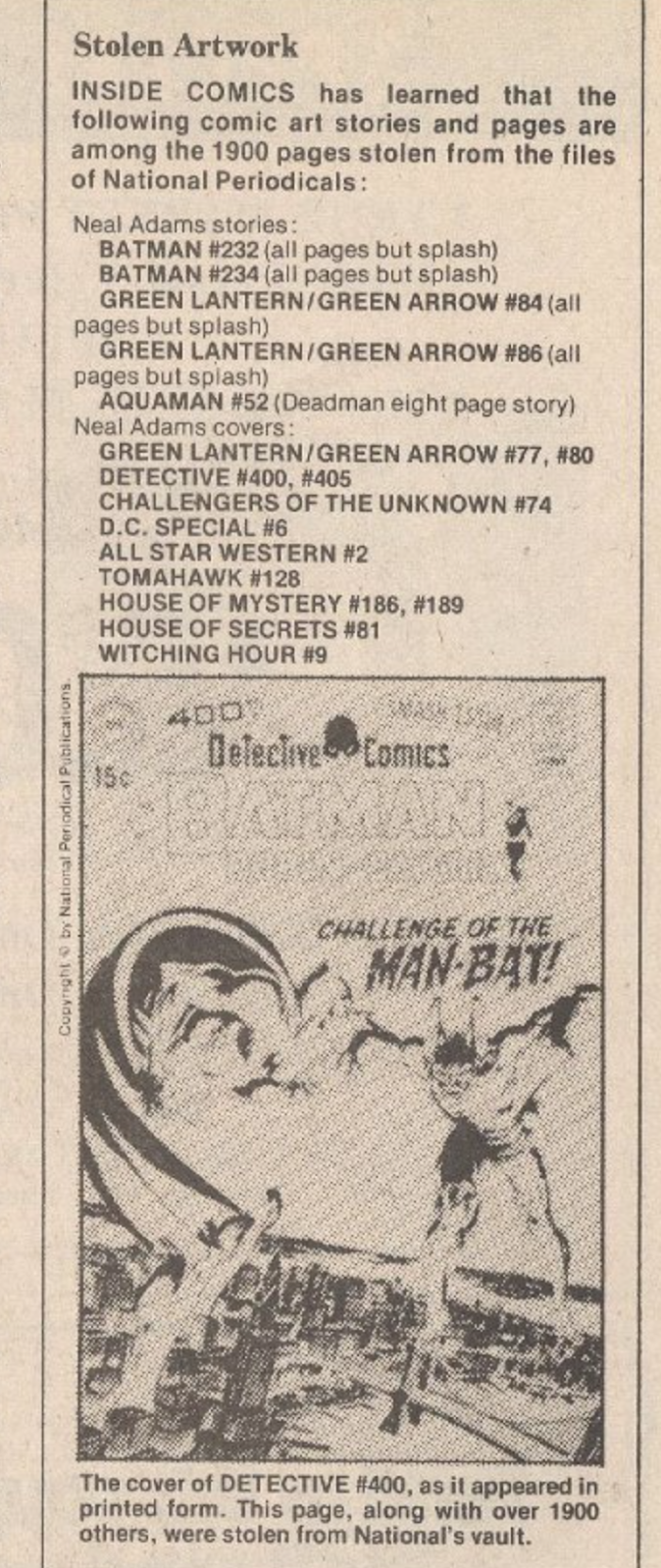
Harrison's production people disagreed, however. According to one staff member, an exact listing of what was stolen has been in circulation for several months. They think that the material will never surface, however. "It's fantastic stuff," one artist said. "I'd like to have some of the material for my own collection. People who buy it may never sell it." Additionally, much of the stolen material was romance pages which are not big sellers and never appear at conventions anyway. [Inside Comics has uncovered a partial listing of the stolen material. See inset elsewhere.]


Wanna Buy Some Hot Pictures?


After the skid of artwork was misplaced, the thief was forced to unload the material quickly. And since there is no known comic fence, he had to take his material to a convention. His first opportunity to sell the artwork was at New York's August Comic Book marketplace. Unfortunately, most of the city's biggest dealers were missing from this particular fanclave. Scheduled only a week before the larger San Diego convention, larger dealers like Phil Seuling, Al Schuster and Bill Morse weren't in attendance.

"That was really a rough break for the seller," said a collector who now owns some of the stolen material. "He was sitting there with 50-60 thousand dollars worth of stuff and the big guys were out of town."

What the thief eventually did was to unload the artwork at any price. Carrying a few sample pages around the Hotel McAlpin's dealer's room (one collector said two Adams detective coves and a Green lantern Green Arrow page was among the batch), he struck a deal with a small time comic art dealer working out of New Jersey.

Another collector who eventually bought several dozen pages of the stolen art claimed that the dealer "Lacked the wherewithal to swing the deal by himself and worked out a deal with a bigger new York dealer." the New Jersey - New York combine bought the 1900 page stack for about $5000. "A value that I would have loved any day." said one New York City collector who heard the price. "Especially since the stuff had to be worth ten or fifteen times what he got."

The dealer who subsequently bought the artwork may have been small, but he was smart. Knowing National would probably try to trace the art, he limited his sales. According to one purchaser, "this dealer wouldn't sell to anyone for speculation purposes. he sold it only to top-notch, highly reputable collectors. He knew that going to big collectors meant the stuff would stand in the closet - in someone's collection."
About a half dozen well known, highly respected collectors eventually purchased the bulk of the choice material for about $20 a page. The seller dumped the pages at this low price to minimize his risk. With dozens of high quality, much desired Neal Adams and Jack Kirby pages in his possession, the dealer sold the pages at a lower-than-normal price in exchange for a relitive measure of security.

"Before he would even let me look at the stuff," a New Jersey collector said, "I had to promise him that I'd keep the stuff for my own collection. Then he brought out the Adams and Kirby and Wrightson and Kaluta stuff. It was unbelievable the stuff he had. His prices were really cheap. So I shut my mouth and bought about 30 pages."

And while he did sell a goodly amount of the pages, had he not brought the material to san Diego, national might have never discovered the theft.


Better Late Than Never
One of the other guests at the San Diego convention was none other than Sol Harrison. Even though several weeks had passed since the material was purloined, harrison was still unaware of the theft.
"Everything was incredibly hectic during the move," Harrison said. "I was mainly concerned with the orderly transition of the office. Who thought we would have such a chunk stolen?"
Harrison didn't find out about the theft until he happened to drop by the convention's auction. On display for bidding was a Neal Adams drawing for a House of Mystery cover.
Sol told me it was the first time he realized something was fishy," one of his assistance said later. "He just knew that page should have been in the office. That's when Sol finally realized stuff was missing."
returning to his office the next week, Harrison initiated an inventory. he also called in a professional security team to investigate the theft. "It just so happens that Warner Communications now owns a security outfit," said Harrison, "and I had no qualms about going to them. I told them, 'Listen, this stuff is missing, and we want it all back'."
Unfortunately for Harrison and National, the security outfit turned up very little. the dealer had been so careful in selling the material, most of it was buried in private collections.
"The only way i am going to give up my stuff," said one collector, "is if i die. And I am 27, so they've got a long wait."
Besides disclosing that 1928 pages were missing, the only other fact the investigation turned up was a rough idea of the thefts date. While almost everyone concerned agreed it came during the National move, no one could do more than speculate. Luckily, one of the stolen stories had been previously taken.
A Neal Adams story, "Snowbirds Don't Fly," had been lifted by one of National's production people several months before. After publisher Infantino discovered the theft, the staffer returned the material one or two weeks before the National move. When the inventory was taken after the 1900 page theft, however, the story was again missing, and that set the theft right around the time of National's move.
One collector, a close friend of neal Adams, said the story was stolen with the intention of returning it to Adams. It never reached Neal - and he would have returned it if it did - and when it was returned to National, "the collector said it was being held in special care."

We Want Our Material Back
After definitely establishing that the original art work was indeed stolen, National's legal department drafted a letter Harrison said was sent to any place "where art had touched base." The notice first appeared in the sixth issue of Comicscene and later in the Comic Reader #101. Captioned "An Important Notice From National Periodicals." The letter read: "It has come to the Publisher's attention that valuable original artwork representing fictional characters of which Publisher is the copyright owner has been stolen from the Publisher's archives and is currently being offered for sale. PLEASE TAKE NOTICE that any person, firm or corporation who is found to possess this artwork or is found selling or attempting to distribute this artwork will be prosecuted to the full extent of the Federal Copyright Act and all other applicable federal and state statutes. Anyone with the knowledge of the whereabouts of this artwork or the events leading to it's theft from the Publisher is urged to contact Publisher immediately."
The letter was the first public notice about the theft of the artwork, and Harrison was particularly disturbed by the cavalier attitude toward the material. he constantly mentioned that National owned the material and that they were "determined to secure it's return." National was finished playing games.
"This is stolen merchandise," he said, his voice raising to a falsetto. "I thin the industry has become very lax in their conception of what a piece of artwork is. If you don't think of it in terms of a piece of artwork, and think of it in terms of a piece of property, you'll know it's a felony. I's stolen property."
He was insistent in his claim that National would take the case to court. "If anyone peddles stolen property, he becomes accessory to that felony. All I want people to understand is that we're going to prosecute these people. We want to find out who did this. Someone stole our property. " Harrison said again. "We want it back and we're going to prosecute to get it."
There was never any doubt that the theft was a felony, but some lawyers who've seen National's statement disagreed with it's thrust.
Alan M. Carson, consulting partner in the california law firm of helmut, Kline and Stone, is copyright specialist and questioned the letter's legal foundation. "it's certainly conceivable that the owner could sign a complaint against the defendant for larceny and other charges," Carson said, "But I really doubt they can prosecute under the Federal Copyright Act."
Seymore C. Kline, also a copyright specialist in helmut, Kline and Stone, attacked the statement's validity from another legal standpoint.
"It's rare - in fact, I can't cite an example - where one can prosecute under the copyright law unless the copyright has truly been infringed upon. Unless the defendant put the material into print, I doubt the owner can sue under the federal Copyright Act."
Kline said that National had a strong case under larceny and theft statutes, however. "The best line of prosecution, it seems to me, is to try to prove that the defendant sold this material over the state lines. Then it becomes a Federal offense - transporting stolen merchandise over state borders."
Carson said that copyright laws are primarily "civil" statutes in most states and rarely entail anything more than lawsuits. "You can sue on federal copyright laws, but I doubt they could try to hang a theft on him under copyright laws."
Harrison, on the other hand, said that the letter was a document prepared by the company's lawyers. "That letter is a legal document. Our legal department framed that letter and they know what it refers to. They feel it's a violation of copyright. I'm not going to question them on that."
*****
The theft also brought to a boil a question that had already been simmering for some time. Some freelane artists were claiming that national never owned the artwork in the first place. in the 22nd-23rd issue of the ACBA Newsletter, the academy of Comic Book Arts took a rare snipe at National: "If, as the Academy argues, the physical artwork belongs to it's creators, then many artists have suffered a grave injustice at the hands of [National] ... Return the artwork to it's creators. Put aside storage charges, security systems, lack of confidence in employees."
Neal Adams, much of whose work was among the stolen, and Howard Chaykin have stated they will no longer work for national due to the theft.
But Nationals main concern will remain with the artwork itself. they have pressed their efforts to regain the stolen material. And they are serious about prosecuting. According to one National staffer, "All you hear is Sol and carmine talk about how they'd like to get the bastards who stole the stuff."
But, as several collectors who purchased pieces of the stolen material have said, National has to find them first. And that's shaping up as a task even Warner Communications vast network cannot handle.
You might even say that finding the thieves is a job for Superman.