Sunday, July 23, 2023

Graphic Novel Review: Abysmalation by Josh Bayer


Abysmalation

by Josh Bayer

(Birdcage Bottom, 2022)

148pgs


review by BK Munn

Fantastic collection of fugitive pieces by this punk cartoonist includes the very funny "Bloggers" series of strips, some autobiographical shorts and playful explorations of comics history, and the epic centrepiece "I'm Drawing Garfield." It's a showcase for Bayer's expressive, gestural, beautifully "messy" cartooning; an intense style with a radical personal approach to everything from page design, to figure drawing, to lettering. Recommended!

Saturday, July 15, 2023

Phyllis Wright, 1930-2023


by BK Munn

Sad news today as we learn that Phyllis Wright died July 9 after a stroke and a short stay in palliative care at Joseph Brant Hospital in Burlington, Ontario. Phyllis was the model for the mother in "Doug Wright's Family," the long-running Canadian comic strip drawn by her first husband Doug Wright, and was instrumental in the founding of the Doug Wright Awards for Canadian Cartooning. She was a continual and joyful presence at the annual awards ceremonies held in Toronto since 2004.

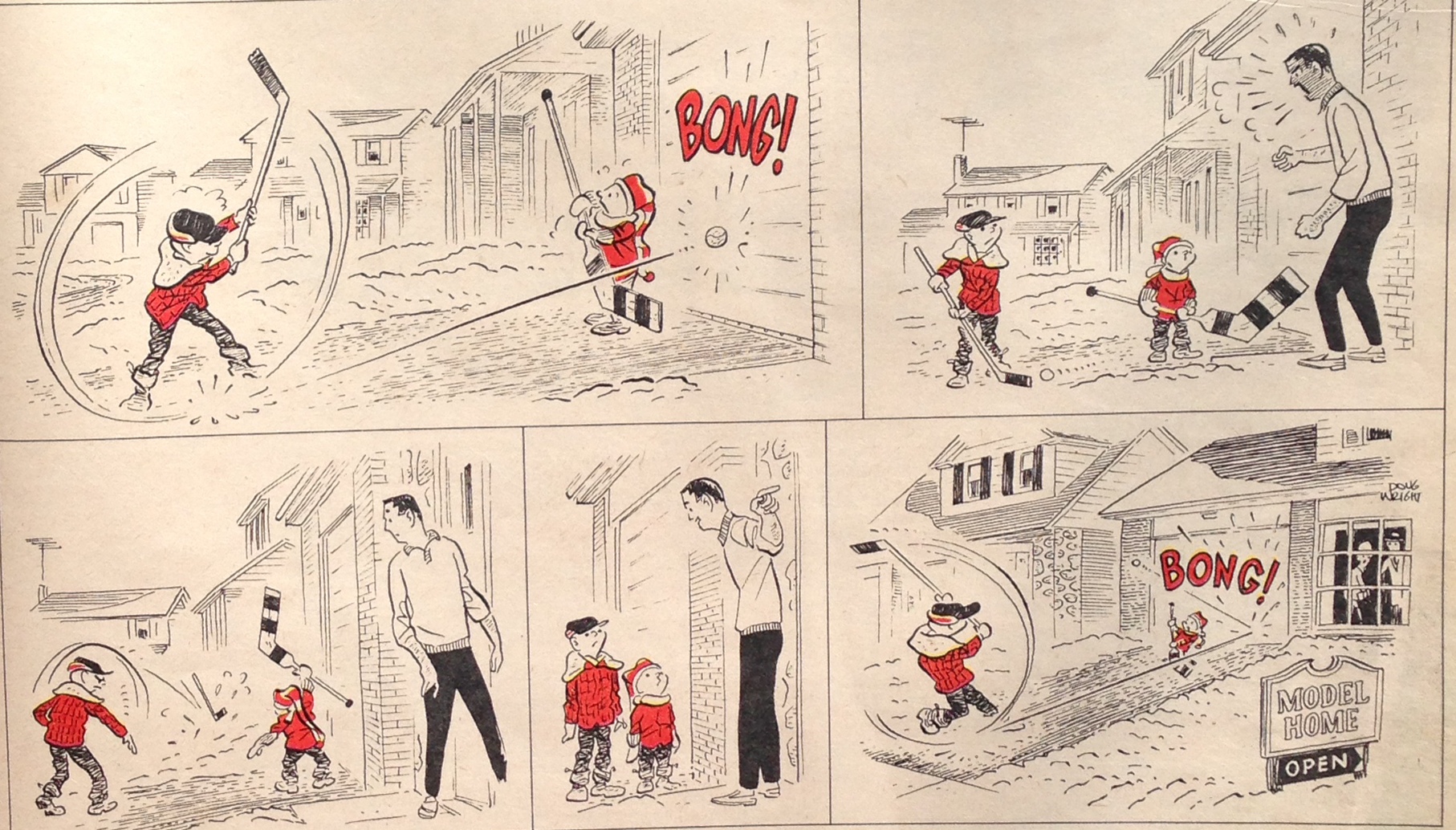
Phyllis and Doug had three boys, Bill, Jim, and Ken, who all became the models for the boys in the comic strip, which ran from 1948 to 1980. As depicted by Doug, Phyllis was a loving but exasperated suburban housewife, with a stylish pixie haircut and often clad in slacks or mod skirt ensembles. Through her association with the Wright Awards, Phyllis was a living link to the world depicted in the comic strip, generous with her support and time, and generous in sharing her family's memories and archive of artwork and photos, some of which became source material for the massive two-volume Collected Doug Wright compiled by the cartoonist Seth and writer Brad Mackay.

After Doug Wright's death in 1983, Phyllis remarried, to Derek Thomas (d. 1998), greatly expanding the size of her family.

Cremation and a private interment at Greenwood Cemetery happened earlier this month. There will be a memorial service July 31 at 11am at Port Nelson United Church.

_____


Friday, April 28, 2023

Close Shaves in the Comics, Part 2: Storm Gets a Mohawk!

 by BK Munn


Now it can be told: the terrifying tale of talcum, tufts, and trimming that is shaving in the comics!

Let's talk about some of the most famous and important shaves in the history of comics.

2. Uncanny X-Men #173. Storm gets a mohawk!

This was the shave that shook all mutantkind! 

Never had a shave had such shocking ramifications for a character in a superhero comic, let alone a woman character! 

Storm was a groundbreaking character: one of the first prominent characters of African descent in U.S. comics, and one of the most powerful woman characters in the Marvel Universe. Storm was born Ororo Munroe, the daughter of a Kenyan princess and an African-American photographer, and raised on the streets of Harlem and Cairo, Egypt before assuming the mantle of an African weather goddess when her mutant powers manifested. When she is first introduced in comic books, in Giant Size X-Men #1, created by writer Len Wein and artist Dave Cockrum, she is depicted as serene royalty. Her superhero costume includes a cape, and her trademark regal hairstyle is a mane of shockingly white, long, flowing hair, accessorized with a crown-like tiara. Storm quickly established herself as one of the most powerful X-Men as well as a gentle voice of reason, a leader, a teacher, and a mentor to student mutants at Xavier's School for Gifted Youngsters, the secret headquarters of The X-Men. Her beauty, highlighted by the contrast between her black skin and white hair, set her apart from the other, decidedly less-glamorous mutants. 

But all this changed in 1983's X-Men #173, "To Have and Have Not!"

After spending a week in Japan in the company of Wolverine's crazy mutant ninja girlfriend Yukio, Ororo finds herself revelling in the down-and-dirty violence that is Yukio's specialty. After using a lightning bolt to knock out a Yakuza thug, Storm notes, "I have never used my powers to deliberately inflict pain." She concludes, "This madness of yours has infected me ---I welcome it!"

Cut to a week later, and the arrival of the rest of the X-Men for Wolverine's wedding. Storm makes one of the most dramatic reveals in X-Men history, debuting her all-leather street punk uniform, topped off by a spectacular feathery mohawk hairstyle. Her "new look" is as shocking as a lightning bolt, electrifying her colleagues, and provoking an emotional response.

“Your clothes! Your…hair! What have you done?!” gasps young Kitty Pryde, while Professor Xavier speculates privately whether the change is “indicative of a deeper, more serious metamorphosis.”

The new look does indeed prove to be indicative of big changes in Storm's character. In the issues that follow, she becomes more calculating, aggressive and self-assured, winning a knife-fight against the Morlock leader Callisto and becoming leader of the X-Men even after losing her powers. Originally intended as a joke by the series artist Paul Smith, writer Chris Claremont quickly seized on the implications of the punk look for the character's development.

The change had an effect on the readership as well, galvanizing interest and making Storm a fan favourite. Through the act of shaving most of her head, Storm became a comic book style icon, her punk look shaking up the staid world of superhero comics and making radical change one of the hallmarks of Reagan 80s Marvel, heralding the new wave of team shake-ups, costume and character redesigns, and universe-rattling crises and secret wars. Her leather uniform also created a template for more "realistic" superhero costuming, especially in film design.


Tuesday, April 25, 2023

Unknown Canadian Cartoonist: Joe Cushner

by BK Munn 

Unknown Canadian Cartoonists: Joe Cushner

My brother, who lives in B.C., sent me these images from an exhibit at the VISAC Gallery in Trail. The artist Joe Cushner worked for the Cominco Smelter doing safety posters and cartoons.
The Art of Health and Safety:
Joe Cushner, Cominco Staff Artist (1950s – 70s)


Saturday, February 11, 2023

SPLIT-FACE vs. TWO-FACE: A TALE OF TWO VILLAINS FROM BATMAN AND DICK TRACY

Just saw the first Dick Tracy movie (1945) on TCM. The villain is Split-Face, played by the great Mike Mazurki. He's a new creation for the movie, not from the comic strip, created by the screenwriter Eric Taylor, author of many B-movie crime pictures. The Batman villain Two-Face debuted in 1942. In a shocking twist, it looks like Dick Tracy is taking a page from Batman. In another shocking twist, Bob Kane is actually credited with his creation (although Bill Finger of course wrote the first appearance in Detective Comics #66). In a twist that will surprise nobody, Kane stole the idea for Two-Face from this poster for the 1941 Dr. Jekyll and Mr. Hyde starring Spencer Tracy


Sunday, January 15, 2023

THE FIRST COMICS ACADEMIC IN FILM? SORRELL BOOKE IN "BYE BYE BRAVERMAN"


by BK MUNN

Is this the first comics academic in film? Sorrell Booke as Holly Levine in "Bye Bye Braverman" (1968, d. Sidney Lumet). In the film, about four writers trying to find their friend's funeral in Brooklyn, Holly announces that he will soon be teaching a course on pop culture, called "From Little Nemo to L'il Abner". This news invites incredulity from his fellow intellectuals, who proceed to quiz him on his comic strip knowledge, asking trivia questions about Little Annie Rooney, Winnie Winkle, The Gumps, Orphan Annie, and Don Winslow of the Navy. Holly passes with flying colours, only getting hung up on the name of the dunce character in The Rinkydinks gang (Denny Dimwit). The film has many other comics references, including mentions of Dick Tracy, Skeezix, Blondie, and Bringing Up Father. Holly has a pop art painting of The Phantom in his apartment, and a Sunday of Irwin Hasen's Dondi is glimpsed at one point. It's a charming comedy in the form of a Joycean odyssey, based on the book "To An Early Grave" by Wallace Markfield (aka "The James Joyce of Brighton Beach").

In real life, Sorrell Booke (1930-1994) was a multilingual polymath, known for his character roles in hundreds of films and television shows. Ironically, he is best known for playing the villainous Boss Hogg on "The Dukes of Hazzard" tv series from 1979 to 1985.

I can't think of many other comics academics in film. Although the study of comic books is mentioned in the novel White Noise, I don't think this was carried over to the recent adaptation. Are there any others?

WEDNESDAY, SEASON ONE

WEDNESDAY, SEASON 1 (2022)

review by BK MUNN

When I was a kid, like everybody I watched reruns of The Addams Family on tv. In retrospect, it’s amazing that the show existed at all, a family sitcom based on some macabre, downright antisocial and perverse cartoons printed in the high-toned New Yorker magazine, but in the context of the times it doesn’t seem out of place. The post-Kennedy, post-Cuban Missile crisis 1960s was a time of high-concept tv shows with increasingly fantastical premises (and The Munsters premiered at the same time, for Christ’s sake). As a show, it still holds up as a goofy, only partly moronic example of 60s culture. They made some good logical decisions, shoe-horning Charles Addams’ disconnected cartoons into a network format, essentially bowdlerizing it for a mainstream audience (not that The New Yorker isn’t mainstream, but you know what I mean). It’s no smarter than Gilligan’s Island or Hogan’s Heroes, and it’s not without its own boring, repetitive schticks and annoying tics, but it lucked out with a few things, like a catchy theme song, great casting, and some creative characterizations that paid off. And for better or for worse, sixty years later the tv show is still the basis for a massive pop culture enterprise. 

As an adult I think of the work of Charles Addams, including the roughly 150 cartoons and drawings he did that can be at least tangentially identified as “Addams Family” cartoons, as something like a holy text, my Bible or Shakespeare, and in many ways the epitome of comics art. I have to admit I’m a bit snobbish about them, and hold them close to my heart (I’m sure Addams was much less precious and, like Charles Schulz, was happy to cash any checks for prostituting his creations). These days, I think of the tv shows and movies as, at best, easily-forgettable aspects of the Addams legacy and, at worst, as something like a hideous boil on the face of the Mona Lisa (maybe like something you’d find in the Addams Family portrait gallery?). That being said, I’m still able to think about the original drawings and their ancillary spinoffs as separate things, and have even watched parts of the movie franchises over the years with a clean conscience (as a kid I also liked the Hanna-Barbera Saturday morning animated show!). 

Like all pop-culture properties, The Addams Family has been seized on as something endlessly franchise-able, to be mined and re-imagined and transformed into a myriad of formats and genres; a universe (dare I say multiverse?) unto itself. Our modern sophisticated tastes demand more than some Boomer artifact, and so we have this new Wednesday show, which takes one of the least-developed, most projected-upon, parts of the universe, essentially a blank slate, and posits her as a teen heroine in a sort of Harry Potter meets Nancy Drew milieu, as a goth Hermione, if you will, in one of these now stereotypical fantasy private schools. The slow addition of *actual* supernatural aspects to the "mythos", above and beyond Addams’ bedrock surrealism, placed front and center, is the novelty here, giving some kind of superpowers to all members of the clan, and special precognitive witchiness to both Morticia and Wednesday, etc. (The full scale “magic-ization” I think very clearly takes away from what made the original concepts unique, but whatever.)  I turned off most of my grumpy critical nitpicking and enjoyed this (almost too long) short series. The casting was mostly good, the plots not too moronic (gleefully full of plot-holes, lacunae, and “traveling at the speed of plot” tv tropes), and overall those things I expected to dislike (dancing to The Cramps, Fred Armisen as Uncle Fester) instead were almost charming. It’s for kids but I’m adult enough to admit I’m basically a big baby and we live in an infantile society. Tim Burton, who has been making shit like this his entire career, had a hand in production and development, and directs half the episodes (the poster says this conglomeration of cliches and half-assed plots comes "from the imagination of Tim Burton" which is quite the self-own but also, which part?), and I can’t really say I hate it.

Thursday, December 29, 2022

Cruisin' 1977


"Cruisin' 1977" by Mike Royer (2022, pencil and ink on bristol board). 

My wife Kara and I collect alot of records and along the way somehow we started collecting the Cruisin' series, a nostalgia title that came out in the early Seventies featuring oldies from the 1950s and 60s interspersed with classic radio dj chatter and station ads. The whole collection is made up of 15 records, from 1955 to 1970, and the unique thing about the series is that the cover of each record features the same group of characters in different scenes through the years. The main protagonists are Eddie and Peg, two teenagers in love, who go through many ups and downs, including the Vietnam War and the student revolts of the Sixties, before finally getting married. Each cover was illustrated in classic comic book style, with word balloons and many background details specific to each year. It wasn't until we had collected these records for many years that I realized that the artist who drew these covers was Mike Royer, a cartoonist famous among comic book fans for his association with Jack Kirby, inking and lettering most of Kirby's comics throughout the 1970s, including The New Gods, Black Panther, and The Eternals.

When we sold our record store earlier this year, I got the idea to memorialize our run with some special art, so I contacted Mr. Royer to see about commissioning him to create a version of one of his classic covers as an homage to the Cruisin' series and to our time at Royal Cat Records. I chose his cover to Cruisin' 1967, which takes place in a hippie headshop, and asked him to update it to a record shop in 1977, the year punk broke, and place Kara and myself in the scene. The results were beyond my wildest dreams! I asked local cartoonist Jay Stephens to add colour to the black-and-white masterpiece Mr. Royer created, and I gave the whole package to Kara for Christmas this year.
Thank you Mike and Jay and Merry Christmas from Bryan and Kara!


Saturday, November 12, 2022

PIERRE FOURNIER, 1949-2022: Creator of Capitaine Kébec and Red Ketchup comics


Obituary by BK Munn

Pierre Fournier, the iconoclastic Quebec cartoonist, died November 11 of complications arising from Lewy body dementia. 

Fournier was at the vanguard of Québécois artists who began making funny, political French-language comics in the 1960s and 1970s. He self-published the groundbreaking superhero satire Les Aventures du Capitaine Kébec and went on to transform the character into a sort of mascot for the francophone comics community, with a a comics-themed tv show, "Les Amis du Capitaine Kébec", as well as more comics and strips. Fournier was among the first contributors to the humour magazine Croc, and introduced another long-running character, Michel Risque, in its pages in 1979. Co-created with artist Réal Godbout, the violent adventure comics parody and its spin-off, Red Ketchup, were intermittently-published in a variety of formats over the following decades (recently reissued in a series of graphic novels by La Pasteque). A Red Ketchup animated cartoon series is set to debut in 2023.

Outside of Croc, Fournier also contributed to the magazine Titanic and the Quebec edition of Mad. He edited his own short-lived humour magazine Anormal in 1991, and was an editor and art director for Matrix Comics. His contributions to comics were recognized with the inaugural Albert Chartier Award and the induction into the Joe Shuster Awards hall of fame in 2008.

As well as writing for film and television, Fournier organized exhibits about the history of Quebec bande dessinée beginning in the 1970s and was something of a comics, science fiction and horror pop culture historian, running a well-regarded blog, Frankensteinia, about aspects of the Frankenstein mythos for many years.

Fournier suffered from a lengthy illness and had been in long-term care since February. His death was confirmed by friends and family through Fournier's page on Facebook.


Tuesday, October 11, 2022

First Doug Wright's Family in The Canadian, 1967


Originally published in the nationally syndicated magazine Weekend (originating in the Montreal Standard but included as an insert in different papers across the country), the comic strip "Doug Wright's Family" moved to upstart competitor The Canadian in 1967. Here's the first strip from The Canadian, printed with a short article trumpeting their new acquisition, with a great photo of Doug Wright, pictured with his eldest son. Both magazines were general interest publications with features for the whole family, from political news, to sports, fashion, celebrity profiles, and weird Cold War fantasies like the one pictured here. The two magazines merged 10 years later.


Saturday, October 08, 2022

FILM REVIEW: The Devil's Hand


The Devil's Hand aka Carnival of Sinners aka La Main du Diable (1943), directed by Maurice Tourneur.

Charming fantasy about a bohemian artist who buys a "Monkey's Paw" totem and makes a Faustian bargain for fame, love, and riches. The hero is pursued by a cute little devil who dresses and thinks like an accountant (or an SS agent), and there are some impressive spooky-looking shots and sequences. A cute satire on bourgeois art and commerce, directed by Jacques Tourneur's father! Made under German occupation, it's very French, very modern, and I've read it characterized as an anti-Nazi Resistance allegory.

Wednesday, October 05, 2022

GUELPH FASHION DESIGNER: JACK PURCELL


The most famous fashion brand to come out of Guelph may be the iconic Jack Purcell sneaker. Born in Guelph, Jack Purcell was the World Badminton Champion in the 1920s and 1930s, and a global celebrity. In 1935, he designed a badminton shoe for rubber company BF Goodrich's PF Flyers shoe brand. The distinctive Purcell "smile" shoes became *THE* shoe for all tennis and badminton players for the next 50 years. In 1972, Converse purchased the brand, and they are still made today, along with athletic wear and street wear accessories that carry the Purcell logo.


Thursday, September 15, 2022

Mr. Freedom, Directed by William Klein


by BK Munn

R.I.P. William Klein (1926-2022), the expatriate American painter, photographer, and film director who created one of the more notable superhero films of the 1960s, Mr. Freedom. Known for his groundbreaking and award-winning street and fashion photography, the New York-born Klein spent most of his adult life in France, where he also directed tv commercials. Mr. Freedom is an absurdist satire on superheroes and U.S. imperialism that stars another expat, John Abbey, as the titular hero, a fascistic brute who is a clear predecessor to comic book characters like Judge Dredd, Marshall Law, and The Comedian.

The plot of the film has Dr. Freedom (Donald Pleasance) sending Mr. Freedom to France to stop the slide of the "crybaby" French culture into Communism and to investigate the death of French superhero Capt. Formidable (Yves Montand). The film was shot in France with mostly French actors (including Serge Gainsburg and the sublime Delphine Seyrig), although everyone speaks only English throughout. The film has many of the hallmarks of 1960s action and spy films (James Bond and its imitators) but despite it's dumb sub-Get Smart/Batman style plot and Saturday morning/comic book dialogue, it has many striking images and scenes, all shot in a primary colour, pop art style. Director Klein was knowledgeable about comics (he mentions his familiarity with Krazy Kat in one interview I've seen), and also produced a fumetti version of Mr. Freedom using stills from the film to promote it, pictured here. Famously, it has been called “conceivably the most anti-American movie ever made.” It's a beautiful thing!