Tuesday, October 11, 2022

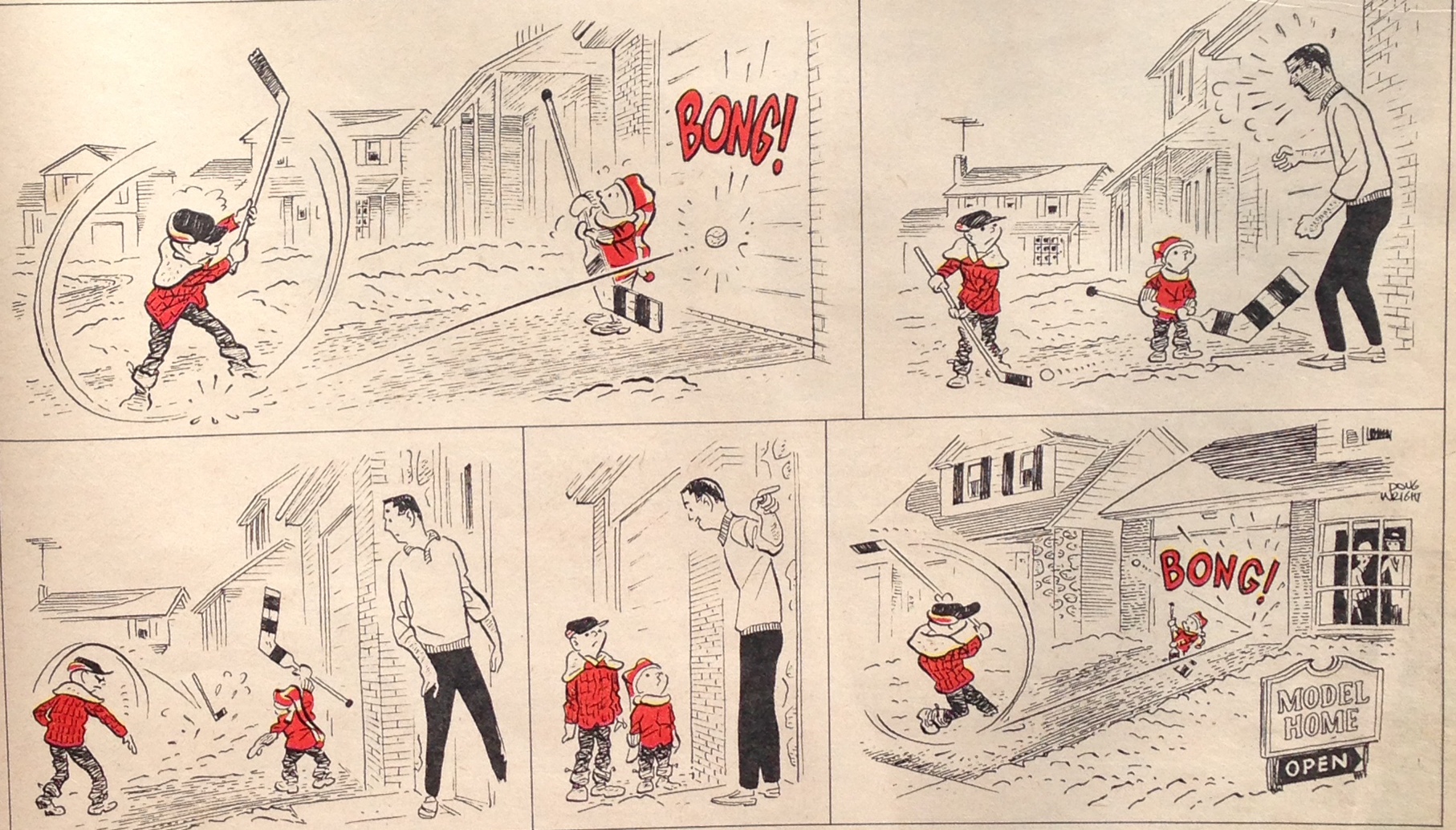
First Doug Wright's Family in The Canadian, 1967


Originally published in the nationally syndicated magazine Weekend (originating in the Montreal Standard but included as an insert in different papers across the country), the comic strip "Doug Wright's Family" moved to upstart competitor The Canadian in 1967. Here's the first strip from The Canadian, printed with a short article trumpeting their new acquisition, with a great photo of Doug Wright, pictured with his eldest son. Both magazines were general interest publications with features for the whole family, from political news, to sports, fashion, celebrity profiles, and weird Cold War fantasies like the one pictured here. The two magazines merged 10 years later.


Saturday, October 08, 2022

FILM REVIEW: The Devil's Hand


The Devil's Hand aka Carnival of Sinners aka La Main du Diable (1943), directed by Maurice Tourneur.

Charming fantasy about a bohemian artist who buys a "Monkey's Paw" totem and makes a Faustian bargain for fame, love, and riches. The hero is pursued by a cute little devil who dresses and thinks like an accountant (or an SS agent), and there are some impressive spooky-looking shots and sequences. A cute satire on bourgeois art and commerce, directed by Jacques Tourneur's father! Made under German occupation, it's very French, very modern, and I've read it characterized as an anti-Nazi Resistance allegory.

Wednesday, October 05, 2022

GUELPH FASHION DESIGNER: JACK PURCELL


The most famous fashion brand to come out of Guelph may be the iconic Jack Purcell sneaker. Born in Guelph, Jack Purcell was the World Badminton Champion in the 1920s and 1930s, and a global celebrity. In 1935, he designed a badminton shoe for rubber company BF Goodrich's PF Flyers shoe brand. The distinctive Purcell "smile" shoes became *THE* shoe for all tennis and badminton players for the next 50 years. In 1972, Converse purchased the brand, and they are still made today, along with athletic wear and street wear accessories that carry the Purcell logo.


Thursday, September 15, 2022

Mr. Freedom, Directed by William Klein


by BK Munn

R.I.P. William Klein (1926-2022), the expatriate American painter, photographer, and film director who created one of the more notable superhero films of the 1960s, Mr. Freedom. Known for his groundbreaking and award-winning street and fashion photography, the New York-born Klein spent most of his adult life in France, where he also directed tv commercials. Mr. Freedom is an absurdist satire on superheroes and U.S. imperialism that stars another expat, John Abbey, as the titular hero, a fascistic brute who is a clear predecessor to comic book characters like Judge Dredd, Marshall Law, and The Comedian.

The plot of the film has Dr. Freedom (Donald Pleasance) sending Mr. Freedom to France to stop the slide of the "crybaby" French culture into Communism and to investigate the death of French superhero Capt. Formidable (Yves Montand). The film was shot in France with mostly French actors (including Serge Gainsburg and the sublime Delphine Seyrig), although everyone speaks only English throughout. The film has many of the hallmarks of 1960s action and spy films (James Bond and its imitators) but despite it's dumb sub-Get Smart/Batman style plot and Saturday morning/comic book dialogue, it has many striking images and scenes, all shot in a primary colour, pop art style. Director Klein was knowledgeable about comics (he mentions his familiarity with Krazy Kat in one interview I've seen), and also produced a fumetti version of Mr. Freedom using stills from the film to promote it, pictured here. Famously, it has been called “conceivably the most anti-American movie ever made.” It's a beautiful thing!


Sunday, January 09, 2022

Allen Baron: Director and 1950s Comic Book Artist

 by BK Munn

I recently had the pleasure of watching Blast of Silence, the brutal, existential 1961 film noir written and directed by and starring Allen Baron. Baron was born in Brooklyn and fell into making movies after a hardscrabble early life that included stints in the U.S. Navy, driving a taxi and working in the comic book industry of the 1950s. The story of the guerrilla production of Blast of Silence, shot on the streets of NYC without permits and with equipment "liberated" from Castro's Cuba, is the stuff of legend and makes for interesting reading. Baron went on to Hollywood and became a well-known tv director. Genre and comic fans may be interested in work he did on some science-fiction and fantasy themed shows like Kolchak the Night Stalker (he also directed more mundane fare like Barney Miller and The Brady Bunch), and he was nominated for a Hugo Award for the 1969 pilot episode of the short-lived The Immortal tv series. But it's his short stint as a comic book artist in the 1950s, directly preceding his first film, that I was curious about. 

A scene in Blast of Silence seems semi-autobiographical: when the ruthless antisocial assassin played by Baron meets a chum from his days in an orphanage, the friend tells a story about getting out of the army, going to art school, and getting a career in commercial art. This is the same path followed by Baron in real life. It looks like he did a batch of romance comics for Lev Gleason and at least one horror story for ACG, the haunting "Bride of the Swamp Monster" in Forbidden Worlds #9 from 1952. While the writer of the story is unknown (perhaps Baron himself), the story is notable for its Hollywood film setting with scenes of a small crew shooting a movie in the swamp.


Wednesday, December 08, 2021

Film Review: Records by Alan Zweig


Records (2021), directed by Alan Zweig.

review by BK Munn


Sometimes a film just speaks to you, you know? Records is Alan Zweig’s sequel and self-described “bookend” to his legendary 2000 documentary Vinyl. In that first film, part of Zweig’s curmudgeonly “Mirror Trilogy” in which he turns the camera on himself at the same time as he projects his anxieties and foibles onto his subjects, looking for clues to his own loneliness and depression, Zweig managed to find some of the worst examples of record collectors. Alongside collecting heroes like Harvey Pekar, Don McKellar, and Jello Biafra, Zweig dredged up a gaggle of misfits with various personal issues and hoarding tendencies, almost uniformly single men, who shared his conflicted attitudes about collecting and seemed to be engaged in filling an inner void with the habitual accumulation of records. 


In this new film, Zweig is seemingly in a much better space, both mentally and in terms of physical location. Twenty years later, he’s traded in his dark, rat-infested apartment for a bright, sun-dappled house in a middle-class Toronto neighbourhood. The aimlessness and self-recrimination of his earlier film(s) has been replaced with some semblance of joy and contentedness; Zweig’s young daughter appears off-camera in the film and the sense we get is she is key to this newfound solidity and balance. His record-collecting has changed, too. Instead of binging and purging indiscriminately, he now seems more focused on buying records for enjoyment, living with some records for only a short time while keeping a core collection that brings him happiness. Likewise, the bulk of collectors he interviews come across as well-adjusted and artistically-inclined music lovers who collect records as an outgrowth of that passion. Many of his subjects use music and collecting in a wholesomely self-directed, therapeutic manner, and several seem to have found their collecting central to long-term relationships and romance. The climax of the film focuses on a happy hetero couple that have that rare thing, a MERGED record collection (gasp!) and, pointedly, two healthy-looking straw-haired tykes who share their parents’ love of tastefully obscure vinyl.


The film is full of stimulating insights into the collector mentality, tempered with Zweig’s patented wry humour. Where the original film took place at the tail-end of vinyl’s long reign as the world’s primary music format, where the sadsack collectors on display seemed like relics of another age, pathetically hanging on to a dead medium, Records comes to us in the middle of the much-touted vinyl resurgence and a newly-thriving industry of deluxe reissues of classic albums and boutique record stores. In a world where you can find a plethora of documentaries about record shops and watch tens of thousands of Youtube videos of record collectors showing off their latest finds, Zweig’s new film nevertheless serves as a timely coda to that bygone era and a fresh way to think about our obsession with “things”. For myself, Zweig’s original film was less a cautionary tale and more of an inspiration. As a confirmed collector from my early years, his exploration of the collector psyche and his Quixotic, haunted quest for the Louvin Brothers’ “Satan is Real” mirrored my own conflicted approach to my vast accumulation of stuff. My wife and I now co-own a record store and have watched Vinyl many times over the years to the point its crusty characters seem like old friends and yes, we also have a large merged record collection (full disclosure: we have met and are on friendly terms with several people in this new documentary and have actually sold at least one record to the director. Zweig had even asked Kara to be in Records, but she demurred since the prospect of having a strange film crew in our tiny home during the pre-vaccine days of the Covid-19 Pandemic did not excite us). The callbacks and self-referential aspects of this new film make it seem like the continuation of a conversation begun two decades ago (these are our people!) and anyone who enjoyed Vinyl or is just curious about why someone might line the walls of their house with thousands of pounds of cardboard-jacketed plastic discs in the era of streaming and digital will find Records a satisfying, and maybe even comforting, experience.


Now streaming on TVO:

https://www.tvo.org/video/documentaries/records


Thursday, November 11, 2021

Funky is 50!

50 years ago today, the first appearance of Funky Flashman. Funky was Jack Kirby's thinly-veiled parody of his old boss Stan Lee. Kirby had just spent a decade working under Lee at Marvel Comics, having Lee take the writing pay and credit for all the characters and stories Kirby wrote and drew. Before Kirby started working for Lee, Lee was known, if he was known at all, for writing a handful of humour titles at his cousin's comic book company. After Kirby arrived, Lee began applying his gift for chatty dialogue and self-promotion to the line of superhero comics Kirby created, and the rest is history. When Kirby left Marvel to create his New Gods series of titles for DC in 1970, he took with him 10 years of resentment that he poured into the darkly humourous portrait of Funky and Funky's manservant House Roy, a parody of Stan Lee's real life assistant (and current Stan Lee apologist and hagiographer) Roy Thomas. Kirby only used the character once, but the nicknames stuck among fans and comics historians, and other creators revived Funky, off and on, most notably for the aptly-named Secret Society of Supervillains later in the 1970s. Panels from Mr. Miracle #6, published November 11, 1971, written and drawn by Jack Kirby.


Friday, October 29, 2021

Review: The Electrical Life of Louis Wain


The Electrical Life of Louis Wain (2021), directed by Will Sharpe.


An Emotional Portrait of the Superstar Cartoonist

by BK Munn

There aren't many serious films about cartoonists, are there? My wife and I have been lifelong admirers of the delightful cat art of Louis Wain, collecting old postcards and children’s books with his images for decades now, so it was a no-brainer that we would rush to see this film, despite our general antipathy towards biopics in general, and twee British artist biopics in particular. I have to say, though, contrary to our misgivings, the film proved to be a moving chronicle of Wain’s unique hardscrabble life and transformation into the superstar cartoonist of Victorian England, his efforts as the sole supporter of a household of five precocious sisters and their mother, his generally tragic circumstances, and his later descent into a form of madness. We were teary-eyed through much of it. Benedict Cumberbatch continues his streak of portraying lovable British eccentrics and geniuses, but I found I could forget about his fame and get lost in his character here. Claire Foy is also affecting as Wain’s wife Emily. It’s a bit too precious at times for what is essentially a tragedy, but the film’s overarching “life is beautiful and silly” theme is solid and quite in keeping with the nature of Wain’s art.

_____

We saw the film after a day browsing antique shops (we bought an old British children’s annual (the 1923 Pip and Squeak) with some cat cartoons, although none by Wain. The world really could use a collection of Wain's comic strips, like those he did for Hearst's Journal-American and associated papers.


Saturday, August 28, 2021

The Best Records of 1986


by BK Munn

So by popular demand, here’s my list of the Best Albums of 1986! Of course, I think they are objectively the best as well as being favourites --my taste is that good! Nostalgia plays a part in this list, I’m sure, but I discovered large chunks of the records here long after the 80s ended. Some of the records I listened to hundreds of times in 1986 and since. Some I discovered for the first time last week. The ranking is based on not just how good the record is, but also how likely I am to listen to it again and/or how tired I am of the record. The list reflects my stunted taste for dumb, post-punk, and garage-flavoured sounds, and really gives a wide berth to most of the bestselling discs of the day. There are innovative pop and rock records from 1986 that were massive crossover hits and are considered classics by huge swaths of the population but I am heartily sick of them (and was likely sick of them in 1986, so don’t come at me with your Paul Simons and Peter Gabriels, etc). There are a few cheats, and a few anachronisms, mostly in the anthology/compilation category, but most of the stuff here was actually released in 1986 for the first time (it’s largely confined to Anglophonia as well, meaning UK/USA/Canada, so no South Africa, no Zimbabwe, no Japan). What else is not on this list? There are only a handful of country-adjacent records here and I really dropped the ball in the 1986 reggae department. Jazz? I’m a dilettante. Miles released “Tutu” in 1986, and it is a *very* 80s-sounding record. Is it even in the top 40 Miles records? I really don’t know. Not for me. John Zorn is on the list because he’s really more of a punk, isn’t he? And because I feel I could actually listen to those records again at some point. What else did I miss, jazz-wise? A bunch of fusion-y and synth-y noodly stuff it sounds like, for the most part. I mean, let me know how wrong I am. When I’m not blasting angry punk I do sometimes listen to *some* of the more refined and civilized things. Tony Bennett released one of his better comeback albums in 1986, and it’s hard to find a bad Tony Bennett album, period, but should it be on this list? (Ditto the great Mel Torme!) What else? Soundtracks? Blue Velvet and The Mission are standouts, but I would rather rewatch the films, honestly. Laurie Anderson’s is a soundtrack that functions as a stand-alone album to me, and is on the list. No orchestral music, generally. This is a rockist’s rock list!

1. The Fall, Bend Sinister

2. Run-DMC, Raising Hell

3. Various, Back From the Grave Vol 3 + 4

4. Deja Voodoo, Swamp of Love

5. Gruesomes, Tyrants of Teen Trash

6. Various, It Came from Canada 2

7. Sonic Youth, Evol

8. Husker Du, Candy Apple Grey

9. Public Image Ltd, Album

10. Schoolly D, Schoolly D

11. Shop Assistants, Shop Assistants

12. Butthole Surfers, Rembrandt Pussyhorse

13. Dead Kennedys, Bedtime for Democracy

14. Jazz Butcher, Distressed Gentlefolk (tie)

14. Hasil Adkins, Out to Hunch (tie)

15. Bad Brains, I Against I

16. Suicide, Ghost Riders

17. Cocteau Twins, Victorialand

18. The Smiths, The Queen is Dead

19. XTC, Skylarking

20. Throwing Muses, Throwing Muses

21. R.E.M., Life’s Rich Pageant

22. Thee Mighty Caesars, Thee Caesars of Trash

23. Cramps, A Date with Elvis

24. Prince, Parade

25. Big Black, Atomizer

26. Ministry, Twitch

27. Talking Heads, True Stories

28. Laurie Anderson, Home of  the Brave

29. Billy Bragg, Talking With The Taxman About Poetry 

30. Camper Van Beethoven, Camper Van Beethoven

31. Jr. Gone Wild, More Pop Less Art

32. Big Audio Dynamite, No. 10 Upping St.

33. Felt, Forever Breathes the Lonely Word

34. Spaceman 3, Sound of Confusion

35. The Housemartins, London 0 Hull 4

36. The Feelies, The Good Earth

37. Eugene Chadbourne, Corpses Of Foreign War

38. The Clean, Compilation

39. Dag Nasty, Can I Say

40. Descendents, Enjoy

41. The Leaving Trains, Kill Tunes

42. Nikki Sudden And The Jacobites, Texas/The Last Bandits in the World

43. The Pandoras, Stop Pretending

44. Salt n Pepa, Hot Cool and Vicious

45. Lyres, Lyres Lyres

46. Kool Moe Dee, s/t

47. Didjits, Fizzjob

48. John Zorn, The Big Gundown

49. This Mortal Coil, Filigree And Shadow

50. Ramones, Animal Boy

51. Razor, Malicious Intent

52. Robyn Hitchcock And The Egyptians, Element Of Light 

53. Motorhead, Orgasmatron

54. Skinny Puppy, Mind: The Perpetual Intercourse 

55. Lou Reed, Mistrial

56. Nick Cave, Kicking Against the Pricks

56. Nick Cave, Your Funeral My Trial

57. That Petrol Emotion, Manic Pop Thrill

58. Delmonas, The Delmonas 5

59. Violent Femmes, The Blind Leading The Naked 

60. Afrika Bambaataa & Soulsonic Force, Planet Rock: The Album

61. Youth of Today, Break Down the Walls

62. Killing Joke, Brighter Than A Thousand Suns 

63. Swans, Holy Money

64. Iggy Pop, Blah Blah Blah

65. Go-Betweens, Liberty Belle And The Black Diamond Express 

66. The Flaming Lips, Hear It Is

67. Siouxsie and the Banshees, Tinderbox

68. Ray Condo And His Hardrock Goners, Crazy Date

69. Art of Noise, In Visible Silence

70. Meat Puppets, Out My Way

71. Velvet Underground, Another VU

72. The No Comprendo, Les Rita Mitsouko

73. fIREHOSE, Ragin', Full-On  

74. Dayglo Abortions, Feed Us A Fetus

75. NoMeansNo, Sex Mad

75. Revolting Cocks, Big Sexy Land

77. New Order, Brotherhood

78. Stetsasonic, On Fire

79. Various, C86 

80. Beastie Boys, Licensed to Ill

81. Stan Ridgway, The Big Heat

82. John Zorn, Cobra

83. The Chameleons, Strange Times

84. The Smithereens, Especially For You

85. Cowboy Junkies, Whites Off Earth Now!!

86. Talk Talk, The Colour of Spring

Friday, August 20, 2021

CR-A-A-A-S-H-! DOUG WRIGHT'S 1967 CAR-TOONS

Some CAR-toons by Doug Wright, from Star Weekly magazine, Sept 30, 1967. The mechanical-minded cartoonist Doug Wright was a natural when it came to delineating automobiles and other machines and this one-pager has the look of a new strip "pitch" designed to highlight these skills, in contrast to the domestic slapstick of his regular weekly gig with the Star, the beloved "Doug Wright's Family" strip. It doesn't look like this ever turned into anything, but what a glimpse into "what might have been..."