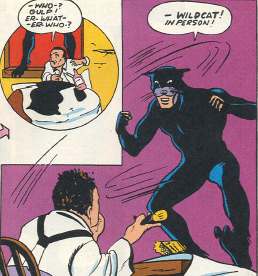
We still haven't decided if Wildcat is working class, and I think it's safe to assume that Irwin Hasen hasn't been a prole for several decades. However, Hasen does have a brand-new pacemaker, according to Mark Evanier.
I like this quote from comics retailer Mike Sterling that was featured on Journalista last week:
Currently processing a nice collection of books, ranging from the Golden Age into the mid-1980s. Highlight of the collection so far (though I don't see much surpassing this): a couple hundred original E.C. comics, including full runs of Weird Science, Weird Fantasy, Shock Suspenstories, and the 3-D books (all two of them), and near-full runs of Tales from the Crypt, Haunt of Fear, and Vault of Horror...plus a handful of Mads and other random E.C.s. I'll let you folks know when they're available for sale.
However, what I'm most excited about in this collection are the issues of Nancy & Sluggo and Fox and the Crow. I'm not letting you know when these are available for sale, because I'm keeping them. So there.
(I should also make up some kind of "pedigree" name for this collection, like the, I don't know, "Seaside Funnybooks in Cardboard Boxes Collection," and price them accordingly. Plus, I can tell exciting stories about how the collection was acquired: "Well, one day, a guy called and asked if we wanted to buy his comics, and we said 'sure, let us take a look at 'em,' and we saw he had some pretty good stuff, so we bought them. The end.")
Sterling's right: why does every Comic Book Guy who buys a collection feel the need to get the thing certified as a "Pedigree Collection"? There seems to be too many of those things already and they're just an excuse to charge more money for an old comic book.
I guess a comic book collection purchased by a comic book store is not technically a Mystery Hoard, but I still like to read about hoards of comics.
When we were kids, my brother acquired a modest collection of old comics--already old in 1981 or so--that sat around upstairs til my parents finally moved this summer, 2002. (I salvaged one or two of them.) There were two Archie books, I think, and one Richie Rich; one Incredible Hulk collection, one compelling Batman story in six issues, one dark and enthralling issue of the X-Men, and the first fifteen or so issues of Spider-Man in three volumes. Oh, I forget, there were also some DC collections: a collection of magical sports stories, a collection of team-ups involving Superman and the standard rotation of allied heroes, and one collection of villain-origin stories; all stuff from the fifties and sixties, I'd guess. All these, I read so many times I could probably reconstruct their stories and much of their dialogue with fair accuracy.
Awhile back I started the Canadian Comic Fan Project, posting the names of fans who appeared in old comic books. When I come across a Canadian letterhack in these old comics, I always wonder if they are still around and if they remember being a comic book fan. Do they still care about the superhero adventures and Archie jokes they loved as a kid? Do they have nostalgia for the comics of the past? Did they maybe grow-up to become comic book writers or cartoonists? I always ask, "where are they now?"
You will hopefully be only slightly less excited than I to learn that earlier this week I got my first answer!
Hello Bryan...I was googling around and did a search for my own name (Roy Bishop) in Hamilton, Ontario. To my surprise I stumbled onto your website.
Years ago when I was about 12 I joined the Archie Fan Club. I wrote to them and gave them a short blurb of how much I liked their TV show on saturday mornings. They published my comments in one of their comic books and I won a cash prize of $1.00...yee ha! Well, jump ahead about 38 years to now. I still have the letter and envelope they sent to me and my original copy of Archie #191. It's one of my childhood joys.
They also spelled my street address incorrectly but no problem. Even today my brother and his wife live at [the same address]. I am still in Hamilton about 5 minutes from the home I grew up in.
I wrote to a pen pal who lived in England because of my mention in that comic. We wrote letters for a few years afterwards.
Bryan, Thanks a bunch for putting my name and address on your webpage. It brings back many good memories. Have a great day. Roy Bishop.
Thanks for writing Roy! It's wonderful to know that the Archie penpal club actually led to some international correspondence in the days before the interweb!
Some obscure Jaime art that I do not own. Many of it viewable at the comicartfans site. (Fans can also now read an interesting blog post by the genius art director who decided to hire Jaime to do the DVD cover for Divorce, Italian Style.)
via Frames per Second magazine, a link to a Vancouver radio show about music inspired by classic cartoons and comic strips --available as an MP3 for the next few days.
This time out, reader submissions to Space Family Robinson: Lost in Space published by Gold Key Comics. A fun reader participation gimmick, "Reader's Create Monsters" tied-in nicely with the comics' science fiction theme and gives a new meaning to "fan art". Two of the above submissions, the "Po-Go Champ Monster" and "The Thorn Bird", were created by Canadian readers. They appeared in issue # 25 of Space Family Robinson, published December 1967.
Where are they now?
Kenny Quercetti North Burnaby BC
Cathy Rawlings Edmonton Alberta
As well, the letters page of the same comic lists several letter writers whose letters were not published, including:
A friend of mine is selling some older Felix the Cat items ebay.
Cartoonist and animator Otto Messmer created Felix the Cat for Pat Sullivan's animation studio in 1919 and Felix first appeared in November 1919 in a short silent film called "Feline Follies". He was a big hit and some people say he inspired the creation of Mickey Mouse. A comic strip, drawn by Messmer, began in 1923 and ran for decades. he strip was meant to appeal to kids for the most part but it was beautifully drawn and had some great fantasy and slapstick touches. There was a great Sunday strip as well and other artists helped out over the years, augmenting Messmer's genius, including Joe Oriolo. Toys, books, and various household items inspired by the character began appearing shortly after the first animated cartoons --the start of a marketing bonanza that continues to this day. (I think that Jay Stephens was working on a Felix project recently.)
Some of the older Felix merchandise is quite weird --often off-model and frequently scary. I think many people confuse some Felix toys with the incredibly more scarce Krazy Kat toys. The two items up for auction are a jointed wooden figure and a stuffed toy Felix with an insane grimace. I've never seen the stuffed Felix before --he has a wire skeleton and you can stand him up in the classic Felix "walking" pose.
From Classics Illustrated #68, "Julius Caesar" by William Shakespeare. 1950/1969. Most likely illustrated by H.C. Kiefer (?) a DC/Fawcett journeyman responsible for many classics.
It's not exactly Fletcher Hanks, but the old Superman comics make for fun and often bizarre reading. I have a small Mystery Hoard of Superman Sunday pages from the Toronto Star that are precious to me and I've also recently discovered the treasures to be found in the old Superman dailies. These old strips have great early art by the likes of Shuster, Curt Swan, and the sublime Wayne Boring, not to mention interesting scripts from the proudly-Canadian Alvin Schwartz.
I've linked to Jared Bond's wonderful Speeding Bullet site before --he's collecting all of the Superman newspaper comic strips online and often finds very interesting things. The strip was occasionally used as a testing ground for ideas that were later used to better or more memorable effect in the comic book. The first bald Lex Luthor and the first telephone booth costume change, for example, happened in the comic strips. Most of these strips have never been reprinted (there are two nice book collections of daily and Sunday strips dating from 1939 up to 1943, but nothing later is currently available). Most of these events are not documented anywhere (including most standard fan histories, Overstreet, etc).
The latest at Speeding Bullet? As Bond notes on a Superman discussion forum, he has uncovered several new "firsts" from 1958:
1) Brainiac
In April 1958 a storyline began involving an alien named Romado, who is clearly a prototype for Brainiac, who would first appear in Action Comics #242 (July 1958). Romado has a computer-enhanced mind, and collects miniature cities in bottles from around the galaxy. He has the shrunken Kryptonian city of Dur-el-va, which he traps Superman in.
2) Bizarro
Bizarro appears in the strips in September of 1958. Though Superboy #68 (cover date of October 1958) hit the stands earlier, this story was actually written first. In this early version, Bizarro has a "B" on his chest. What is creepy is that Superman convinces Lois to betray Bizarro and trick him into getting exposed to his version of kryptonite, which "kills" him. (Though as Superman says, how can you kill a shadow...)
3) Metallo
December 15, 1958 begins a new story of Professor Vale saving a patient from a horrible accident, and having to put in a mechanical heart, etc. to save him. He is powered by uranium pellets, with the possibility of some other rare mineral....I haven't read much of the story yet, as the year ends, but it is clearly the first Metallo story. This is winter 1958. In the comics, he first appears in Action Comics #252 (May 1959)
It's always fun to come across early citations of now-common words. For instance, who knew that the earliest cited use of the noun superpower was in an issue of Supersnipe Comics from 1945? Several people, apparently.
I've always been interested in the history of the word superman. Some odd coincidences: Recently I was reading John Carey's The Intellectuals and the Masses which traces aspects of Nietzsche's thought up to the 1940s in part through an examination of the British modernists' disdain for popular culture. Many of the most famous (and famously elite) avant-garde writers of the early 20th Century dabbled in proto-fascist ideas --even those who at some point embraced aspects of socialism. Bernard Shaw is a case in point.
I think many dictionaries cite George Bernard Shaw as responsible for the coinage of superman in his 1903 play Man and Superman. Shaw took the word on loan from the German Ubermensch, first used by Nietzsche in 1883's Thus Spoke Zarathustra. Nietzsche's term is literally "overman". There are English versions that translate it as "superman" that predate Shaw.
A member of the non-revolutionary socialist Fabian Society, nevertheless Shaw "yielded to a craving for strong men in government and ignored the faults and praised what seemed to him the virtues of manifest villains, such as Stalin, Hitler, and Mussolini," according to Robertson Davies.
Anyway, I discovered my favourite early superman citation recently in a work by one of Shaw's contemporaries, P.G. Wodehouse's Something Fresh, a novel first published in 1915. Wodehouse is described by Carey as a champion of lower middle class "clerk" culture; one of the writers who used vulgar slang and wrote for a mass audience. The quote describes George Emerson, a policeman, and is spoken by the object of his affection, Aline Peters:
"You are too overwhelming, too much like a bomb. I think you must be one of these Supermen one reads about. You would want your own way and nothing but your own way. I expect it's through having to be constantly moving people on out in Hong Kong, and all that sort of thing. Now Freddie will roll through hoops and sham dead, and we shall be the happiest pair in the world. I am much too placid and mild to make you happy. You want someone who would stand up to you."
Today's penpals are concerned with questions meta and multinational.
From "The Legion Outpost" --Adventure Comics #346, 1966:
Dear Editor: I really enjoy your letter column, but the Legion Outpost picture is out of date. Colossal Boy is shown wearing a red suit instead of a green one and Light Lass has the insignia she used when she was Light Lass. David Ouellette Essex, Ontario
From "Metropolis Mailbag" --Superman #128, 1959:
Dear Editor: If Perry White sent Clark Kent to a foreign country, such as Canada, on an assignment, how could Clark get a passport, inasmuch as he has no birth certificate, not having been born on this planet? I know he could fly across the border as Superman, but wouldn't that be too risky? Edward Katz Quebec
As well, the letters page of World's Finest #226, 1974 reveals several names "Boiled Down from the B & B Mailbag":
Part 2 of 3
"We're Wolf" by Genevieve Castree
Drawn and Quarterly Showcase Three
edited by Chris Oliveros
D&Q
95 pages
ISBN 1-896597-88-2
$19.95 Cdn/$14.95 US
It's snowing again today, which puts me in mind of snow in the comics (technically, since it hasn't really stopped snowing for several weeks, there should be many more of these entries, but I've been too busy shoveling).
Perhaps the most famous of all snow-themed comics is Herge's Tintin in Tibet, the classic, austere graphic novel that Herge identified as his favourite. Who could forget, after reading this story as a child, the epic journey of the indomitable boy reporter to find his long-lost friend Chang? During a troubled period of his life, Herge poured all his artistry into this simple tale of Tintin's adventure in the Himalayas, his encounter with the lonely Yeti, and the struggles of his companions to survive and reunite Tintin with Chang, his friend from an adventure drawn decades earlier. The only Tintin album without a villain, Tintin in Tibet is full of haunting cartoon images, emotion, and lots and lots of snow.
The iconic nature of this book, and the place it holds in the imagination of its readers, is one of the themes of Genevieve Castree's (she signs herself Genevieve Elverum here) contribution to the third volume of the Drawn and Quarterly Showcase anthology. "We're Wolf!" is a beautiful meditation on nostalgia, self, and lycanthropy that takes as its inspiration Tintin's snow-bound adventure --its pace, use of silence, and feeling. The story follows a young woman through two seasons, Summer and Winter, both highly suggestive of states of mind as well as stages of life and love, and with aspects of Herge's book used as outward emblems of an interior life.
The title page of Castree's story features a highly stylized version of the famous cover from Tintin in Tibet, grasped in a tiny hand --an elaborate play on words that refers to her title ("We're Wolf" or "Werewolf") and her subject, as well as to the character on her faux-Tintin cover.
The metaphor is stretched even further throughout the story as Castree's character, a young woman/cartoonist surrogate, in turn reads the comic, imagines herself inside it, hiking over snow-covered mountains, and finally giving birth to a brood of tiny Yeti-like werewolves. The narrative is quite dreamlike and Castree's art is a charming mix of ligne-clare cartooning and gorgeous colour with a very personal style. And of course there is quite a bit of snow. Ice-caves, mountain peaks, sleeping bags, pine-needles, vast expanses of white. The story is very evocative of childhood (I particulary like the idea of dealing with a Summer-time depression by curling up with your favourite kids comic --kind of like a snowball saved from winter in the freezer and unwrapped in the hottest day of the year) and it is wide open to interpretation.
How are these images connected? What does it all symbolize? I cannot say. I only know that it is beautiful and that the book (and Castree) is a treasure: the other selections include a nice coming-of-age story by Sammy Harkham ("Somersaulting") and a quirky postmodern pastiche of a 1930s pulp adventure by Matt Broersma ("The Mummy") that is someways reminiscent of early Herge. And yes, I know this book was published in 2005 --I've been saving it for a snowy day.
Next time: the forecast calls for more snow Part 3 Part 1
R.I.P. Geneviève. Her husband wrote a song about their first meeting and reading comics.
"Building a Better Robot World!" Mystery Hoard Promotions presents:
ROBO-FEST 2008!
Canada's First Trade Show and Conference dedicated to Consumer Robotics
The event will bring together manufacturers, hobbyists, and researchers from the emerging field of robotics. Robo-Fest is an opportunity to showcase new developments in robot technology.
What you can expect at Robo-Fest:
robot demonstrations and competitive events
discussion of business and technical issues
vendors from the personal, mobile and service robot industry
When:
Winter, 2008
Where:
Guelph, Ontario --the center of Canada's technology triangle!
Current habit: leafing through old Archie comics looking for unusual images. As we all know, Archie comics can take on a uniform look --all the girls, with the exception of Big Ethel, are drawn using the same basic body type. You hardly ever see the sort of zaftig-type Dan DeCarlo drew in his Humorama adult joke gags, or any other size or shape of woman for that matter. The adult women in most Archie comics have historically been either comic grotesques (Miss Grundy), slightly more adult variations on the teen girls (Josie, the art teacher), or slightly heavier hausfrau types (Archie's mom). These are a few exceptions recently discovered:
From "Reggie the Match Maker" --Archie's Pals & Gals Giant #18, 1961. Reggie cons a kid into a date with his sister, only to wind up wrasslin with the wrong girl. Jumpin' Jaime Hernandez!
And speaking of Jaime Hernandez, "Fat Chance" (Betty and Veronica Spectacular Giant #145, 1967) gives us a peak at Veronica's unconscious anxieties as she morphs through a series of weight gains--sort of like Maggie in "The Race" from Penny Century #6.
Another habit: collecting names and addresses of Canadians who wrote to comic books in the 1950s and 60s.
The Canadian Comic Fan Project, Part One If you are out there please contact me! From Betty and Veronica Summer Fun, 1967.
Eileen Boutcher 194 Pelham St Lunenberg, Nova Scotia age 11 & 1/2
David Zuckerman 2278 Noel St Montreal 9, PO age 12
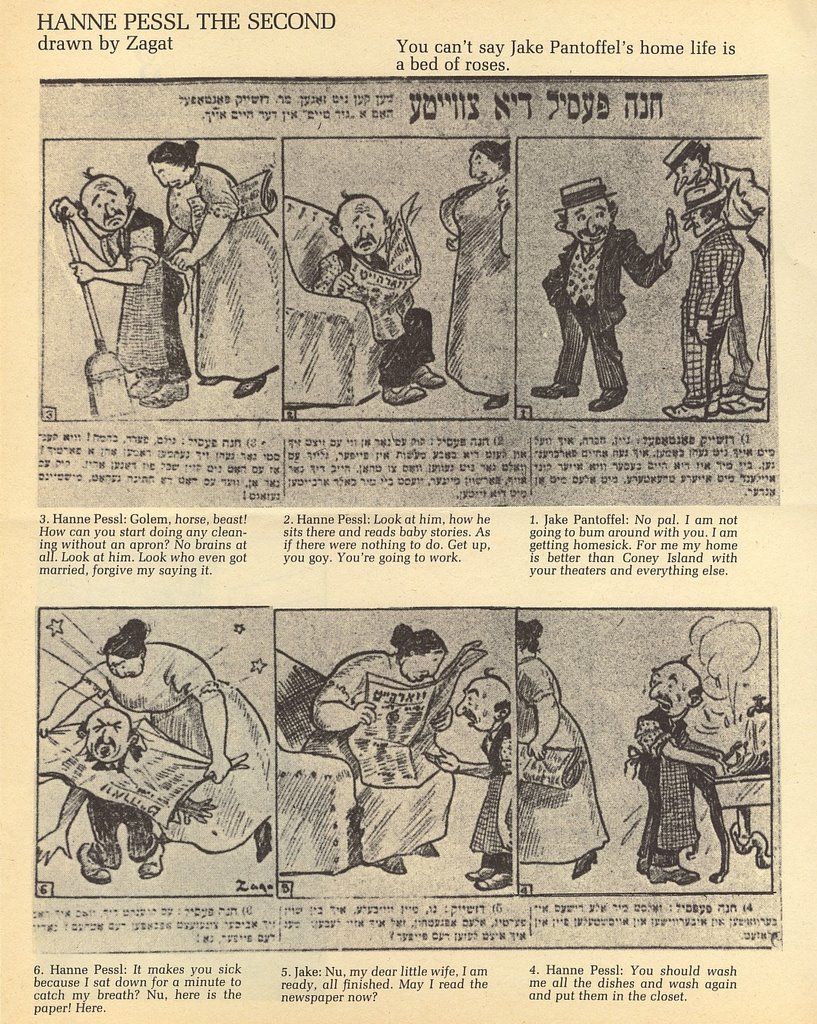
Look at him, how he sits there and reads baby stories.
Rooting around in the files...
Samuel Zagat (1890-1964) was a cartoonist and photographer, part of a small group of left-wing Jewish artists who flourished in the socialist press in the early part of the 20th Century. I had never heard of him before I found this cartoon in a disintegrating book about the New York Jewish immigrant experience a few years ago.
Zagat drew a strip called "Gimple Beinish" (1912-19) for the Yiddish daily Warheit /Varhayt in New York. He was also an editorial cartoonist for the Daily Forward. A book of his drawings was published in 1972.
The strip here, featuring Hanne Pessl, was originally in Yiddish and reads right to left.
Deborah Eisenberg, the U.S. Alice Munro, was on the CBC last week talking about her latest collection, Twilight of the Superheroes. The title story is about a cartoonist who lives through 9/11 and it has some interesting things to say about the idea of superheroes as a metaphor for Empire. Eisenberg states her case plainly in a Bookninja interview from last summer, where she discusses the Superman movie:
"It's both heart-rending and nauseating that the national impulse would be to seek solace and reinforcement at this moment, in, for instance, Superman as a representation of moral action. I can't claim to be an expert on the cast of Marvel Comics, or, in fact, to know much of anything about any of them, but nonetheless, they're present even in my inhospitable consciousness. So it seems that they must perfectly express something about our culture.
And I suppose that what it is they so perfectly express is our desire to understand our disproportionate power as power that's unambiguously and inevitably used for the benefit of humanity. Even in regard to the Unites States of the Second World War, this view might have merited a raised eyebrow or two, but now it's shockingly self-deceiving at the least, and pretty brutal. It seems to me that not only is there an enormous longing for what we imagine to have been a time of innocence in our recent history, but that there's also a sort of willful childishness, or, to put it another way, a self-congratulatory coyness in the way imagination is collecting around these figures now. Even the nostalgia doesn't seem quite authentic. It's as if there were something endearing, something loveable, about trying to maintain this view of ourselves as childishly innocent and good even though we know very well that it's not accurate – something gallant and charming. This is a form of bullying, in my opinion; a demonstration that we can afford (temporarily, anyhow) to hold on to these consoling charades of power-with-integrity, however degraded, even laughable,we understand them to be.
Born in 1945, Eisenberg probably missed out on the first wave of superhero comics and was not quite 10 when "Superduperman" appeared in MAD. She was graduating from college when Jack Kirby and Steve Ditko were repopulating New York with superheroes and was well into her adult life when Batmania and Wonder Warthog were stirring up the kids, so she can be forgiven for mixing up her publishers. In any case, everyone knows that outside of a few arrested adolescents like Michael Chabon and Jonathan Lethem, serious writers don't read superhero comic books. Nevertheless, Eisenberg still makes a few interesting points. Even if mainstream kids comics can't be expected to engage with adult themes and political issues, what about Hollywood? I've seen enough of the current crop of superhero movies to know that they are trafficking mainly in the same thing the comics have got by on for generations --escapism, power fantasies, and nostalgia. I'm less familiar with the current superhero comics world since the heavyhanded Watchmen metaphors of the 1980s --the world of The Authority and Identity Crisis. Outside of Dan Clowes' "The Death Ray" (or for that matter, David Boring), are there any contemporary superhero iterations that deal with their own limitations as a genre in ways that are not just pat or satirical? Is it even really possible or necessary? Are superheroes bad for us? Adorno said "After Auschwitz it is barbaric to write poetry." Should we say, after 9/11 it is barbaric to draw superheroes?
I leave the final word to that other great philosopher, Sergio Aragones:
"It's the super-hero syndrome, exactly. [...] It's out of our power to solve. It's defeatism --you can do nothing about it. It's like "I surrender." The only way I can solve my problem is with a super-hero, or an astronaut, or somebody from outer space, or God helping me. And this is like throwing your gloves on the floor. When you have to fight, then you think you have a solution, but when you don't want to fight any more, that's when you go to total despair and then you go looking for some super-heroes to solve your problems. Which is very bad. I don't think those movies give any good messages. That the only love you find is with mermaids or with things from outer space. No! No! No! Reality is what can save you."