Monday, March 09, 2009

Craptain Canuck vs Watchmen, Part 2


3 Superhero Comics That Were Better Than the Watchmen Movie

It should come as no surprise that I felt the best part of the recent Watchmen movie was the ending. Specifically, the choice of music played over the closing credits: Leonard Cohen's "First We Take Manhattan." No other song could be so fitting. An ironic, apocalyptic song-poem droned by Cohen over a cheezy, 1980s synth-pop track, the piece perfectly sums up the contradictory impulses at work in the horrible film that preceded it. Serving as a nod both to the conspiratorial nature of the film's plot and to the centrality of the ubermensch Dr. Manhattan character, the song's opening lines, "They sentenced me to twenty years of boredom...," perfectly sum up my feelings after sitting through the seemingly interminable movie.

The best part of the recent Watchmen hoopla and hype is that it has re-opened the critical debate on the comic book source material of the movie. Stalwart soldiers for the cause of comic art, like Jeet Heer, take a stance against all superhero comics that are not straight parodies or fun kids' stuff. Others, like cartoonist-critic Frank Santoro, say you have to be a true-believer to even begin to understand where Alan Moore is coming from. Somewhere in the vast middle is Tom Spurgeon who, while he pans the film, still finds several interesting approaches to enjoying the graphic novel.

There is no denying the graphic novel is interesting, a workmanlike, well-crafted, intricately plotted story packed-full of stimulating and often funny ideas about superheroes and politics, but it is essentially a failed masterpiece the parts of which never really cohere in any significant way. A great gaudy graphically complex book, Watchmen nevertheless suffers from Dave Gibbons stiff figure drawing and Moore's shallow characterizations, unbelievable plot, and ambiguous relationship to the material.

In truth, it is extremely hard to take superhero adventures seriously, let alone craft aesthetically sophisticated versions of them for adults. The most successful contemporary examples of mass-market superhero comics seem to straddle a fine line between slick genre exercises that meld aspects of crime fiction to superhero fantasy and utter fannish dreck that would have been rejected by producers of 1970s Saturday morning cartoons. There is only so much metaphor and thematic density a rickety genre about magic boyscouts in circus costumes can support.

For your consideration, another group of superhero-related comics that attempt to do something with the genre, inspired by Sean Rogers' recent Watchmen "Corrective":


1. Trashman by Spain Rodriguez

(collected in Trashman Lives! by Fantagraphics Books)

Originally appearing in 1960s underground press forums like the East Village Other and in Spain's own Subvert comic book series, Trashman answers the question nobody asked, "What if Jack Kirby's Sgt. Fury was a horny Marxist from the future?" Spain re-imagines the traditional superhero story from the point of view of a working-class leftist militant confronted with creeping political fascism and corporate capitalism, confronting it with paranoid drug-influenced page layouts and plotting, clunky post-Kirby figure drawing, heavy black inks, and trippy sloganeering and self-referentiality, all set in a fantasy of revolutionary sex and violence. Trashman is really a prole named Harry Barnes who is recruited and trained by the Sixth International to fight the cops and defend the workers. Trashman has several paranormal senses and the ability to change his shape at will, but he mostly likes to shoot people with machine guns in the service of a disjointed narrative --sort of OMAC meets Che Guevera. The Trashman comics are beautiful and funny love letters to a revolutionary ideal.


2. Archie as Pureheart

by various

(available in 2010 as Archie: Pureheart the Powerful from IDW)

As explained here, the Archie team decided to simultaneously cash in and parody the craze in superhero comics spurred by the 1960s Stan Lee/Jack Kirby/Steve Ditko revolution at Marvel and the revitalization of Silver Age superhero products at DC by penning a series of adventures starring the Riverdale gang as a group of superheroes, with lots of tongue-in-cheek fun and beautiful fluid clean cartooning. It's a self-aware kids comics that's not afraid to take a numbskull premise and run with it, without looking back, and without making a career of it. The result reads like a combination of classic MAD superhero parodies ("Superduperman," et al), Ditko and Lee's Spider-Man, and Otto Binder and CC Beck's Captain Marvel/Shazam comics of the 40s and 50s. The sort of superhero comics that Jaime Hernandez would do, minus the sex and punk rock (but still with lots of fishnet stockings and people hitting each other with their butts).


3. Jimmy Corrigan, Smartest Kid on Earth, by Chris Ware (Fantagraphics)

Ware's searing masterpiece puts Watchmen to shame with its ironic distance, convolutions and diagrammatic precision. A reflection on mortality, failure, family, childhood, and an obsession with superheroes, Jimmy Corrigan is a graphic novel that treats the godlike nature of our heroes with a probing wit and academic artistic scalpel. The fact that both almighty god and a washed-up Steve Reeves-style actor appear as a Superman figure is just a bonus. Did any comic do more for and to the genre of superheroes than Jimmy Corrigan? As Peter Schjeldahl wrote for The New Yorker, "Reading 'Jimmy Corrigan' is like operating an intricate machine whose function is not immediately apparent. Gradually, meanings emerge and emotions crystallize. None gladden." The doom that comes to Jimmy is ultimately more banal and overpoweringly wonderful than the boredom of Dr. Manhattan's demise and resurrection.

Wednesday, February 25, 2009

Graphic Novel Review: Tamara Drewe


Part 1 of The Best of 2008
(see the full list here)

Tamara Drewe
by Posy Simmonds
(Jonathan Cape/Random House)

review by BK Munn


Posy Simmonds draws the best cows of any living cartoonist and her ability is ably demonstrated in this pastoral farce that reads like Leah McClaren as drawn by Frank Thorne (or maybe David Lodge meets Colleen Doran?) --and is in reality an homage to Thomas Hardy's Far From the Madding Crowd (which was originally illustrated by another woman, Helen Paterson, way back in the 1800s). The book has a wonderful polyvocal narrative centred around the goings-on at a writers' retreat in the English countryside. The titular heroine, a zaftig columnist-turned-novelist, is the catalyst for a series of romantic and literary calamities that befall a small group of creative types forced into close quarters in the wide-open spaces. For a comic, Tamara Drewe has relatively large chunks of text, and the book feels very writer-ly, as befits its source, subject matter, episodic plot, and original serial publication, but it actually has a very tight structure built on a foundation of humour, beauty, and skilled storytelling.

Thursday, February 19, 2009

Batwoman loves Catman


I love this cover. Sort of a Freudian dream image combining a child-like approach to lust and femininity with bold iconography. You can see why artists like Dan Clowes have made so much of Silver Age DC comics tropes. Background: Catman was a Batman villain who had a major crush on Batwoman (Kathy Kane) and fantasized about her wearing kinky costumes. Sort of a superhero (or supervillain) stalker. But he had a cool pad and liked cats, so he couldn't be all wrong. The Catman "epic" played out over a scattered trilogy of issues during the mid-60s.

Monday, February 16, 2009

Captain Canuck vs The Nihilists of Sarnia


This classic comic book adventure presents the superhero dilemma in a new light. Canada's favourite son, Capt. Canuck, superhero with a cause, fights U.S. imperialism as only he can, through meditation.

Tuesday, February 10, 2009

Who Cares If A Comic Book Doesn't Solve a Problem?

I wonder with some of these vendors, these artists, these companies--are they really asking themselves ‘what problem does this solve?’ --Nina Stone

Maybe I just didn't understand the argument, but I'm not sure if I get the point of Nina Stone's post about the New York Comicon. Stone writes with great empathy about the plight of the lonely vendors with empty booths at the convention, dredging up her own memories of being a gifted elementary school near-crybaby and comparing her experience of being thrust into the adult world of problem-solving without the tools or even the desire to figure out solutions in a logical, "adult" way, to the experience of entrepreneurs, publishers and artists who have created products for which there appears to be little or no market. Stone blames the "insular" and "self-serving" (read: childish) nature of comics fans for their inability to be "more successful."

Businesses and products (and art) flounder and fail all the time. And its not just because the creators can't see past their own navels and are stuck in a sort of anal-stage of business development, playing with themselves like monkeys in a cage and filing their own shit in sealed mylar sleeves. If the magic key to "success" was "solve the 'right' problem" (which sounds like "build a better mousetrap" to me), you would still have the same situation. There are so many other factors that go into "success" it's almost not worth talking about. Much more than "guidance," a lot of it seems to be luck and timing. Oh, and intelligence. And talent. And a million other things. And what is "success" anyway? I'm guessing, the financial renumeration enjoyed by people on the bestseller list or people with a blockbuster movie. Or "success" means having a girlfriend or the respect of strangers, maybe?

For many, comic conventions are therapy. They are a thousand other things. Comic conventions --just like hardware conventions or fashion tradeshows-- are also filled with dishonesty and ugliness. Intellectually and aesthetically. Sometimes they are also filled with great art or, at the very least, even products that satisfy a small but needy and grateful market.

Monday, February 09, 2009

Best of 2008


by BK Munn

Of the graphic novels and comics I've read from 2008, here are my favourites. I've categorized according to rough genres. I'm drawn to long-form fiction comics (graphic novels) more than most forms of comics and tend to favour them in my reading and list-making. Dash Shaw's Bottomless Bellybutton was a revelation for me, wonderful art, a mesmerizing, emotional narrative. It was also the work of a relative newcomer, as is the work I've listed in minicomics. I feel kind of silly comparing, say, Jason Kieffer's or Jesse Jacobs' short comics with Shaw's massive book but end-of-year lists seem to do that all the time. Some things are easier to rank. I actually read more new superhero comics in 2008 than in any year since 1986, including large chunks of the latest from Grant Morrison, Brian Bendis, and Ed Brubaker, and I can honestly say that the 6 pages of Gary Panter in Omega #7 and the first two chapters of Jaime Hernandez's superhero saga in the new Love and Rockets blew most of those long-underwear types out of the sky. They were also more profoundly beautiful than several of my choices in other categories.

I also refuse to rank archival re-issues of classic comic strips by past masters, some of the best comics of all time, alongside new minicomics or memoirs or prints of Japanese horror adventure comics. And speaking of translations, I decided to lump the translated Canadian comics on my list in with the other translated comics I read. So, more divisions. I thought of a separate Canadian category for all, but thought the Canuck entries stand up well in international company. It also says something for the current era of comics publishing that there is enough interesting, quite excellent and even wonderful work being published in a number of different categories.

Fiction
Tamara Drewe by Posy Simmonds
Bottomless Bellybutton by Dash Shaw
Skim by Jillian Tamaki and Mariko Tamaki
Acme Novelty Library #19 by Chris Ware
Dietch's Pictorama by Kim, Simon and Seth Dietch

Non-Fiction/Memoir/Reportage
What It Is by Lynda Barry
Drop-In by Dave Lapp
My Brain is Hanging Upside Down by David Heatley

Minicomics
Kieffer #2 by Jason Kieffer
Blue Winter, Shapes in the Snow by Jesse Jacobs
Small Victories by Jesse Jacobs

Reprints
Breakdowns by Art Spiegelman
Little Orphan Annie Vol 1 by Harold Gray
Popeye Vol 3 by EC Segar

Translations
Paul Goes Fishing by Michel Rabagliati
Burma Chronicles by Guy Delisle
Tokyo Zombie by Yusaku Hanakuma
Cat-Eyed Boy by Kazuo Umezu
Red-Colored Elegy by Seiichi Hayashi

Superhero
Love and Rockets #1 by Jaime and Gilbert Hernandez
Omega the Unknown #7 by Gary Panter, Jonathan Lethem and Farel Dalrymple

Webcomic
www.harkavagrant.com by Kate Beaton

Friday, February 06, 2009

Canadian Fan Project: Super Letters


More missives from the distant past of fandom, when Canadian comic book fans weren't shy about speaking truth to power:

"As an ardent reader of your fascinating magazines, this is my first opportunity to catch you. In 'The Unknown Superman', you show Strong Bear boring with his hands in the coarse soil and tough rocks. If his ring was not destroyed by that, why was it destroyed when Lois dropped it? And why didn't the ring become indestructible on earth just as everything from Krypton does, if Strong Bear automatically gained superpowers here?" Robert Romano, Montreal Quebec (Lois Lane #52, 1964)

"I though Jimmy Olsen No.101 was just great because it had an interesting plot and plenty of excitement. But in my opinion, it was a mistake to kill off Miri and her father, Dr, Zak-Lor. This was a pretty drastic and unnecessary move, because they were two very important characters in the story. But aside from that, the feature was out of this world!" Arpad de Szoeczy, Weston, Ont. (Jimmy Olsen #103, 1967)

"I say, guv'nor, this is Ringo Starr speaking on behalf of all us Beatles. We are quite flattered that you mentioned us in your comic. But if you're going to put us in, please do it properly. On the first page you show Mr. James Olsen watching us on the telly and your artist depicts us with lapels on our jackets, whereas we have none. We want to thank you for the publicity. You see, we are making all this money to get something we have always needed --a haircut!" Pat (Ringo) Boardman, Toronto (Jimmy Olsen 81, 1964)

"I especially like Rose and Thorn. I am looking forward to seeing much more of her. I don't really know why I like Rose, but maybe its because she has the same haircut I do!" Linda Hamilton, Winnipeg (Lois Lane #108, 1971)

"I truly enjoy your stories, and their characters. They're simply great! I don't believe in telling people of their mistakes, especially since I haven't any to speak of ...So I'm writing just to tell you that I think you're very fair in your attitudes towards your readers. You take the complaints of those who do write to complain, and you answer them constructively. As long as Lois Lane is on sale, I will continue to buy it, and remain a follower of Lois adventures!" Bonnie Erickson, Alberta (Lois Lane #137, 1974)

Tuesday, February 03, 2009

Superman Robots


Some of the most poignant melodramatic aspects of the Superman family children's comics of the 1950s and 60s involve the Superman robots. Automaton slaves created by scientific genius Superman to act as his backup beards, and kept hidden in the closet when not in use, many classic stories relate the AI-like attempts at individuality and rebellion of these sad creatures. Superman kept his robots stashed away in his parents' basement, in a cave at the North Pole, in the closet of his apartment (whole Phds await!). Supergirl kept her robot double waiting patiently in the trunk of a tree, never sleeping, in those anxiously whimsical stories drawn by Jim Mooney.

The most recent robot tale I've read concerns Robot X-3. While training a new batch of robots (Superman trains his robots instead of programming them with essential information like, "don't let anyone see you change into Clark Kent"), Superman is turned invisible by red kryptonite and X-3 has to take his place and rescue some astronauts. X-3 gets lost in space and ends up on a tiny planet where he meets a stranded mermaid woman who reminds him of Superman's first girlfriend, Lori Lemaris. X-3 is such a hero-worshipper that, when the mermaid dies, he creates a robot mermaid family and builds a little house where he lives forever and happily ever after, kind of like The Little Prince meets Space Family Robinson, as illustrated by Kurt Schaffenberger .

Thursday, January 29, 2009

My Barbarian

Bringing the "people dressed as Canadian superheroes" file up to date:

Monday, January 26, 2009

David Mirvish Books Closing

The Star
Spacing Toronto

Globe Books

It is quite the news. When I first read about it and posted it to Sequential, I thought that the closing of Mirvish was long overdue, in the context of North American booksellers, and definitely in relation to the book market as constituted by the Book Depots, BMVs, and Chapters/Amazons of the world. No way to compete, despite the deep pockets of the owner. Sure Mirvish Village is a "village," but it's not exactly Guelph, a one (or two) bookstore town. There are tons of (chain) stores within fifteen minutes of Mirvish. Not to mention that the store seemed overstaffed and closed early (chains stay open to 9 or midnight --especially in populous/cosmopolitan areas of megacities). Hell, the Bookshelf in Guelph is open most nights to 8 and our Chapters to 10. (But lets not forget that Heather Reisman set up a $3 million/year fund to Israeli army vets.) Anyway, Mirvish is going online, where they have a very slim chance, based on financial backing, acumen, and customer loyalty, to make a go of it as a boutique/gateway site for moneyed art book buyers. Overall, it was a great space, offering a great service. Books you would never stumble across anywhere if you didn't know what to ask for. Booklaunches for Shary Boyle and other artists. Support for small presses like The Porcupine's Quill. I had many great experiences there and found some great books. Silver lining: maybe the Beguiling will move out of its cramped space across the street, if the rent is reasonable.

Thursday, January 22, 2009

NFB Reveals New Site

Canada's National Film Board, or NFB for short, has been producing movies, ranging from animated shorts to documentaries to full-length features, since forever. They gave finally got around to opening a youtube-style website where you can watch all their films. There are over 700 films currently uploaded, with more added daily.

Here are some highlights:

1978 cartoon about death and the afterlife by Ishu Patel


1939 film about unemployment in the Depression


women pilots in WWII by Jane Marsh


Norman McLaren's Le Merle, 1958

Wednesday, January 21, 2009

Be Nice, Clear Your Ice!

Ben Wicks was a bestselling author, tv host, and cartoonist. But his most lasting contribution to Canadian culture, besides the Ben Wicks Pub in Cabbagetown, may be this awesome public service ad that has inspired millions of Canucks:

Monday, November 10, 2008

Top 5 Fictional Comic Books


I recently read with interest this examination of books that never existed outside of fiction on the Guardian Book Blog. In that discussion of Borges-style imaginary books like The Blind Assassin from the Margaret Atwood novel of the same name, a poster in the comments section mentioned several apocryphal novels glimpsed fleetingly in a sequence from Neil Gaiman's Sandman comic book. The post made me think about my favourite examples of "fictional" comic books and cartoon characters, as featured in some classic comics and graphic novels.

5. "The Comic Book Archer" (Adventure Comics 269) by Robert Bernstein and Lee Elias

In this 1960 story, superhero and Robin Hood imitator Green Arrow tries to help a young comic book artist get published in "All-Star Comics" by reproducing the feats of the cartoonist's creation, "Wizard Archer." This is a fun little gem from the Silver Age of U.S. comics that features a self-referential, behind-the-scenes peek at a DC-like comics company, in which caricatures of writer Robert Bernstein and cartoonist Lee Elias appear to explain how comic books are made ("The artists draw whatever the writers tell them to in their scripts!"). Of course, the upshot is that Green Arrow proves the archery tricks that appear in the comic can actually be accomplished in "real life" and so Wizard Archer appears in the next issue of All-Star, which finds a space on the shelves alongside Atlantis Comics, The Golden Avenger, and Western Heroes. (this story is reprinted in Showcase Green Arrow)


4. Watchmen by Alan Moore and Dave Gibbons (DC)

The comic-within-a-comic of this graphic novel is the famous Tales from the Black Freighter, the pirate comic and Brecht-reference that answers the question, what kind of comics would kids read in a world where superheroes are real? Text pieces in the book suggest that Tales was part of a larger pirate genre, spear-headed by EC's Piracy. The pirate story "Marooned" is used by Moore as part of the elaborate system of parallels and gothic devices that make up the bally-hooed structure of Watchmen and still reads today as an affecting piece of purple prose, regardless of the repellent stiffness of Gibbons drawings.


3. Hicksville by Dylan Horrocks (Drawn and Quarterly)

This graphic novel about an American journalist investigating the bizarre secrets of a small New Zealand town is equal parts ode to comics and metatextual exegisis of comics storytelling. It also contains more than its fair share of imaginary comics (or comics-within-comics), including Captain Tomorrow -- the creation of New Zealand ex-pat Dick Burger, an autobiographical minicomic by Burger's ex-assistant Sam Zabel, and mysterious about maps, Maori, and Captain Cook. At the heart of the book lies the mystery of the Hicksville Lighthouse, repository of all of the great comic might-have-beens, the mythical comics that the world's greatest artists and writers would have created if not constrained by commerce and the philistinism of comic book production in the 20th Century. Thus, we are treated to the exquisite idea of Harvey Kurtzman's magnum opus History of War, lying alongside lost works by Jack Kirby, Picasso, Winsor McCay, and untold hundreds of others.


2. David Boring by Daniel Clowes (Pantheon)

This graphic novel has been described by Clowes as "Fassbinder meets half-baked Nabokov on Gilligan's Island" and largely resists summarization. It deals in small part with efforts of the eponymous lead to learn more about his father, a cartoonist who worked on a superhero comic book called The Yellow Streak. The single extant issue of the comic book exists only in fragmented form, having been torn up by Boring's mother. Piecing together the few panels of the comic remaining, it appears that the Yellow Streak comic is a synthesis of Superman and Johnny Thunder, but the story is mostly unreadable, portraying a weird Freudian nightmare universe akin to the world created by Wayne Boring and other artists of the Weisinger-era Superman comics, the world of Jimmy Olsen and the Phantom Zone. Boring's efforts to make sense of these fragments, trying to find some reference to the real world history or psyche of his father form one of the major subplots of the book and relate to Clowes' recurring themes of alienation and authenticity.


1.
Wimbledon Green by Seth (D+Q)


Seth's first graphic novel, It's a Good Life If You Don't Weaken, introduced us to the fictional New Yorker cartoonist Kalo, one of the great hoaxes of modern comics. Seth wrote an introduction to Horrock's Hicksville and seems to have a soft spot for imaginary comics. Wimbledon Green is the story of an Uncle Scrooge-like comic collector who criss-crosses the country looking for the world's most rare and obscure comics, including such gems as The Green Ghost #1 (the Holy Grail of comics collectors), All Bedtime Comics and Mighty Orbit. But the cream of Wimbledon Green's collection is the classic hobo comic book, Fine and Dandy, a wonderful series that recalls 30s comic strips, Laurel and Hardy, and the work of John Stanley, a Seth touchstone and idol.

Monday, October 13, 2008

Review: Manga Serials


I missed out on responding to Tom Spurgeon's most recent "5 for Friday" questionnaire, Right to Left, or, "Name Five Manga Series You Personally Are In The Midst Of Reading, Whether Or Not The Series Is Ongoing Or Finished." Since the last time I reviewed a random manga title was awhile ago, I thought I'd respond to Spurgeon's quiz here:

The most recent translated Japanese comic I read was Seiichi Hayashi's Red Colored Elegy, a wonderfully evocative existential graphic novel about two young lovers in 1970s Japan, which the comics critic Bill Randall has suggested owes a large debt to gegika pioneer Yoshiharu Tsuge. But this is a stand-alone novel, and one of the better ones I've read this year. In terms of multi-volume stories, however, my reading has generally been limited to adolescent and melodramatic genre fare.

1. Cat-Eyed Boy and The Drifting Classroom, by Kazuo Umezu

The beautifully packaged Cat-Eyed Boy (published by VIZ) tells the story of the titular feline demon, equal parts Tintin, Sluggo, Ditko-era Peter Parker, and Klarion the Witch-Boy, an itinerant monster-fighter who enjoys living in people's attics and defending children and their families (usually against their will) from (sometimes quite disturbing) manifestations of evil. Cat-Eyed Boy is a perfect serial character (the stories originally ran in a kids magazine with a horror edge, a fact referred to in several episodes), with a built in appeal to younger readers centred on the hero's rejection by society as well as a childlike approach to plot and narrative logic, not to mention horrific, "I dare you to look"-style imagery. The stories are disgusting, scary, hilarious, and emotionally powerful. I burned through the two-volume omnibus edition of these books, and the horrific images, humour, and cartooning artistry have stayed with me. The amazing, Willy Wonka-flavoured book design is discussed by Chris Butcher here).

By contrast, I am slowly savouring Umezu's magnum opus, The Drifting Classroom, ordering two volumes at a time and waiting anxiously between installments (I've just finished volume 6). The story, about an entire school of Japanese children mysteriously transported to a post-apocalyptic future, and the resulting Lord of the Flies-style debacle that ensues, is a breakneck, fast-paced horror-thriller about loyalty, familial love, politics, savage murder, giant insect creatures, Plague, and the howling fear of imminent, inevitable dirty death. The original serial nature of the work shows in its overall frantic pace, where events tumble over each other, unchecked, with very little in the way of pacing, reflection or character development. But it is thrilling, sad, and spooky.

2. Dororo by Osamu Tezuka

I've only read the first volume of Vertical's 3-volume collection of this disturbing 1960s Tezuka classic, written in the vein of Kurosawa meets Frankenstein. The story, about a young urchin who teams up with a ronin, who is really a bizarre Pinocchio-like character whose body parts have been stolen by demons, is gross and mesmerizing, with great storytelling and Tezuka's patented cross-genre goofiness. The book design of this series, like most of Vertical's offerings, is beautiful.

3. Nana by Ai Yazawa

I first became aware of Nana, a sort of punk soap opera several levels below, continents and generations removed from Love and Rockets, by flipping through the pages of Shojo Beat magazine at the grocery store a few years ago. The most accessible, recognizingly human, and serious of the many girls' manga series on the market in North America that I've encountered, the story, about two young women trying to make it in the big city, is compelling, humourous, and sharply-drawn. Very much a melodrama, the book packaging of the first two volumes I have is reflective of the intended audience, with muted colors and thoughtful imagery.

4. One Piece by Eiichiro Oda

This serial is one of the very few boys' series I can even stand to look at in Shonen Jump magazine, thanks to the open, fluidly dynamic and cartoony style of writer-illustrator Oda. The story, about a Plastic Man-empowered wannabe boy-pirate in search of a mythical magic coin with his Jason and the Argonauts/Seven Samurai company of super-powered fighters (think Jimmy Olsen meets the plot of Fantastic Four #5, forever), is strictly pulp boilerplate and shows no sign of ending soon (there are over 50 volumes). Moronic and basically for kids, it is nevertheless one of the most coherent and appealing of the popular comedy-adventure fight comics.

5. Death Note by Tsugumi Ohba and Takeshi Obata

I am "in the midst of reading" this series only in the sense that I stopped before finishing the final volume. At the time of first reading, the series just became too cyclical and frustrating, after a pivotal set-back/do-over half-way through where a major protagonist was replaced by a younger variation of himself. The series, about a highschool student who is granted the demonic power to kill people at a distance by writing their name in a notebook, is a tense, page-turner of a gothic thriller, relentless in its pacing, and full of agonizing reversals, hairbreadth escapes, gasp-inducing shocks, moral quandaries, and crazy-explosive Hollywood set-pieces. The Byzantine story and plot mechanics are very nicely complimented by the laser-sharp daring of Obata, a virtuoso cinematographer to writer Ohba's Hitchcock-ian plodding.

Wednesday, October 01, 2008

Review: How Sluggo Survives

how sluggo survives


How Sluggo Survives
Ernie Bushmiller, edited by James Kitchen
Kitchen Sink Press
1989
ISBN 0-87816-067-1
out-of-print, price my vary

I found this book as part of a Mystery Hoard that included, in total, 3 issues of Wizard Magazine and a giveaway Spider-Man comic.

How Sluggo Survives is a collection of Ernie Bushmiller's Nancy comic strips that focuses on Nancy' co-star and sometime boyfriend, Sluggo. Sluggo is a tough working class kid with no visible means of support, modeled after the slang-talking, newsboy-cap-wearing inner-city kids of U.S. popular culture, akin to Hollywood's Dead-End Kids and Jack Kirby's kid gangs.

This is a fascinating volume, part of a series of themed reprints published by Denis Kitchen during the short-lived Nancy renaissance of the 1980s, when everyone from Frank Miller to various Underground and RAW alumni were singing the praises of the so-called 'dumbest comic strip' ever. One of the best parts of the book is the introduction by reclusive control freak, painter and RAW Magazine cartoonist Jerry Moriarty. Moriarty sums up the appeal of Nancy for the Underground generation as "brain repair," noting that "[b]eing a reluctant Ernie Bushmiller fan also said something about esthetic renewal and ongoing change and hope." Moriarty's essay is accompanied by notes from his alter-ego, Jack, of "Jack Survives" fame. The conceit of this Jack piece is that Jack has been a living in Nancy's town and has observed her adventures with Sluggo from a distance, although he sometimes feels like he is observing something resembling the activity of another dimension, perhaps the creation of his elderly neighbour Bushmiller.

The strips in How Sluggo Survives seem to have been chosen for the degree to which they reveal aspects of Sluggo's life away from Nancy. Many intriguing snippets of his existence are revealed, including Sluggo's address (140 Drabb St.), his various jobs (office boy, delivery boy, scrap dealer, grifter, goldbrick), and portents of his future --a recurring gag revolves around the fortunes he receives from one of those "weight and fortune" amusements that used to litter the commercial districts of every town in North America. Sluggo is a fascinating, mysterious character: a proto-punk hobo child who oozes America from every inky line.

Since I grew up largely post-RAW, I've always taken for granted the canon-icity of Nancy and so the Nancy naysayers and those who argue that Bushmiller's strip is moronic (or even those who appreciate Nancy in an ironic or, "so bad it's good" sense) have always puzzled me. The strip is well-crafted, charming, and, more often than not, very funny and thought-provoking. Highly recommended!

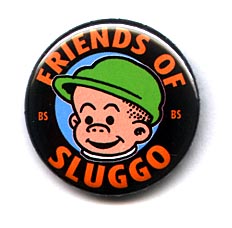
friends of sluggo button

Tuesday, September 23, 2008

Superboy Fan Letters Will Blow Your Mind


I accidentally left a copy of Superboy #185, a giant-size 100 page anthology comic from 1972, lying on the kitchen table earlier tonight. For some reason, Kara picked it up and started thumbing through it. I came across her several minutes later. She was sitting abjectly, in something resembling a catatonic state, the letters page from the issue open before her. The cause of her apparent stroke? A letter from Gary Skinner of Columbus, Ohio:

Dear Mr. Bridwell,

It may be a whole year before I can regain my honor, but I have new evidence which will at least allow us to share the blame, with neither of us the loser. The subject is my letter in the Giant Superboy #174. I knew darn well that more had been done to the Kents in the story of their deaths than the elimination of their glasses and the altering of their hair color. They were definitely changed to look more youthful and the change was an artistic one. I looked through the original story in Superman #161, and the difference was there, miniscule though it was. In the reprint, the Kents' necks had been redrawn to be slim, whereas the original had portrayed them as old people with husky, fat necks. I lose in my assumption that Al Plastino himself had redrawn the, but you lose also , because in rejuvenating them, you definitely redrew them, as I maintained. I am exonerated.

By the way, you blew something else on the same letter page. You are supposed to be the authority on the Superman family and all details thereof, but you forgot something concerning the the enlarging of Kandor. Although I cannot quote the magazine or issue from which I got my information, I recall that Brainiac built his shrinking ray in a special way, in combination with his own design of enlarging ray. Such are the conditions that only Brainiac's own ray can enlarge the city to normal without side-effects. Superman himself hasn't been able to duplicate that ray exactly, and even though Brainiac has been disassembled, so sophisticated a computer was he that the memories within his brain are locked there in defiance of any probing ray that might try to extract them. The secret is his alone, and until Superman can get around that little obstacle, the city of Kandor will be dinky as ever. Too bad.

I guess I've henpecked you enough for one day. And at the risk of sounding sarcastic, keep up the good work.


The lesson here is twofold: old Superboy comics have a Kryptonite-like effect on those unfamiliar with the minutiae of the Silver Age mythos and the fannish compulsion to know all. As well, we learn that the fan culture of 1972, as fostered by uber-fan E. Nelson Bridwell, was as vibrant and probing as any in existence today, whether obsessing over the age of Jonathan and Martha Kent --rejuvenated in 1968 (Superboy #145)-- or the nature of Brainiac's nefarious technology.

A final note: Al Plastino lives!

Tuesday, August 19, 2008

"Why even bother drawing Supergirl in such a way that a discussion of her underwear wearing habits is even necessary?"

supergirl in space by jim mooney
I guess this is where I say modern superhero comics suck and are mostly ugly.

Gary Panter's art is ugly but is also beautiful.

The title quote comes from comments on this old blog. I am grateful to the Publishers Weekly comics blog, The Beat, written by the venerable Heidi MacDonald, for her 63 comment-generating, quizzical post about a recent comic book cover featuring the Supergirl character. The character is featured in one panel within the comic in question. The panel also features the welcome return of Streaky, the Super-Cat. It's no Jim Mooney classic, but it will do. I'm still baffled by the post (and I even read the comic in question --which does not feature underwear, you may be glad to know).

Well, at least people are talking about something important, instead of the Wright Awards.

Monday, August 18, 2008

I Re-Cruited Some Grem-lins


Well, this looks pretty fucking amazing. Renegade: The Lives and Tales of Mark E. Smith promises to be the greatest Fall-related tome since Pan by Camden Joy or maybe Smith's own lyric collection, VII. The Exclaim! piece includes an embedded video of the Fall's cover of "Victoria" by The Kinks. The Youtube version of "Wings", one of my favourite 1980s music videos, is unavailable as an embed, apparently, but I happily substitute the live version below. I really can't recommend enough the jumbled images of notorious alleged squirrel killer Smith as filmed from the mosh pit sleepwalking himself through this number. On the subject of comics, you can read Smith here. He is a fan of Luther Arkwright and a detractor of "VIZ comic". My own opinion is that VIZ rocks (rocked?) and that Luther Arkwright is overrated.

I feel like this should go without saying, but: watch out for those time-locks!

---
more

Monday, August 04, 2008

Radio Humour

radio craft magazine 1944 hugo gernsback tv

Is it a Mystery Hoard if there is only one item in the hoard?

I found this magazine in the store around the corner, among an assorted batch of old magazines and newspapers. The owner of the store wanted to give it to me, but I eventually talked him up to $2.

This issue of Radio Craft, dated December 1944, was published and edited by Hugo Gernsback, the so-called "godfather of American science fiction." Gernsback was an early fan of radio and a very early adopter of television, as the cover to this issue attests. The Gernsback-penned cover feature outlines "the technique of a remote controlled robot machine gun," designed to address "the desire of all military authorities of the belligerent armies to conserve human life as much as possible" --this in the middle of WWII! The great cover graphic is perhaps one of the first visual representations of a video game precursor (or is it drone warfare?).

This issue also includes several how-to articles written for the radio hobbyist and professional, with special attention given to military issues. There are many wiring and circuit diagrams that confound me.

frank franklin beaven radio cartoon

The best feature of the magazine, from my point of view, are the two radio-themed cartoons by Frank Beaven, a New Yorker and Humorama contributor and sometime writer. Both cartoons manage to ring fairly lame changes on rather trite stock situations from the cartoonists' gag bag. The first cartoon, showcasing the standard offensively racist "captured by African natives" scenario, is delightfully obscure. Adding to the wonder, the gag is credited to Ed Marles of Chilliwack, BC --making this entry eligible for inclusion in the Canadian Comic Fan Project.

frank beaven cartoon flying carpet

The rest of this issue of Radio Craft is filled out with some wonderful Second World War ads with excellent illustrations, like the inside-front-cover ad for the first cell phone that paints a hellish picture of war by throwing in everything but the kitchen sink and stars a Henry-Fonda-type dogface GI barking into one of those great old Motorola walkie-talkies. The second ad, hawking the Echophone EC-1 radio, is a highly-stylized episode in the adventures of Hogarth, the pop-eyed radio nerd and Echophone spokes-cartoon. World War Two was really a golden age!

motorola ad walkie talkie cell phone 1944

echophone radio ad 1944 hogarth

Thursday, June 26, 2008

Super Mom

by BK Munn

In honour of the 70th anniversary of the appearance of the Superman character in comic books, Mystery Hoard presents the first in a series of reflections on the Superman influence in comics.

"Richie Rich, the Poor Little Rich Boy in Super Mom"
Richie Rich Millions #45
January 1971


I bought this comic as part of a small Mystery Hoard at a local antique mall. Antique malls are an interesting source of Hoards --it is rare to find a large selection of comics in such places. Rather, small collections are usually offered by individual dealers, as found, more or less in the beat up, random state they were discovered at an estate sale or auction. I suspect this is the situation under which I found a small selection of Harvey Comics titles recently, as I browsed through the mall, with one eye peeled for old Little Dot comics. The Dot comics were intended as a joke birthday gift for a relative who had fond memories of the character from childhood. Imagine my pleasure, then, when I discovered this collection, which contained among other things an issue of Little Dot's Uncles and Aunts. As well, the collection contained this issue of Richie Rich Millions, featuring the titular character and a hodgepodge of his fellow Harvey "stars" like Little Lotta, Dot, and Wendy, the Good Little Witch.

Every Richie Rich story is the story of hyper-capitalism gone wrong. Richie, "the poor little rich boy," is the freakish, hypercephalic hero of a fantasy world that combines the kid adventure scenarios of Little Lulu and Casper with a nightmarish, Dick Sprang-like parody of Scrooge McDuck-style wealth. In Richie's world, people fly around in solid gold helicopters and eat off of disposable dishes made of giant diamonds. Parodied successfully in Dan Clowes' wonderful "Playful Obsession" strip of some years back, these stories represent a childish or pre-capitalist conception of wealth and power: the child reader for whom 25 cents represents a small fortune sees in the "money to burn" universe of Richie Rich a reflection of their own dream of mobility, power and adulthood.


"Super Mom" is a typical Richie Rich outing in that it involves the core members of the Rich clan, including Richie's father and mother (missing is the family butler Cadbury) in a short adventure that takes place in the Rich mansion. The story combines the standard Richie Rich plot device of staggering displays of cartoon wealth with a minor mystery and a punchline "payoff", also involving a joke on wealth or money. Where this story deviates from the norm is in its Oedipal theme and in the presence of the superhero plot device.

Richie's opening salutation to his mother, who is clad in a supergirl costume for a costume party, reads like dialog out of an adult film and we can't help but notice along with Richie, perhaps for the first time, that the voluptuous curves of Mrs. Rich do seem to lend themselves to the wearing of superhero tights (and that Richie's thick-ankled go-go boots look much more fetching on a woman). Nor can we help but notice the impish glee Richie evinces at the sight of his mother's rapidly retreating, yet still magnificent, blue bikini-clad buttocks.


While the creepiness of Richie Rich is legendary, the sexual aspect of the character is the least often acknowledged, although the obvious phallic nature of his monumental obsessions and his overcompensating, moronic displays of wealth and gestures of charity all combine to form a picture of Freudian perversion.


The essential plot of "Super Mom" is similar to typical mystery stories involving iterations of the classic Superman and Superboy characters. Very often, members of the Superman family would develop superpowers or engage in what appear to be superheroic feats, only to have the hero figure out that there is a completely logical explanation. Thus, Ma Kent might be compelled to act as a costumed bankrobber until Superboy figures out she is being controlled by gangsters, etc. In a sense, this Scooby-Doo style plot is the basic premise of most children's mystery comics.


Although Richie was to appear as a superhero in later adventures, this seems to be the only instance of his mother exhibiting super-powers. Her abilities are never mentioned again, even after, in the story's denouement, it is revealed that she has developed super-strength through the constant, life-long wearing of heavy jewelry (were children ever amused by this?).

Tuesday, May 13, 2008

Most Expensive Comic Book Ever, Part II


I take it back. A while ago I wondered if this Taschen collection of Robert Crumb sex stories was the most expensive comic book ever. This week, Gary Panter launched his new book, appropriately titled Gary Panter. Published by Dan Nadel's excellent Picturebox, the book is billed as "an intimate look at the work and life of a legendary artist," this massive, wonderful-looking, 688-page retrospective collects comics and images from one of my favourite artists and a close competitor for the previously-bestowed-on-Crumb honorific, "greatest living cartoonist." He certainly is one of the nicest cartoonists ever, as I found out when he signed a book for me during his brief appearance at the Toronto Comic Art Festival a few years back.

I can't wait to see a copy of this "in the flesh". Interested parties can pick up a copy for a measly $95. Supremely interested parties can acquire a copy, along with a limited silk-screen print, signature, doodle, and hand-painted slip-case, for $1000.

Saturday, May 03, 2008

Wonder Woman Costume and Supergirl Underwear


I just noticed that the ads that appeared at the top of my last post were for Wonder Woman Costumes and Supergirl Underwear and Loungewear. I feel that, if I acheive nothing else with the Mystery Hoard blog, I will have the pleasure of knowing that readers have been offered such essential, life-enhancing products as a result of my efforts.

Thursday, May 01, 2008

Solomon Grundy and the Animated Corpse of the Working Class


The Animated Corpse of the Working Class

by BK Munn

We search in vain for examples of the working class superhero. With few exceptions, he is nowhere to be found. In his place, everywhere we find the figure of the superhero working on the side of the bosses, whether as an ideological footsoldier in the armies of the mass media (the Daily Planets and Bugles, WHIZ's and WXYZ's), as a representative of the Repressive State Apparatus (the police and armed forces), or even as the boss himself: we need not enumerate how many capitalists seem to moonlight as masked vigilantes, erstwhile Robin Hoods reduced to acting as night watchmen over the money bins of their fellow billionaires.

Ah, but who do they guard against? Who appears to play the role of Beagle Boy opposite the concerted efforts of these super-powered Scrooge McDucks? The superhero's triumphalist rhetoric of truth, justice, and the American Way must not remain unchallenged --nor can the use of force continue to be monopolized by a single comic book class. At last, a dim figure steps forward to take up its historic role of class antagonism.

Enter the supervillain, shambling leftward onto the world-historic stage. As an expression of class anxiety, he is unparalleled in art. From his secret origins as the stepchild of the mustache-twirling Oil Can Harry of melodrama and the grand-guignol grotesques of Dick Tracy, the comic book villain embodies all of the perceived threats to the capitalist utopias envisioned by the comic book creator, a world of shiny metropolises, lorded over by masonic fraternities of top-hatted magicians, fetishistic playboys, and patriarchal circus strongmen.

The supervillain disturbs this child-like Eden by introducing a note of the abject to the proceedings. The supervillain, representing the poor and working class multitude, is our window into the world of the superhero. Whether mad-scientist, gun-toting mobster, or costumed gadgeteer, the comic book villain represents "the return of the repressed" in the dream world of adolescent power fantasies. No matter how often or how ingeniously the superhero puts him down, the villainous representative of the working class schemes his way out of his prison and into a new museum heist, nuclear extortion, or revenge plot. The chief lesson of the superhero narrative is that no plot device or deus ex machina can ultimately contain the immense power of the working class, especially when organized or constituted as a corporate mass entity.

The appeal of their forceful presence is almost magnetic. What youthful reader has not experienced a comradely thrill when encountering for the first time such deliciously named amalgamations as The Monster Society of Evil, The Legion of Doom, or The Secret Society of Supervillains? These unions and guilds of the downtrodden lumpen proletariat of the comics form an essential counterpoint to the legalistic Chamber of Commerce-like aura that adheres to the clubby superhero organizations (The Justice League of America, The Avengers, et al).

Nowhere is this more evident than in this charming little epic from 1947's All-Star Comics #33. The two post-War years of 1946 and 1947 were memorable as a time of intense class conflict, as the wartime economic boom combined with an increasingly militant U.S. working class made up of returning soldiers and a Depression-hardened nation. Some of these issues are bound to find their way into the prole art form of comics.

"The Revenge of Solomon Grundy" features the return of the nursery-rhyme-inspired supervillain Solomon Grundy, after a long absence. Last seen imprisoned by Green Lantern in a magical green ball, Grundy personifies the bottled-up desire of working class ambition, on hold during the "no-strike" years of World War II and still frustrated by the years of the Great Depression of the 1930s. At the same time, he represents the refusal of the disciplinary regime of the social factory system --a sort of unliving mass strike.

Grundy's attributes are those of the dreaded poor or proletariat unleashed. From his humble origins as a small-time criminal who meets his ignoble end drowned in a swamp, to his reincarnation as a monstrous, barely articulate agent of vengeance, Grundy is a proto-Hulk, equal parts lovable hillbilly and Luddite loom-smasher. Clad in tattered working-man's clothes, including giant hobnail-style brown boots, the zombie-like Grundy stands in stark sartorial contrast to the dandified glamour of the superheroes, with their capes, primary colours, and bold trademarked insignia. He is the Other to the rich and powerful superhero, a dialectic whose hallmark is violence and confrontation.

The plot of the story is delightfully simple. Freed from his magical prison by a stray bolt of lightning, Solomon Grundy rampages through the countryside and a series of small towns in search of his arch-enemy, the superhero Green Lantern. Alerted by a radio report, the members of the Justice Society disrupt their monthly meeting and split up to search for the so-called "inhuman menace to mankind." Encountering Grundy separately, the members of the Society suffer defeat after defeat, but manage to each solve a number of local dilemmas brought to light by the appearance of the ghostly apparition of Grundy. Thus, the sound thrashing administered to The Flash is the occasion for a local police chief to redeem himself. Likewise, Dr. Midnight's narrow escape from death at the hands of Grundy results in his foiling a pair of safe-crackers.

The locus of the action is largely industrial, with all of the settings having heavy ideological overtones. For instance, the heroes battle Grundy in two factories: Diminutive college student-turned costumed pugilist The Atom engages his opposite inside a shoe factory, where versions of Grundy's giant boots are arranged in rows and the giant seizes the means of production, as it were, to deliver a major beating. In a similar manner, Johnny Thunder encounters a copy-cat version of Grundy at a cereal factory. The other heroes attempt to prevent Grundy's riotous war on private property in the form of a town square, a rich family's mansion, and a newspaper office, with mixed results.

The solution is total banishment: the lesson of the comics is that Grundy, aka the working class, cannot be stopped by bullets or brawn. It remains for Green Lantern to encase him in another bubble and transport him to the moon, in something of an anti-climax.

It is easy, given stories like this, to imagine Solomon Grundy as a mass or corporate figure, his part-human, part-swamp composition a dual metaphor for both the imagined threat posed by an aroused working class --a working class that can only be constrained by a concerted effort on the part of capital, utilizing all of capital's weapons-- and a repressed proletarian subjectivity, reveling in freedom and destruction. In this respect, even the efforts of a penny-a-word pulp writer like Gardner Fox and a team of teenage artists employed in sweatshop-style production, labouring over adventure stories for children, have a part to play in the ideology and iconography of class struggle.

Thursday, April 24, 2008

Unsung Geniuses: Florence Thomas of ViewMaster

Florence Thomas viewmaster reels

by BK Munn

Most fans of the tiny fantasy worlds glimpsed through the lens of a View-Master viewer are probably unaware of the name Florence Thomas. Thomas was the Portland, Oregon sculptor employed by the makers of the 3-D viewer to create miniature dioramas of fairy tales and pop culture scenes which she then photographed for reproduction into the iconic circular white reels that have delighted children and adult collectors for decades.

Thomas produced her first reels for View-Master in 1946 --a series of Fairy Tales and Mother Goose rhymes that are still in circulation. According to one source, Thomas "developed special methods of close-up stereo photography and modeling which is now in common use by major motion picture studios" (John Waldsmith, Stereo Views, 1991). She created scenes of such detail and attractiveness that you feel you could step inside and look around a corner at a complete world. Besides the Fairy Tales, these worlds included versions of the Frankenstein and Dracula stories, scenes from the comic strip Peanuts, and 3-D versions of animated cartoons like The Flintstones. Amazingly, all of the puppet-like figures were sculpted from clay and the scenes were shot using a single-lens camera (not a stereo camera) that was moved on a track to get the stereo shot. Sometimes the models were moved slightly between shots to enhance the 3-D effect. During her heyday, Thomas appeared on television and radio to satisfy the curiosity of the children who consumed View-Masters by the millions in the 1950s and 60s. Today, she is largely forgotten except for a few collectors. You can see her at work (in 3-D, of course!) on this collector's reel. A tv appearance is available on this dvd.

Thomas trained a successor, Joe Liptak, seen below shooting a scene from the Disney Robin Hood set. The work of these two geniuses, lovingly crafted three-dimensional stories, live on in the creations of artists like Vladimir, recently profiled in The Believer magazine.
joe liptak viewmaster view-master

Monday, April 07, 2008

Andy Warhol is ... Robin the Boy Wonder!


From a Batmania-era issue of Esquire magazine, a photo layout of Andy Warhol dressed as Robin and Nico dressed as Batman. Lester Bangs said that Nico was sort of a racist dunce, but she is such an intense vision and one of my favourite singers ever.

(via Jeff Trexler)