Tuesday, August 29, 2006
Philips READUS E-Reader Scroll Prototype - Gizmodo
Courtesy of Gizmodo, the Philips READUS E-Reader Scroll Prototype, a hand-held device with a screen that rolls out like a piece of paper, for that tactile fake paper reading experience. A potential challenger to the ipod and Sony ebook products. Maybe one day we will read Elvis Road by the Elvis Studio on a device like this. Maybe not.

Webcomics Economics
Webcomics creator T. Campbell digests the sad news that most people don't make any money creating webcomics ("especially if they have nothing to do with videogames" is the commonest wisdom I hear). Sure some people have jobs with startups and hyped businesses like Clickwheel, but on the creative side, not alot of black ink. Campbell looks at the idea behind webcomics collective (he is a member of several, it seems) and his verdict is generally negative:
It's still weird the ammount of cheerleading and "team comics"-style hype these webcomics people engage in. Quite a bit of mystical vision-eering about the possibilities of comics on computer screens similar to the "comics can be anything you want them to be" era of print comics cheerleading circa 1980-2000.
This is bad news for those who, like me, have likened Keenspot and Modern Tales to "the DC and Marvel of webcomics" or "the comic-strip syndicates of webcomics." This was certainly true in intent and for a while it seemed true in execution. And after that, we wanted it to be true, because we were particularly good at being members of collectives or because we just wanted to make and make and make comics without having to complicate our taxes.
Bad news for us, and yet... great news for everyone doing webcomics, because the businesses that are doing best in webcomics are businesses of one. And all you need to be a business of one is the decision to be.
It's still weird the ammount of cheerleading and "team comics"-style hype these webcomics people engage in. Quite a bit of mystical vision-eering about the possibilities of comics on computer screens similar to the "comics can be anything you want them to be" era of print comics cheerleading circa 1980-2000.
Tuesday, August 15, 2006
PayPal, ECommerce, and Comics
It took me awhile to get on the Paypal bandwagon. I've been using ebay in various capacities since 1997 but it wasn't until a few years ago that I finally broke down and started accepting Paypal payments for auctions. Previously, as someone who didn't have a traditional bricks-and-mortar store and no credit card merchant account, I was stuck relying on money orders and the vagaries of cross-border postal systems. Now that payment is virtually instantaneous and I don't have to truck piles of weird money orders to my bank every week I wonder how I ever got along without Paypal.
On the surface it seems to be the most flexible and reliable online payment technology and my prediction is that Paypal (or whatever it evolves into) will be one of the largest banks in the world in another 10 years.
It's ease of use and popularity (as documented here) are legendary , which makes it all the more puzzling why it hasn't been more widely adopted for other forms of e-commerce.
My own largely postitive experience (I'll get to the negatives in a minute) and general love of Paypal received some food for thought recently when I read the Joey Manley interview in the latest Comics Journal (Issue #277). How is paypal being experienced by the online comics communtiy? Manley, the webcomics guru and founder of several successful webcomics sites and services (Modern Tales, Serializer, and the new AdultWebcomics) was interviewed by the Journal's Dirk Deppey about the future of comics on the web. Many of Manley's sites accept some form of paypal payments, and Manley explains his basic preferences to Deppey, an otherwise uninhibited and tech-savvy webhead, not to mention crac-a-jack journalist and editor:
Manley has a well-documented history as a participant in the micropayments debate and criticisms of Bitpass. A few years ago, when micropayments advocate and cartoonist Scott Mccloud published an essay on the future of webcomics and micropayments, he started a debate on the viability of his proposed model for comics ecommerce. Manley weighed in with a general dismissal of micropayments, describing them as unviable for less-popular content (he also expressed doubts about advertising). But Manley has kept an open mind, investigating new options as they appear, including Paypal competitors like Clickandbuy. Nowadays, Manley's websites mostly follow a subscription model balanced with lots of free content, and flexibility given to the users of his products.
The artists that work with Manley, including Guelph's own Jay Stephens, are generally enthusiastic. Achewood's chris onstad is a recent convert to the Manley business plan, moving a selection of his work to Webcomicsnation's subscription-only platform:
As well, Paypal announced last year it would be experimenting with micropayments, adding a new fee scale and making the system more flexible.
Paypal still has many drawbacks. One of which, as Manley recently noted on his blog, is that Paypal doesn't allow payments for adult content, making the roll-out of his latest porn/erotica-comics venture a bit problematic (Paypal is really missing the boat there, refusing to cash in on one of the biggest revenue sources on the web).
Additionally, the system of fees, privacy issues, and (at least for Canadians) problematic exchange rates are still big stumbling blocks, especially for small mom-and-pop type users who accept Paypal payments. Still, at least for now (and Google has announced a competing sertvie, Gbuy), it's the only game in town.
On the surface it seems to be the most flexible and reliable online payment technology and my prediction is that Paypal (or whatever it evolves into) will be one of the largest banks in the world in another 10 years.
It's ease of use and popularity (as documented here) are legendary , which makes it all the more puzzling why it hasn't been more widely adopted for other forms of e-commerce.
My own largely postitive experience (I'll get to the negatives in a minute) and general love of Paypal received some food for thought recently when I read the Joey Manley interview in the latest Comics Journal (Issue #277). How is paypal being experienced by the online comics communtiy? Manley, the webcomics guru and founder of several successful webcomics sites and services (Modern Tales, Serializer, and the new AdultWebcomics) was interviewed by the Journal's Dirk Deppey about the future of comics on the web. Many of Manley's sites accept some form of paypal payments, and Manley explains his basic preferences to Deppey, an otherwise uninhibited and tech-savvy webhead, not to mention crac-a-jack journalist and editor:
DEPPEY: I've even got problems with Paypal. I refuse to get a full account with them because I won't give them my bank numbers and whatnot.
MANLEY: Well, that's understandable. We've never attempted to sell anything by micropayment, and there's a reason for that. I don't have a lot of faith in that model for the kinds of things I try to do. I do have a lot of faith in the idea that a certain kind of material will thrive online if it can be supported by its readers directly forking over cash. That can be in the form of print compilations, that people buy, that can be in the form of T-shirt sales, or it can be in the form of subscriptions, or possibly micropayments. I haven't seen a micropayment system that works for me either, and think it's unfortunate in some ways that the failure of Bitpass to really set the world on fire has sort of discredited the underlying idea of micropayments for everybody, always.
Manley has a well-documented history as a participant in the micropayments debate and criticisms of Bitpass. A few years ago, when micropayments advocate and cartoonist Scott Mccloud published an essay on the future of webcomics and micropayments, he started a debate on the viability of his proposed model for comics ecommerce. Manley weighed in with a general dismissal of micropayments, describing them as unviable for less-popular content (he also expressed doubts about advertising). But Manley has kept an open mind, investigating new options as they appear, including Paypal competitors like Clickandbuy. Nowadays, Manley's websites mostly follow a subscription model balanced with lots of free content, and flexibility given to the users of his products.
The artists that work with Manley, including Guelph's own Jay Stephens, are generally enthusiastic. Achewood's chris onstad is a recent convert to the Manley business plan, moving a selection of his work to Webcomicsnation's subscription-only platform:
"Webcomics Nation is the perfect solution for hosting subscriber material,” said Onstad. “The content management interfaces are extremely well-designed, and the whole product is very well thought out. From uploading art to managing payments, it’s very well integrated. It’s the best system I’ve seen for anyone trying to make a living off of their comics."
As well, Paypal announced last year it would be experimenting with micropayments, adding a new fee scale and making the system more flexible.
Paypal still has many drawbacks. One of which, as Manley recently noted on his blog, is that Paypal doesn't allow payments for adult content, making the roll-out of his latest porn/erotica-comics venture a bit problematic (Paypal is really missing the boat there, refusing to cash in on one of the biggest revenue sources on the web).
Additionally, the system of fees, privacy issues, and (at least for Canadians) problematic exchange rates are still big stumbling blocks, especially for small mom-and-pop type users who accept Paypal payments. Still, at least for now (and Google has announced a competing sertvie, Gbuy), it's the only game in town.
Friday, August 04, 2006
The Music of Jack Kirby
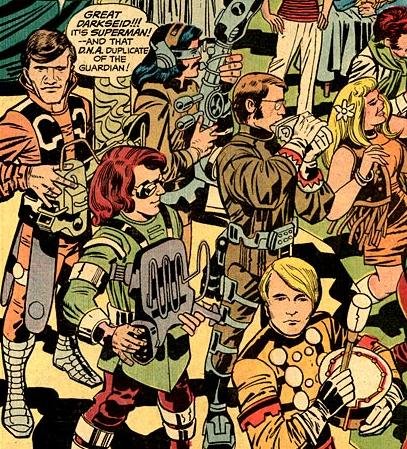
I've not really thought about what Jack Kirby's comics would sound like when set to music, and aside from the theme songs and music that accompanied various Marvel Comics animated cartoon adaptations from the 1960s and 70s, and various references in pop music, I've never heard any musical attempts to interpret the spirit of Kirby's art.
The Kirby Quartet, on the other hand, have developed an entire repertoire of music that they claim has "the same energy and passion" that Kirby brought to his drawing. Based in Toronto, the group is currently touring the West Coast with an upcoming stop August 8 and 9 in Vancouver for "two concerts to raise funds for First United Church Mission in Vancouver’s Downtown Eastside." (info 604-736-6926)
The Repertoire
Ludwig van Beethoven, String quartet No. 1 in F major, Op. 18
Joseph Haydn, String quartet No. 43 in G Major, Op. 54, No. 1
Wolfgang Amadeus Mozart, String quartet in B flat major ("Hunt"), K. 458
Wolfgang Amadeus Mozart, String quintet in G minor, K. 516
Maurice Ravel, String quartet, in F major (1903)
Anton Webern, Langsamer Satz (1905)
John Zorn, Cat O’Nine Tails
Felix Mendelssohn, String quintet in B-flat Major, Op. 87
Kirby Quartet Home Page
Wednesday, August 02, 2006
Sony ebook pushed back
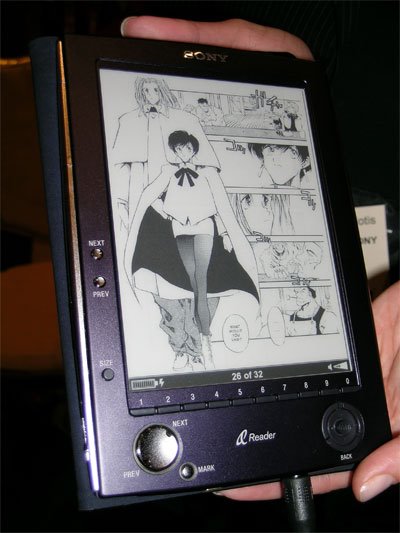
The much-hyped Sony Reader portable ebook has had its release date delayed once again, eliciting groans from tech reporters and gadget lovers the world over. Not that anyone is really acting surprised. The new toy has had tons of critics since it was first announced. Many industry watchers continue to be sceptical of the proprietary nature of Sony's copy-protection software.
The ebook is Sony's followup to the Librie, the last launch to meet with a mediocre reception.
Many U.S. publishers, including manga giant Tokyopop, have already signed on as content-providers but it looks like graphic novel fans will have to wait awhile longer for the privelege of not trading electronic comics they purchase from Sony.
Sony's such a tease CNET News.com
Sunday, July 30, 2006
Superman vs Wayne Boring

Wayne Boring is one of the most iconic artists to ever work on the classic Superman comics. Starting as a member of the Shuster studio, he soon became the primary Superman artist for National/DC and drew the daily comic strip for many years.
His influence has been far-reaching --his clunky, wide-shouldered version of Superman has been appropriated in parody and pop art and he has been the inspiration for a modern graphic novel classic --Dan Clowes' David Boring, about a young man who obsesses about his missing father, an obscure comic book artist.
Wayne Boring drew himself into a Superman adventure back in 1951. In the story, Superman wrecks Boring's studio to prove he is the real McCoy to a writer. These strips are not well-known today --we have the Speeding Bullet website to thank for digging them up:
Speeding Bullet
Wednesday, July 19, 2006
Comics Sales: 1946
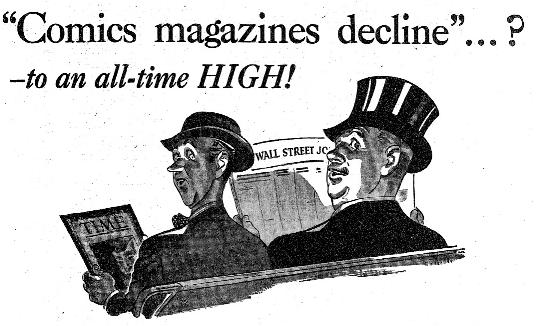
This one is very interesting. A trade ad from National Comics from 1946, disputing Time Magazine and Wall St Journal articles about declining comics circulation. The ad is hilarious, with an illo of a snooty capitalist reading the news and looking over his shoulder. Hard numbers from National (also a major distributor at the time) about the circulations of other comics publishers, ranked into categories according to quality/durability.
Full article.

Saturday, July 15, 2006
Super-stuff

In my continuing effort to document cool things on the web about classic Superman comics --among the greatest and weirdest childrens literature of the 20th Century-- a few links to recent discoveries.
The continuing archival research into the first Superboy and the 1940 New York World's Fair "Superman Day" continues at the Superman Through The Ages website with newly scanned photos of the participants (mentioned previously here).
The latest thing is a discussion of a figure in the background of one of the photos, a young girl with a homemade "S" crest on top of what could be a Supergirl costume. The first fan costume parade?
Superman Through the Ages! Forum - The Very First Super Boy!
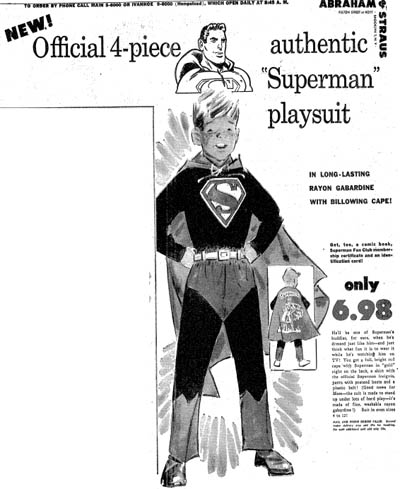
Another great find is this old ad for a Superman costume --dating back to 1954. Jared Bond has a website called The Speeding Bullet that is all about the Superman comic strip and lately he's been digging up newspaper articles and ads from the classic period (the best is a newspaper article about Joe Shuster getting arrested for trying to steal a car in Florida in 1940).
Lastly, there was a great series of interviews on the U.S. public radio show Studio 360 about Superman as an American icon. Gerard Jones talked about the life of Jerry and Joe, mostly reiterating points from his Men of Tommorrow bio but also making reference to Siegel's early intentions for Superman and Lois (hinted at in the aborted "K Metal" storyline). Jones mentions that Siegel wanted Superman to marry so he could write a "Nick and Nora Charles"-style series. Interesting, because this is what happened in one of my favourite 1970s kids comics, the Mr. and Mrs. Superman stories. Most of these stories, which take place in an alternate reality on a world called Earth-2, where written by uber-fan E. Nelson Bridwell and drawn by Kurt Schaffenberger in his clunky, charmingly old-fashioned (for the 1970s) style. In the stories, Lois helps her husband solve crimes while trying to set up house as newlyweds who also work together at the Daily Star. Sort of The Front Page meets The Thin Man, in tights.
The radio show also includes quotes from Jules Feiffer on Siegel ("a charming, lovely man") and Siegel and Shuster ("they got screwed"). Art Spiegelman has a few choice quotes, too ("there was only room for so many Chagalls" & "Superman is Jewish the way Clark Kent is Jewish").
Friday, June 30, 2006
The Beat is moving
Heidi MacDonald is moving her fun news blog about comics culture to the website of her current corporate masters at Publisher's Weekly. Since she has been working for PW for awhile and co-edits their weekly e-magazine about comics, the move makes a lot of sense and eliminates the need to constantly remind her audience who her employer is when reporting on PW stories or Reed Exhibits events (like the New York Comic Con). It's also a good move on the part of PW --they get an established, well-liked property with a huge backlog of posts and enormous community goodwill (not to mention one of the most experienced women journalists in the comics world --and one with a variety of interests beyond the myopic realm of superheroes and kids comics). Congrats to Heidi and here's to many more years of the Beat!
MILE HIGH COMICS presents THE BEAT at COMICON.com: The Beat is moving
MILE HIGH COMICS presents THE BEAT at COMICON.com: The Beat is moving
Sunday, June 18, 2006
Superboy 1940
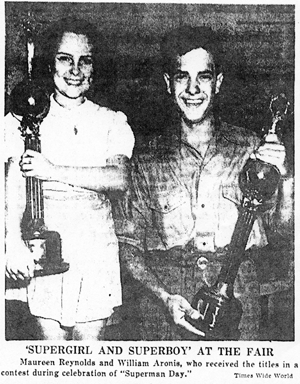 Surprising bit of arcana concerning the early days of Superman that may be of interest especially to people curious about the ongoing litigation involving the Siegel family and the ownership of Superboy. It seems that the name "Superboy" was being used by the owners and promoters of Superman as early as 1940, when a Superman Day was held at the New York World's Fair. Long-time fans and collectors may know that a special World's Fair comic book featuring Superman was published, but many may not know that a Superboy and Supergirl, selected from real live boys and girls, were crowned on July 4, 1940.
Recently, the website Superman Through the Ages was contacted by Bill Aronis, who states in a letter that he was selected as "superboy" for a day by a panel consisting of Charles Atlas and other celebrities as part of a promotion for Superman comics. 15 at the time, Aronis responded to an ad on the back of a Superman comic and was chosen from among hundred of other applicants. He received a trophy and a tour of the National offices and met some of the creative talent behind the comic book.
The use of the name Superboy for this event predates Superboy's actual comic book debut in More Fun Comics #101 by 5 years. The use of the name Supergirl (won by Maureen Reynolds) predates the appearance of the comic book Supergirl by 18 years (the so-called "Magic Totem Super-Girl" from a story in Superman #123 or by 9 years (the so-called "Lucy Regent Supergirl Story" in Superboy #5 published in 1949), depending on which history you subscribe to.
Recently, the heirs of writer Jerry Siegel, who created Superman with cartoonist Joe Shuster, succeeded in winning co-copyright of the character Superboy. The Siegels argue that the concept and name of Superboy, and the idea for stories of a teenaged Superman, were invented by Siegel before he entered the army in 1943 (Siegel submitted Superboy concepts to National/Detective beginning in 1938, shortly after Action Comics #1 was published).
Read the full story here:
1940 New York Times Superman Day Article
photo above: the first Superboy?
Friday, June 09, 2006
Wonder Woman: Lesbian or Dyke?
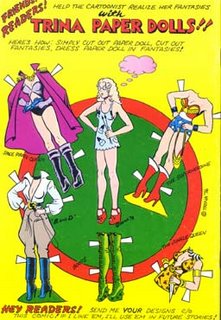
A recent essay by Trina Robbins is now online. Trina discusses the lesbian overtones in the classic Wonder Woman titles and, as her title suggests, comes down on the "The inhabitants of Paradise Island were lesbians" side of the equation. Robbins reviews the reception of the WW comics based on a sampling of old letters page comments and finds a few choice quotes from WW's writer on the topic of his goals in creating the heroine. Always a fascinating topic, more so lately in light of the increasing attention to issues of superhero sexuality in the mainstream media.
Robbins doesn't really go into the flipside of her question (a topic popular not only with Wertham but also with contemporary readers like Chester Brown): "What is it that male readers find so stimulating about Wonder Woman's adventures?"
Wonder Woman: Lesbian or Dyke?
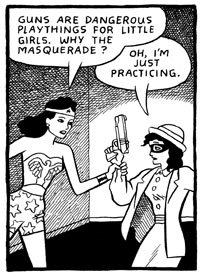
Above: Trina Paper Dolls and a panel from a Wonder Woman homage by Chester Brown
Wednesday, June 07, 2006
That's What You Think!
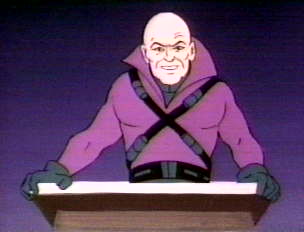
Thought Frequential was a dead blog?
That's what you think! And the Legion of Doom echoes that sentiment:
To celebrate the return of this infrequent weblog about comics, Frequential links to the latest potential viral website honouring the greatest tv show ever.
Superfriends was my favourite tv show for about 4 years when I was a kid, and here's why.
Comics Comics
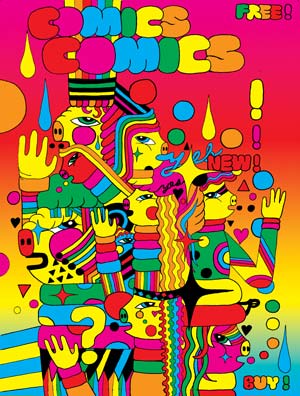
Wow, Dan Nadel and Timothy Hodler have a blog and are putting out a FREE magazine about comics that should bring the artcrit and design sensibility seen in the Ganzfeld to an exclusively comics environ. Nadel seems to have a very unique (to comics criticism, anyway) take on art and his editorial style (basically: "this ugly drawing is comics --deal with it") is refreshing.
The blog is mostly a way to hype publishing efforts like PictureBox, Lime Publishing, and Nadel's Art Out of Time, but also has reviews (like a feature on Carl Barks) and excerpts from the new Comics Comics mag.
Hodler's essay on Barks has some interesting points. He argues that "His sense of space is outstanding" and that "this isn't complicated, theoretical stuff that needs a lot of explication to understand, anyway. In some ways, Barks' place in comics is similar to Robert Louis Stevenson's in English literature. They're both so masterful that sometimes they're taken for granted, their contributions to our culture overlooked or dismissed as children's stories."
I like those old Barks comics as well, but find it hard sometimes to get past the weirdness of the Disney brand (not to mention the weirdness of the animal conceit that the Air Pirates and Mad's "Mickey Rodent" had such fun with). Barks did manage some interesting social satire and his storytelling and dialogue are very sharp, but Robert Louis Stevenson? Maybe it's just because one of my old perfessors was an editor of the Complete RLS, but I don't see the complexity of plot or theme in the decidedly adult work of Stevenson mirrored in Barks. Now when we compare Stevenson's drawing to Barks...
Comics Comics
Wednesday, April 26, 2006
Nana Live
Everyone's favorite band inspired by a Japanese manga, Nana. Nana is a comic serialized in Shojo Beat about two girls named Nana and the band they are involved with. I tell people it is like Sailor Moon meets Love and Rockets. But not really.
Thanks to Heidi at THE BEAT for linking to this video.
Thanks to Heidi at THE BEAT for linking to this video.
Thursday, April 20, 2006
Little Lefty
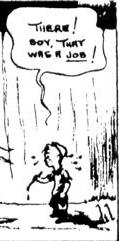
Kudos to Allan Holtz over at Stripper's Guide for unearthing and profiling the forgotten socialist classic, Little Lefty, a comic strip from the U.S. Daily Worker by Maurice del Bourgo. Holtz provides some background and dates for this didactic version of Percy Crosby's Skippy, complete with samples.
Holtz has also started digging up old news articles about cartoonists, including Peter Arno's highly publicized divorce suit.
Stripper's Guide: Obscurity of the Day: Little Lefty
Friday, April 14, 2006
V for Anarchy

Lots of interesting anarchist related activity around the movie based on the Moore and David Lloyd graphic novel, V for Vendetta, beginning April 17th:
V for Vendetta
A for Action!!!!
4/17: International A for Anarchy Action Day!
While V for Vendetta has been playing for a few weeks in the US, its only just premiered in Spain and a range of other for countries. The time is now here to ramp up this effort! We're calling for creating actions worldwide to educate moviegoers on the promise of anarchy and to take a parting shot at the corporations behind the film V for Vendetta film for eviscerating the anarchist politics of the original V for Vendetta graphic novel.
12:30-1:30PM Time Warner Center, 59th St and Columbus Circle
1:45-2:30PM DC Comics, 1700 Broadway between 53rd and 54th Streets
2:45-3:30PM AMC Empire 25, 234 West 42nd St. at 8th Avenue (this may change closer to date)
Come to leaflet, hold posters and banners, take pictures and video (bring your cameras) of the action!
Details on the NY Action
We'll perform street theater, leaflet, hold a banner promoting the A for Anarchy website (http://aforanarchy.com), and hold posters —detournments of V for Vendetta movie posters courtesy of our creative comrades in Spain (visit their site at http://vdevendetta.info).
To challenge the film's liberal politics, our street theater will feature a two-faced Clinton-Bush under the control of the ruling class and corporate power. The anarchist V will chase off these scoundrels and speak to the notion of a society without capitalism and the state.
We'll begin our action at the Time-Warner Center, home to the largest media conglomerate the world has ever seen (Time-Warner, with revenues last year of $43 billion), creators of the V for Vendetta film. It's no surprise that an institution at the heart of global capitalism would never expose mass audiences to anarchist thought. We'll be visiting their office not to protest them, because we don't expect them to "reform" or to be "more open to our message", since we call for nothing short of the wholesale destruction of the entire economic system they dominate. Rather, we intend to use their presence as a backdrop to illustrate the real agenda of corporate films like V for Vendetta, which co-opt the style of subversion yet never provide the kind of substance that would fundamentally challenge their interests.
Next, we'll visit DC Comics, the creative robber barons who used tricks of intellectual property to retain ownership of V for Vendetta, allowing their corporate parent, Time Warner to create a film that fundamentally betrayed V for Vendetta graphic novel writer Alan Moore's original anarchist vision. DC has a long history of bilking creators and destroying anarchist heroes—they did much the same with the original anarchist comic book hero—Superman! That's right, Superman. In the first 2-3 years of Superman comic books and comic strips, the Man of Steel was a far cry from the character we know today. Described by co-creator Jerry Siegel as "a thorn in the side of the establishment", this Superman's tagline was not, "Truth, Justice, and the American Way," but rather "Champion of the Oppressed." Instead of super-villians and space aliens, he used direct action to fight slumlords, munitions manufacturers and their lackeys in government, warmongering heads of state, and the execution of innocent people. Within three years, DC had seized control of the character and began transforming him into the toothless symbol of status quo "justice" we've known for decades.
Finally, we'll take our message directly to the moviegoing public by performing our street theater in front of the exiting crowd of a V for Vendetta matinee screening, inspiring them to connect the insurrectionary action of the V movie with an explictly anti-statist and anti-capitalist politics, and to recognize that eliminating oppressive governments isn't just for the movies!
Wednesday, March 29, 2006
THE BEAT on uclick deal
MILE HIGH COMICS presents THE BEAT at COMICON.com: Tokyopop and uclick team
Heidi writes up the second deal for Tokyopop in as many days. All this talk about comics on tiny cell screens makes me yearn for comics on tv! comics on walls! comics on blimps!
Heidi writes up the second deal for Tokyopop in as many days. All this talk about comics on tiny cell screens makes me yearn for comics on tv! comics on walls! comics on blimps!
Tuesday, March 21, 2006
Music And Comics: Two Great Tastes That Taste Great Together? | Comixpedia
Music And Comics: Two Great Tastes That Taste Great Together? | Comixpedia
Tym Godek has the beginnings of a thought on the combination of music and comics (in a webcomix format, I assume).
While we all love the cute little bleeps and glurks our computers make while we explore webpages, I wonder how far a musical comic can go before we really do have to consider it more akin to film or video than a novel or short story. Of course, I read many comics as a kid that came with a record and didn't think of them as some new hybrid art form.

"Power Records: The action comes alive as you read!"
Tym Godek has the beginnings of a thought on the combination of music and comics (in a webcomix format, I assume).
While we all love the cute little bleeps and glurks our computers make while we explore webpages, I wonder how far a musical comic can go before we really do have to consider it more akin to film or video than a novel or short story. Of course, I read many comics as a kid that came with a record and didn't think of them as some new hybrid art form.
Try as they might no one has come up with a clear-cut, irrefutable definition of what "comics" is. The advent of web technology and the possibility of integrating elements such as animation and sound has blurred the picture even more. What is it that makes a comic a comic, and how does the addition of these other elements affect that? Is there something essential to comics that is lost in the attempt to integrate sound?
"Power Records: The action comes alive as you read!"
Thursday, March 09, 2006
Smart Panel Developments
The only thing keeping Marvel from becoming the most boring comics publisher in the world is this little tech gimmick:
The Great Curve: Marvel.com adding blogs?: "Additionally, Marvel will be offering a ton of new Digital Comics that can now be viewed on desktops all over the world. Fans can't get enough of the new comic format and are singing the praises of the never-before-seen Smart Panel comic viewer technology. Keep a lookout for new and improved Digital Comics in the coming months. "
The Great Curve: Marvel.com adding blogs?: "Additionally, Marvel will be offering a ton of new Digital Comics that can now be viewed on desktops all over the world. Fans can't get enough of the new comic format and are singing the praises of the never-before-seen Smart Panel comic viewer technology. Keep a lookout for new and improved Digital Comics in the coming months. "
Internet Comics=Boring?
itpblog � Blog Archive � Making Comics Boring, One Click at a Time
So why would I want to download a podcasted comic strip, just to click through it, sequentially, one frame at a time?
Subscribe to:
Posts (Atom)