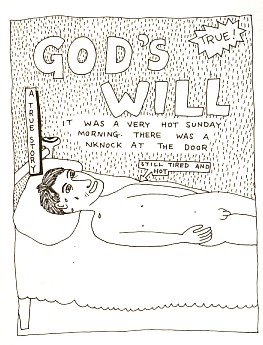
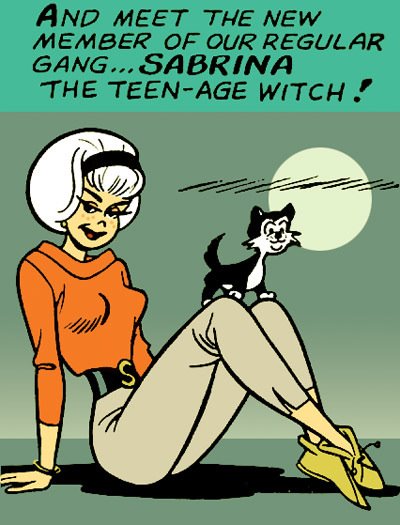
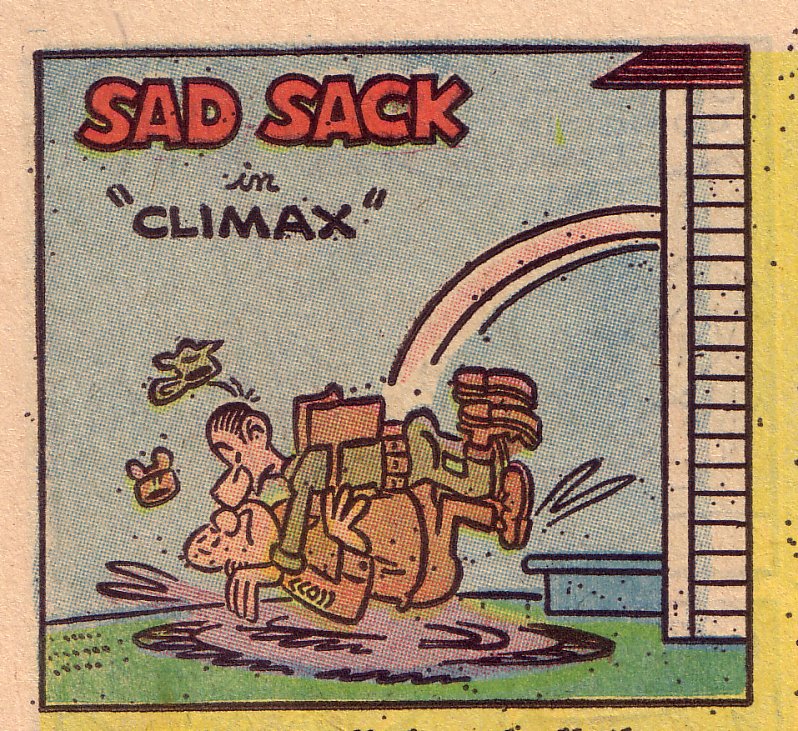
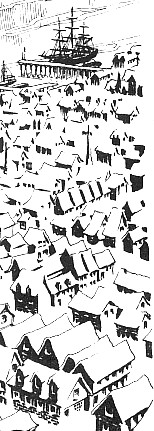
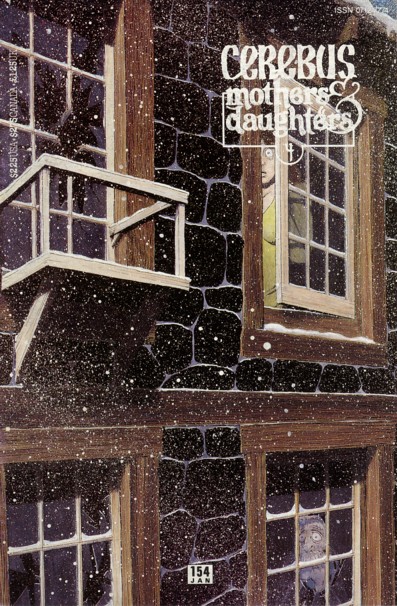
Some obscure Jaime art that I do not own. Many of it viewable at the comicartfans site. (Fans can also now read an interesting blog post by the genius art director who decided to hire Jaime to do the DVD cover for Divorce, Italian Style.)


1) Brainiac
In April 1958 a storyline began involving an alien named Romado, who is clearly a prototype for Brainiac, who would first appear in Action Comics #242 (July 1958). Romado has a computer-enhanced mind, and collects miniature cities in bottles from around the galaxy. He has the shrunken Kryptonian city of Dur-el-va, which he traps Superman in.
2) Bizarro
Bizarro appears in the strips in September of 1958. Though Superboy #68 (cover date of October 1958) hit the stands earlier, this story was actually written first. In this early version, Bizarro has a "B" on his chest. What is creepy is that Superman convinces Lois to betray Bizarro and trick him into getting exposed to his version of kryptonite, which "kills" him. (Though as Superman says, how can you kill a shadow...)
3) Metallo
December 15, 1958 begins a new story of Professor Vale saving a patient from a horrible accident, and having to put in a mechanical heart, etc. to save him. He is powered by uranium pellets, with the possibility of some other rare mineral....I haven't read much of the story yet, as the year ends, but it is clearly the first Metallo story. This is winter 1958. In the comics, he first appears in Action Comics #252 (May 1959)

"You are too overwhelming, too much like a bomb. I think you must be one of these Supermen one reads about. You would want your own way and nothing but your own way. I expect it's through having to be constantly moving people on out in Hong Kong, and all that sort of thing. Now Freddie will roll through hoops and sham dead, and we shall be the happiest pair in the world. I am much too placid and mild to make you happy. You want someone who would stand up to you."___

Dear Editor: I really enjoy your letter column, but the Legion Outpost picture is out of date. Colossal Boy is shown wearing a red suit instead of a green one and Light Lass has the insignia she used when she was Light Lass.
David Ouellette
Essex, Ontario
Dear Editor: If Perry White sent Clark Kent to a foreign country, such as Canada, on an assignment, how could Clark get a passport, inasmuch as he has no birth certificate, not having been born on this planet? I know he could fly across the border as Superman, but wouldn't that be too risky?
Edward Katz
Quebec
Alex Fedyk
Vancouver, B.C.
Roma Pohorecky
Winnipeg, Manitoba
Kevin Ferris
Winnipeg, Manitoba


Another habit: collecting names and addresses of Canadians who wrote to comic books in the 1950s and 60s.
The Canadian Comic Fan Project, Part One
If you are out there please contact me! From Betty and Veronica Summer Fun, 1967.
Eileen Boutcher
194 Pelham St
Lunenberg, Nova Scotia
age 11 & 1/2
David Zuckerman
2278 Noel St
Montreal 9, PO
age 12


"It's both heart-rending and nauseating that the national impulse would be to seek solace and reinforcement at this moment, in, for instance, Superman as a representation of moral action. I can't claim to be an expert on the cast of Marvel Comics, or, in fact, to know much of anything about any of them, but nonetheless, they're present even in my inhospitable consciousness. So it seems that they must perfectly express something about our culture.
And I suppose that what it is they so perfectly express is our desire to understand our disproportionate power as power that's unambiguously and inevitably used for the benefit of humanity. Even in regard to the Unites States of the Second World War, this view might have merited a raised eyebrow or two, but now it's shockingly self-deceiving at the least, and pretty brutal. It seems to me that not only is there an enormous longing for what we imagine to have been a time of innocence in our recent history, but that there's also a sort of willful childishness, or, to put it another way, a self-congratulatory coyness in the way imagination is collecting around these figures now. Even the nostalgia doesn't seem quite authentic. It's as if there were something endearing, something loveable, about trying to maintain this view of ourselves as childishly innocent and good even though we know very well that it's not accurate – something gallant and charming. This is a form of bullying, in my opinion; a demonstration that we can afford (temporarily, anyhow) to hold on to these consoling charades of power-with-integrity, however degraded, even laughable,we understand them to be.
"It's the super-hero syndrome, exactly. [...] It's out of our power to solve. It's defeatism --you can do nothing about it. It's like "I surrender." The only way I can solve my problem is with a super-hero, or an astronaut, or somebody from outer space, or God helping me. And this is like throwing your gloves on the floor. When you have to fight, then you think you have a solution, but when you don't want to fight any more, that's when you go to total despair and then you go looking for some super-heroes to solve your problems. Which is very bad. I don't think those movies give any good messages. That the only love you find is with mermaids or with things from outer space. No! No! No! Reality is what can save you."
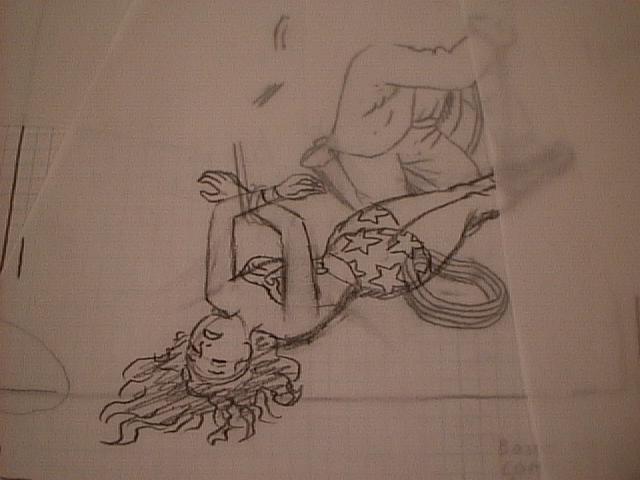
The organizers of The Doug Wright Awards for Canadian Cartooning are delighted to announce their third fundraising auction: a one-of-a-kind piece of original art by groundbreaking Canadian cartoonist Chester Brown.
Considered a pioneer of the 1980s alternative comic renaissance, and undeniably one of the form’s most original and refreshing talents, Toronto's Chester Brown agreed to lend his distinctive style to the superhero genre as a gesture of support to the Wright Awards. The result was a stunning interpretation of the comics' first female superhero: the Amazonian princess known as Wonder Woman. Inspired by a page from one of Wonder Woman's earliest appearances, these drawing are the Original Pencils used in the creation of the artwork from our last auction. These pencils provide a rare glimpse into Chester's creative process. By looking at these pencil drawings, you can follow Chester as he composes a page of original art, from rough sketches to word balloons. There are over thirty individual drawings included in this auction, each averaging approx 6" x 4"!
This artwork marks the Montreal-born artist’s first-ever piece of superhero art ever - a fact that makes it both historically significant, and a guaranteed collector’s item.
The Wright Awards were established in 2005 to recognize and spotlight the wide array of talented cartoonists working across Canada. The premiere award event recognizing the art of graphic novels and comics, The Wrights are named in honour of Doug Wright (1917-1983) whose humourous strip Doug Wright's Family graced newspapers and magazines across Canada for nearly 35 years.
Chester Brown is one of the pioneers of the 1980s comic renaissance and one of the art form’s most acclaimed talents. He began self-publishing his critically regarded comic-book series Yummy Fur in 1983. In it, Brown serialized his first four graphic novels: Ed the Happy Clown (1989), The Playboy (1992), I Never Liked You (1994), and The Little Man (1998). His Louis Riel was published as a graphic novel in 2003 and was the first graphic novel to make it to the Canadian national bestseller list as well as bestseller lists worldwide
All proceeds will benefit the 2007 edition of The Doug Wright Awards for Canadian Cartooning, which will be handed out next year in Toronto.




"Canadians are cautious optimists. We are suspicious when things seem too good to be true. There's stuff we percieve to be sacred --untouchable-- of course, nothing is. However, resigned cynicism is prt of our charm. And probably, just as Canadian anyway. Or whatever."

But, somehow, somewhen, the world changed. NASCAR became a "sport"; poker became a spectator event on television; Las Vegas became acceptable; Target & Wal-Mart supplanted Saks & Bloomingdales. Men stopped wearing hats in the streets and started wearing them in restaurants. Women turned in their high heels for sneakers. Ties were replaced by bluetooths and gowns by jeans. People no longer aspire to higher class, but struggle to maintain a lower- class facade, no matter what their finances.
Back in the day, Carter Hall was an archeologically-oriented sophisticate; Ted Grant was a medical student, then a wealthy celebrity. Nowadays, Carter is some sort of barely restrained savage and Ted Grant is some beer-swilling Wolverine-lite, and a reader can only assume that criminals can literally smell either one of them from a block away.