Friday, January 26, 2007

Canadian Nerds


The Canadian Comic Fan Project, Part Two

Where are they now?


Beloin Chin
53 Stevens Ave
Marathon, Ontario
(Everything's Archie, Archie Giant #9, August 1970)

Belinda Goetz
Box 35
Stewart, B.C.
Age 13
(Laugh #233, Aug 1970)

Linda Billry
Box 87
Masset, B.C.
Age 15
(Laugh #233, Aug 1970)

Bonnie White
Talbotville Royal, Ontario
Age 10
(Laugh #233, Aug 1970)

Laurie Pahl
496 N. Court St
Port Arthur, Thunder Bay Ontario
Age 12
(Laugh #233, Aug 1970)

Marilyn Kusznier
185 Clarke St
Port Arthur Thunder Bay Ontario
Age 12
(Laugh #233, Aug 1970)

Roy Bishop
16 Welbouren Dr
Hamilton, Ontario
(Archie #191, June 1969)


top image: Fran the Fan from Mad House Glads #74, August 1970 (art by Dan DeCarlo)


New ad campaign for Toronto tourism: selling the plate the steak is on.


CityNews: Off Beat Ads Selling Toronto To Americans

Monday, January 15, 2007

Robo-Fest 2008

"Building a Better Robot World!"

Mystery Hoard Promotions presents:

ROBO-FEST 2008!


Canada's First Trade Show and Conference dedicated to Consumer Robotics

The event will bring together manufacturers, hobbyists, and researchers from the emerging field of robotics. Robo-Fest is an opportunity to showcase new developments in robot technology.

What you can expect at Robo-Fest:
  • robot demonstrations and competitive events
  • discussion of business and technical issues
  • vendors from the personal, mobile and service robot industry

When:

Winter, 2008

Where:

Guelph, Ontario
--the center of Canada's technology triangle!

Contact:
contact us!

Saturday, January 13, 2007

Classic Off-model Archie

Current habit: leafing through old Archie comics looking for unusual images. As we all know, Archie comics can take on a uniform look --all the girls, with the exception of Big Ethel, are drawn using the same basic body type. You hardly ever see the sort of zaftig-type Dan DeCarlo drew in his Humorama adult joke gags, or any other size or shape of woman for that matter. The adult women in most Archie comics have historically been either comic grotesques (Miss Grundy), slightly more adult variations on the teen girls (Josie, the art teacher), or slightly heavier hausfrau types (Archie's mom). These are a few exceptions recently discovered:


From "Reggie the Match Maker" --Archie's Pals & Gals Giant #18, 1961.
Reggie cons a kid into a date with his sister, only to wind up wrasslin with the wrong girl. Jumpin' Jaime Hernandez!


And speaking of Jaime Hernandez, "Fat Chance" (Betty and Veronica Spectacular Giant #145, 1967) gives us a peak at Veronica's unconscious anxieties as she morphs through a series of weight gains--sort of like Maggie in "The Race" from Penny Century #6.


Another habit: collecting names and addresses of Canadians who wrote to comic books in the 1950s and 60s.

The Canadian Comic Fan Project, Part One
If you are out there please contact me! From Betty and Veronica Summer Fun, 1967.

Eileen Boutcher
194 Pelham St
Lunenberg, Nova Scotia
age 11 & 1/2

David Zuckerman
2278 Noel St
Montreal 9, PO
age 12

Thursday, December 14, 2006

Samuel Zagat


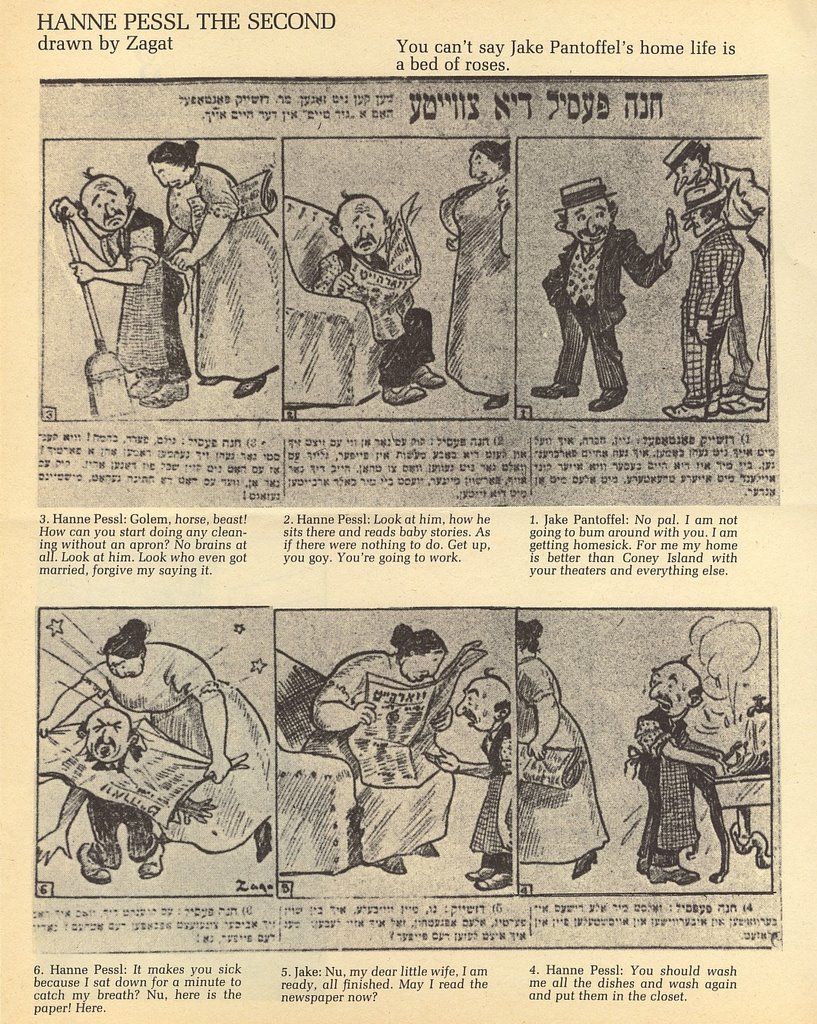
Look at him, how he sits there and reads baby stories.


Rooting around in the files...

Samuel Zagat (1890-1964) was a cartoonist and photographer, part of a small group of left-wing Jewish artists who flourished in the socialist press in the early part of the 20th Century. I had never heard of him before I found this cartoon in a disintegrating book about the New York Jewish immigrant experience a few years ago.

Zagat drew a strip called "Gimple Beinish" (1912-19) for the Yiddish daily Warheit /Varhayt in New York. He was also an editorial cartoonist for the Daily Forward. A book of his drawings was published in 1972.

The strip here, featuring Hanne Pessl, was originally in Yiddish and reads right to left.

Thursday, December 07, 2006

Twilight of the Superheroes


Deborah Eisenberg, the U.S. Alice Munro, was on the CBC last week talking about her latest collection, Twilight of the Superheroes. The title story is about a cartoonist who lives through 9/11 and it has some interesting things to say about the idea of superheroes as a metaphor for Empire. Eisenberg states her case plainly in a Bookninja interview from last summer, where she discusses the Superman movie:

"It's both heart-rending and nauseating that the national impulse would be to seek solace and reinforcement at this moment, in, for instance, Superman as a representation of moral action. I can't claim to be an expert on the cast of Marvel Comics, or, in fact, to know much of anything about any of them, but nonetheless, they're present even in my inhospitable consciousness. So it seems that they must perfectly express something about our culture.

And I suppose that what it is they so perfectly express is our desire to understand our disproportionate power as power that's unambiguously and inevitably used for the benefit of humanity. Even in regard to the Unites States of the Second World War, this view might have merited a raised eyebrow or two, but now it's shockingly self-deceiving at the least, and pretty brutal. It seems to me that not only is there an enormous longing for what we imagine to have been a time of innocence in our recent history, but that there's also a sort of willful childishness, or, to put it another way, a self-congratulatory coyness in the way imagination is collecting around these figures now. Even the nostalgia doesn't seem quite authentic. It's as if there were something endearing, something loveable, about trying to maintain this view of ourselves as childishly innocent and good even though we know very well that it's not accurate – something gallant and charming. This is a form of bullying, in my opinion; a demonstration that we can afford (temporarily, anyhow) to hold on to these consoling charades of power-with-integrity, however degraded, even laughable,we understand them to be.


Born in 1945, Eisenberg probably missed out on the first wave of superhero comics and was not quite 10 when "Superduperman" appeared in MAD. She was graduating from college when Jack Kirby and Steve Ditko were repopulating New York with superheroes and was well into her adult life when Batmania and Wonder Warthog were stirring up the kids, so she can be forgiven for mixing up her publishers. In any case, everyone knows that outside of a few arrested adolescents like Michael Chabon and Jonathan Lethem, serious writers don't read superhero comic books. Nevertheless, Eisenberg still makes a few interesting points. Even if mainstream kids comics can't be expected to engage with adult themes and political issues, what about Hollywood? I've seen enough of the current crop of superhero movies to know that they are trafficking mainly in the same thing the comics have got by on for generations --escapism, power fantasies, and nostalgia. I'm less familiar with the current superhero comics world since the heavyhanded Watchmen metaphors of the 1980s --the world of The Authority and Identity Crisis. Outside of Dan Clowes' "The Death Ray" (or for that matter, David Boring), are there any contemporary superhero iterations that deal with their own limitations as a genre in ways that are not just pat or satirical? Is it even really possible or necessary? Are superheroes bad for us? Adorno said "After Auschwitz it is barbaric to write poetry." Should we say, after 9/11 it is barbaric to draw superheroes?

I leave the final word to that other great philosopher, Sergio Aragones:

"It's the super-hero syndrome, exactly. [...] It's out of our power to solve. It's defeatism --you can do nothing about it. It's like "I surrender." The only way I can solve my problem is with a super-hero, or an astronaut, or somebody from outer space, or God helping me. And this is like throwing your gloves on the floor. When you have to fight, then you think you have a solution, but when you don't want to fight any more, that's when you go to total despair and then you go looking for some super-heroes to solve your problems. Which is very bad. I don't think those movies give any good messages. That the only love you find is with mermaids or with things from outer space. No! No! No! Reality is what can save you."


THE_ARTS_TONIGHT

Wednesday, December 06, 2006

CHESTER BROWN ORIGINAL ART auction


Another fundraiser for the Wright Awards.

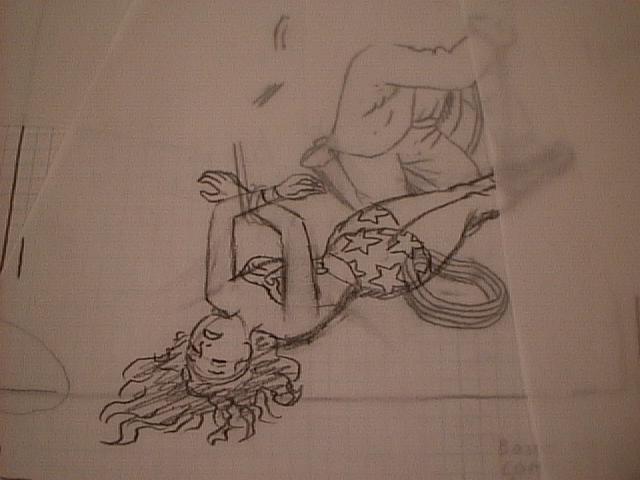
This time around, it's Chester Brown's original pencils for the Wonder Woman page he donated for the previous auction last summer. It's a fascinating view of his working methods. The difference between these loosely assembled drawings and the finished art sold earlier is striking (Chester's pencils are pretty tight but I think he still edits when he inks --Wonder Woman's ass looks rounder in one of his pencils).

Chester uses many smaller pencil drawings to compose a page. He draws each panel --and sometimes each figure in each panel-- separately. He does the same thing for all of his lettering and word balloons. He then lays all of the separate pages into the order they are supposed to read in, places a piece of paper on top, and traces over them onto his final art with a brush. He documented this process in his short story "Showing Helder" in an early issue of his comic book series Yummy Fur.

Anyway, the Wonder Woman drawings are now being auctioned off on ebay:


The organizers of The Doug Wright Awards for Canadian Cartooning are delighted to announce their third fundraising auction: a one-of-a-kind piece of original art by groundbreaking Canadian cartoonist Chester Brown.

Considered a pioneer of the 1980s alternative comic renaissance, and undeniably one of the form’s most original and refreshing talents, Toronto's Chester Brown agreed to lend his distinctive style to the superhero genre as a gesture of support to the Wright Awards. The result was a stunning interpretation of the comics' first female superhero: the Amazonian princess known as Wonder Woman. Inspired by a page from one of Wonder Woman's earliest appearances, these drawing are the Original Pencils used in the creation of the artwork from our last auction. These pencils provide a rare glimpse into Chester's creative process. By looking at these pencil drawings, you can follow Chester as he composes a page of original art, from rough sketches to word balloons. There are over thirty individual drawings included in this auction, each averaging approx 6" x 4"!

This artwork marks the Montreal-born artist’s first-ever piece of superhero art ever - a fact that makes it both historically significant, and a guaranteed collector’s item.

The Wright Awards were established in 2005 to recognize and spotlight the wide array of talented cartoonists working across Canada. The premiere award event recognizing the art of graphic novels and comics, The Wrights are named in honour of Doug Wright (1917-1983) whose humourous strip Doug Wright's Family graced newspapers and magazines across Canada for nearly 35 years.

Chester Brown is one of the pioneers of the 1980s comic renaissance and one of the art form’s most acclaimed talents. He began self-publishing his critically regarded comic-book series Yummy Fur in 1983. In it, Brown serialized his first four graphic novels: Ed the Happy Clown (1989), The Playboy (1992), I Never Liked You (1994), and The Little Man (1998). His Louis Riel was published as a graphic novel in 2003 and was the first graphic novel to make it to the Canadian national bestseller list as well as bestseller lists worldwide

All proceeds will benefit the 2007 edition of The Doug Wright Awards for Canadian Cartooning, which will be handed out next year in Toronto.

Snow in the Comics


Part 1 of 3

by BK Munn

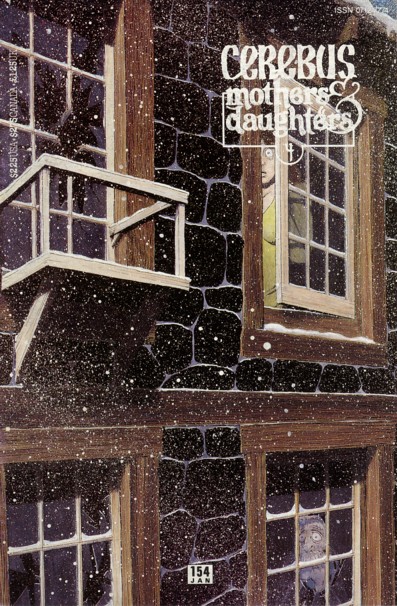
It's snowing again this morning, putting me in mind of snow in the comics. Trying to remember my experience of snow in the comics, the first thing that comes to mind is Peanuts which always was very seasonal in its rhythms. Although other daily strip cartoonists did winter-themed gags and even created snowy adventure storylines (I think the final episode of Caniff's Terry and the Pirates took place on a snow-filled runway), Peanuts is really the winter strip par excellence, a position that was ratified with the animated Christmas special back in the 1960s. Outside of the strips, U.S. kids comics creators like John Stanley, Carl Barks, and the Archie gang always published season-specific issues. As well, I'm sure I read the occasional superhero comic as a kid featuring a chilly, John Romita Spider-Man brawling over snowy New York City rooftops. But the first time I think I really noticed snow as an actual presence and plot device in a graphic novel context was Cerebus.
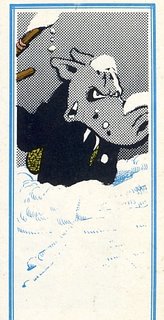

At some point in the early 1980s, Dave Sim seemed to decide to make snow a major character in his High Society graphic novel. I'm sure there was snow in earlier issues since much of the series was a parody of the Barry Windsor-Smith Conan comics and I'm pretty sure there was at least one issue of Conan that featured barbarians fighting frost giants in the wilds of Hyperboria, or wherever it was that Conan was from, but Sim's use of snow in these later Cerebus issues really struck a chord with my 13-year-old self.
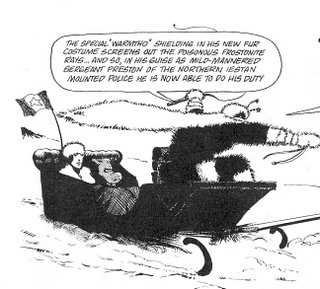
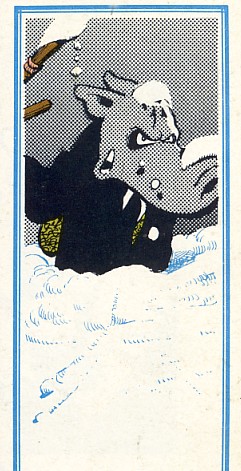
The first snow-themed issue I remember is Cerebus #44, "The Deciding Vote". Fans (or maybe just Sim) later called this the "wuffa-wuffa" issue, after the sound the lead character made when walking with snowshoes. The plot of the issue, Cerebus following an old farmer around in order to solicit the geezer's vote for Prime Minister, took a backseat to the slapstick images of Cerebus trying to navigate his way through snowdrifts and the drunken antics of Sim's superhero parody character The Roach. Y'see, Sim the artist was telling us, Cerebus's attempt to transform himself from barabarian to politician is an uphill battle and even the elements are against him.
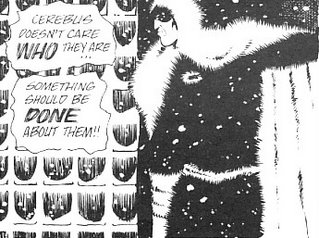
Things only got worse for the character as the book progressed: Cerebus' time in office seemed to take place over the course of one long winter, which meant that the snow hung around. Sim seemed to take great delight in drawing the characters in the midst of blizzards or contrasting the heated conversations of his characters with the serenity and quiet of the outdoors. The story, and Cerebus' political career, culminated with an invasion of the city by barbarians. Sim told the story in a series of long panels, ending with his now-isolated character walking off into the distance into a sea of white.
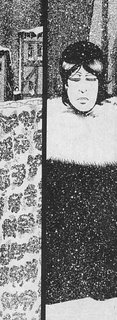
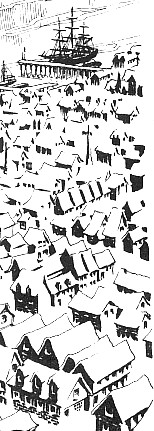
Snow popped up in the next few graphic novels as well. In Church and State, Cerebus becomes Pope, gets thrown off the side of a snow-covered mountain, and has to spend many pages climbing back up. Meanwhile, other characters stand around in the snow, looking pensive and plotting schemes of vast socio-political importance. During this time, Sim's assistant Gerhard really started to make his presence felt in the series, drawing highly-detailed walls, cityscapes, gargoyles, etc, all blanketed in layers of snow.
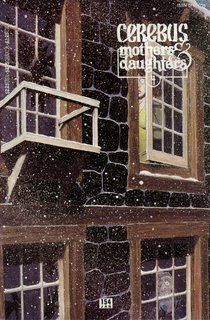
I think that, in part, Sim was initially sort of stuck with the northern fantasy world he had inherited from his pastiche of the world of Robert E. Howard. However, he eventually realized that he could incorporate aspects of this universe into the tale to his advantage, using the weather as a major storytelling tool (and in a black-and-white book, snow makes a nice contrast). As well, the world he was creating was starting to take on more aspects of the real world that he was interested in. I used to imagine that his fictional city state of Iest was a brilliant amalgamation of Kitchener, Ottawa, 1917 St. Petersburg, medieval Europe, Carl Bark's Duckburg, and Conan's D&D fantasyland. At the same time, I sometimes resented the enormous use of white space in Cerebus, an indication I thought of a certain amount of cartoonist laziness. And after awhile, the device takes on a strained air (not unlike the device of using a cartoon aardvark barbarian as the lead character in a 3000 page graphic novel about religion, politics, and gender relations). The depictions of falling snow still are very affecting, as long as one of Sim's gross caricatures is not in the panel, maybe because falling snow is still evocative of a certain sense of nostalgia (childhood, holidays, etc). Overall, and despite the general failings of Sim's project as a whole, I can still appreciate these early Cerebus stories for their modest attempts at depicting the Canadian landscape in graphic novel form. Really, a very sophisticated and sustained, at times subtle use of nature for such a young artform.

Next time: the forecast calls for more snow
Part 2
Part 3

Thursday, November 30, 2006

Amazing Heroes Top 100


a propos of nothing:

In a truly horrible old issue of the Fantagraphics fanzine Amazing Heroes (cover feature on the 1980s post-Kirby Eternals comic book for god's sake), we find this truly horrible top 100 list of comic book sales from January 1985. The most interesting thing to me today is that Superman (#92) sold less than Cerebus (#85) and that World's Finest (#99) sold less than Muppet Babies (#98). This in the same month that issue #2 of the original Crisis on Infinite Earth miniseries was on sale (#3) leading up to the death of Supergirl and the John Byrne revamp of Superman:


Those were the 80s!

Wednesday, November 15, 2006

Graphic Novel Review: Gilded Lilies


Gilded Lilies: Comics & Drawings
by Jillian Tamaki
Conundrum Press
124 pages
ISBN 1-894994-19-1
$20 Cdn/$17 US

I find it a source of daily amazement that beautifully packaged collections of comics are being published with such regular frequency. The latest exhibit is this little squarebond trade from Conundrum Press collecting some early comics narratives and drawings from cartoonist and illustrator Jillian Tamaki. The restraint and tastefulness of the book design, including the subdued blues and oranges of the cover, is really very pretty and makes me wish that everything on my bookshelves could look this good.

Tamaki is a Canadian cartoonist currently living in Brooklyn, NY. Her illustration work has appeared in prestige U.S. magazines as well as in places like The Walrus here in Canada. Along with her cousin Mariko Tamaki, she won an Honourary Mention from last year's Wright Awards jury for the comic book Skim, which is currently being expanded into a full graphic novel for House of Anansi Press.

Gilded Lilies features two longer solo strips by Jillian. The first is a 21-page rumination on post-Wayne Gretzky Edmonton called City of Champions. The second is the 76-page silent and dreamlike The Tape Mines. City of Champions is made up of a series of vignettes: quotidian scenes of Edmonton residents and their environment in the wake of Gretzky's departure from the Edmonton Oilers hockey franchise for the glamour and big money of Los Angeles in 1988. At first glance the Gretzky trade is a slightly weird premise for an artistic investigation into the character of a city but the short history that Tamaki sketches in the first few pages of the strip is deft and stikes just the right note of loss tinged with humour. A montage documenting the trade and its immediate real-world effects (Edmonton Oilers' owner Peter Pocklington being burned in effigy, newspaper headlines, crying children) is contrasted with a short text piece:

"Canadians are cautious optimists. We are suspicious when things seem too good to be true. There's stuff we percieve to be sacred --untouchable-- of course, nothing is. However, resigned cynicism is prt of our charm. And probably, just as Canadian anyway. Or whatever."


This is followed by scenes of ordinary people going about their daily routines, either with determined resignation or total obliviousness to the world of sports titans, politicians, and millionaires. It's hard to say, really. What is evident is Tamaki's ability to capture ambiguity and the feeling of urban space --street people, kids at play-- in a few strokes of her pen, conveying her own experience as a student in Alberta through tiny sketches.

The Tape Mines is a more complex narrative that charts the journey of a pair of youngsters through a surrealist, Alice-in-Wonderland-style series of adventures. Told entirely without words, the tale unscrolls organically, mostly without benefit of panel borders or any indication of time of place. The two young protagonists begin the story working as child labour, manually rewinding cassette tapes in an eerie forest "factory", but a series of increasingly bizarre events and transformations soon elevates their adventure into a modern Grimm's fairy tale. Tamaki's drawing style, utilizing slanting sloping figures akin to handwriting, propels the narrative forward without being too showy. A self-confessed student of George Grosz, Tamaki's sometimes grotesque figures, rendered in brush and pen with large areas of black and grey washes, have a generalized sadness about them that is compelling as well as spooky.

Taken as a whole, Gilded Lilies is a beautiful introduction to Tamaki's art, including early work and reflections on childhood, providing insight into the world of a self-possessed cartoonist that we can expect great things from.


More:

-Tamaki interview at Illustration Friday, including a photo of the artist at work on a comic

Tuesday, October 31, 2006

Hallowe'en Haiku


Back in the day
they made fun comics.
Nostalgia for ghosts and monsters.


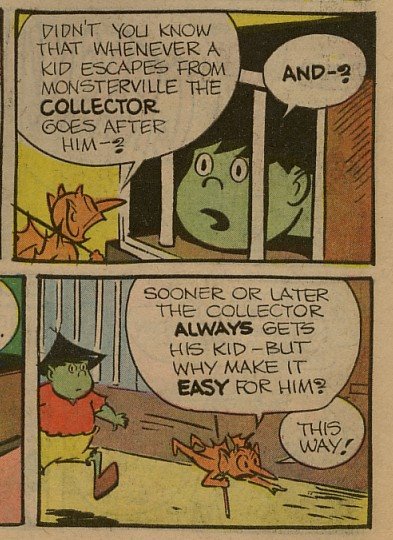
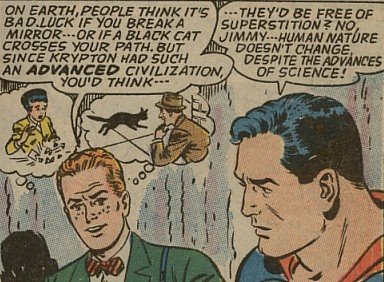
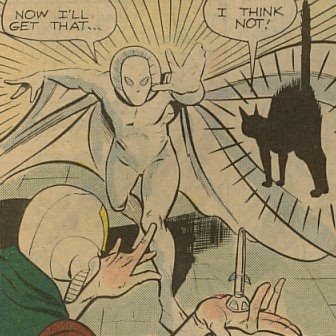
(top to bottom: John Stanley's Melvin Monster, Curt Swan's Superman, and Steve Ditko's Captain Atom featuring The Ghost, 13, and Faustus the magical cat from the future)

Saturday, October 21, 2006

Class, Dismissed


More about the idea of class in mainstream superhero comics, this time from The Absorbascon, a blog that seems to have a thing for the 1980s Hispanic superhero Vibe:

But, somehow, somewhen, the world changed. NASCAR became a "sport"; poker became a spectator event on television; Las Vegas became acceptable; Target & Wal-Mart supplanted Saks & Bloomingdales. Men stopped wearing hats in the streets and started wearing them in restaurants. Women turned in their high heels for sneakers. Ties were replaced by bluetooths and gowns by jeans. People no longer aspire to higher class, but struggle to maintain a lower- class facade, no matter what their finances.

Back in the day, Carter Hall was an archeologically-oriented sophisticate; Ted Grant was a medical student, then a wealthy celebrity. Nowadays, Carter is some sort of barely restrained savage and Ted Grant is some beer-swilling Wolverine-lite, and a reader can only assume that criminals can literally smell either one of them from a block away.


The post tends to conflate the economic realities of class with the trappings of culture, style and attitude that we clothe ourselves in, and often equates education with class, but it sparks off an interesting line of thought and the comments section has some great discussion.

As well, The Legion Abstract has assembled a nice list of recent discussions on this topic here.


(above: College student The Atom contemplates the power of the proletariat, art by Jon Chester Kozlak, All Star Comics #33, 1947)

Friday, October 20, 2006

(not quite a) Graphic Novel Review: Nog a Dod


Nog a Dod: Prehistoric Canadian Psychedoolia
Edited by Marc Bell
Conundrum Press
288 pages
ISBN 1-894994-16-7
$25

review by BK Munn

1. "A renovated sandwich takes your eyebrows to tuba practice."

Nog a Dog is something of an artistic manifesto for a group of friends who have been sharing their art back-and-forth in zine form over the past decade or so. According to editor and contributor Marc Bell, the book is a "filtering down" of work created "by a loosely affiliated group of Canadian artists." It's quite a work of conservation, since many of the booklets collected in this squarebound trade paperback were originally printed in very small quantities and were often disassembled and recombined by their intended audience.

2. "S/he turned up to fight crime with washroom keys."


Reading the book --a bewildering array of photo-montage, piggy-back art, doodles, word games, anti-narrative comics and paintings-- I get the feeling that I'm eavesdropping on a cultish jam-session whose members share a secret surrealist language of in-jokes and myths. But far from being the proverbial turn-off , the good-natured lame-ass clubbiness of the work serves as something of a doorway to a particular way of seeing.

3. "I'll dump these dirty umbrellas in T.O."

The book collects large chunks of material from over 40 zines --some in full colour but many in black and white. Having all of these books crammed together, living under one roof as it were, is something of a godsend --accumulating something that I would never otherwise see until some museum retrospective is published 20 years from now and all the energy of this art has dissipated. Even back when I was regularly ordering things through the pages of the old Factsheet 5 or Broken Pencil I often shied away from tiny drawing zines and artist's books in favour of comics. After all, I reasoned, 10 pages of stapled-together drawings is a poor substitute for ten pages of stapled together narrative. Now that the lines between comics and the gallery seem more blurred to me, I'm just overwhelmed and intimidated by the volume of work out there and fear it's impossible to keep track of these artists without some kind of guide. Luckily Bell has stepped in to try to organize a bit of the exuberance and put faces to names (or names to drawings). Many of the contributors will be familiar to readers of contemporary art comics: Marc Bell and frequent collaborators Jason McLean & Peter Thompson, Keith Jones, etc. Most I was unfamiliar with before this volume. Among the revelations for me were the dark dreamscapes of Jonathen Petersen whose drawing style here is sort of like Mark Beyer meets Yellow Submarine. As well, the chubby sketches of Amy Lockhart, who also provides the book's gorgeous cover, are comforting and disturbing at the same time.

4. "Personal obsession is the crowning glory of life."


There are comic strip-type stories here, notably by Keith Jones and Mark Connery, but I'm not sure I prefer these more orderly sequential drawings to the anarchy that the majority of the book represents. There's something else that is harder to pin down going on here, something that the wonderful world of sequential art in all its glory is not sufficient to express. Although in turns beautiful and baffling, repeated journeys through the book reveal a sort of meta-narrative at work, documenting the process better than Bell's sometimes confusing attempt at collation. The collection tells the story of how these artists have interacted, developing weird tropes, recurrent characters, and their own drawing chops over the course of this "project." Above all, the book says "Don't just sit there, draw something! Transform the raw materials of your world's monoculture --restaurant reviews, newscasters, JFK, Stephen Harper, The Lord of the Rings-- into something representing your own worldview."


More:
conundrum press


Wednesday, October 11, 2006

Sabrina Mania


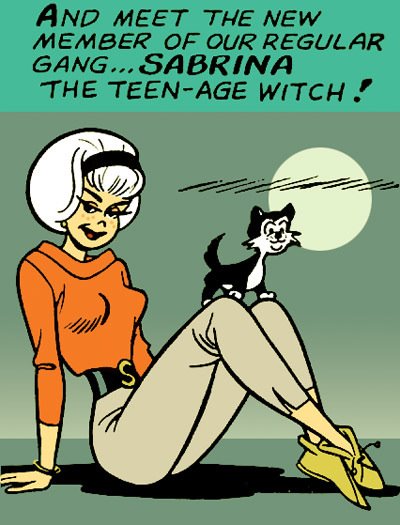
Jay Stephens sings the praises of Sabrina the Teenage Witch and her creators George Gladir and the late great Dan DeCarlo over at his Monsterama Blog. Nowadays she is a tv star and her comic is drawn in a manga style but Jay remembers her back in the day. Also included is a look at Archie's Madhouse and the usual assortment of creepy comics and pop culture artifacts.

For myself, I've always felt there's something missing from the classic Sabrina comics stories --her fit in the Archie world has never been perfect, maybe because so much of her cast is so comic-book ugly (not that Archie and Jughead are any great prizes). The dynamic that enervates the other Archie teenage romantic rivalry series just isn't there. Maybe because the series has never been a priority for the publisher, even when it has been a cartoon show and live-action sitcom and Archie and the gang have languished.

Hallowe'en is coming!

Tuesday, October 10, 2006

Sacked!


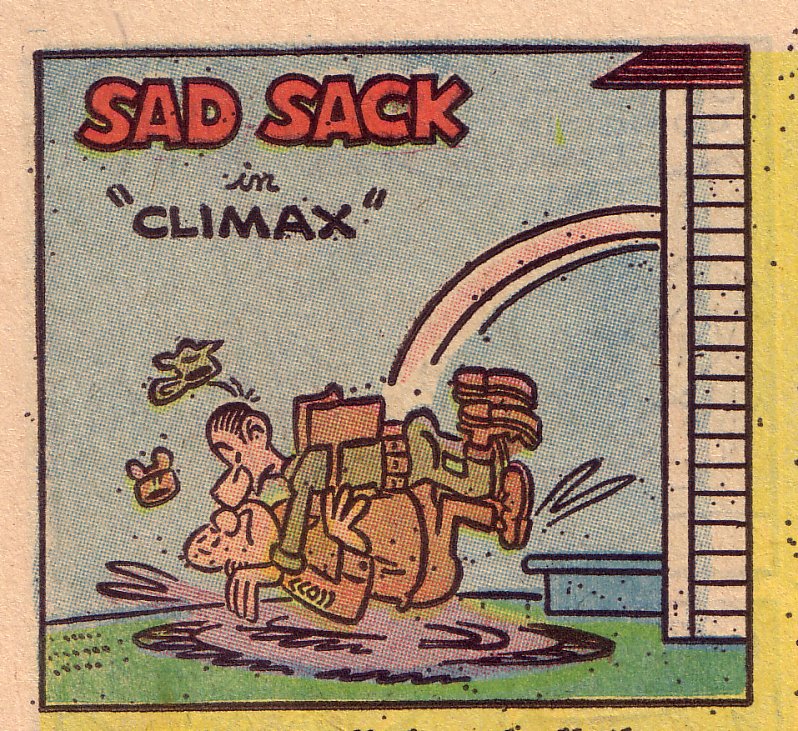
It's a Sad Sack world, we're all just living in it.

Thursday, October 05, 2006

Graphic Novel Review: Mendacity

Free Image Hosting at www.ImageShack.us

Mendacity: One Woman's Ordeal
Art by Sophie Cossette
Written by Tamara Faith Berger
Kiss Machine
$4.00

What if Little Annie Fannie was a Moldovan Existentialist?

Mendacity is the latest in Kiss Machine's new line of "graphic novellas." A previous volume, last year's Skim, won an honourable mention from the Wright Awards jury for its smart writing and razor-sharp draughtmanship, so I was pleasantly surprised to find this new offering on the magazine rack of my local bookstore.

The comic tells the story of Inna Rosca, a bored young woman from Moldova who answers a classified ad for foreign workers in order to escape her abusive home life and the general political malaise of her homeland. Perhaps naively, she signs up with an outfit that turns out to be a criminal gang and she soon finds herself with a group of other women, without a passport and in the hands of a human trafficking ring.

What follows is a grim tale of life in an Israeli brothel where Inna is kept as a sex-slave, at the service of an endless stream of johns. Curiously, she maintains a sort of bored composure throughout, whether being gang-raped, listening to the elaborate philosophical rationalizations of her pimp, or engaging in more passionate sex with her lover and errant "rescuer," a married john named Hersh. Her constant companion and only solace is a book, "On the Heights of Despair" by the Romanian-born existentialist philosopher E.M. Cioran.

I almost don't know what to make of all this depressing story besides "life is bleak, especially if you are a Romanian prostitute in an Israeli brothel." I suspect the ideas of Cioran (at least his non-Fascist ideas) are meant to serve as a sort of philosophical underpinning to the narrative, his philosophy of the absurdity of life and human degradation a back-beat or counterpoint to the relentlessly depressing ordeal endured by Inna. The overt, resigned sexuality of the protagonist and her existential leanings remind me of Ana, the titular heroine of a graphic novel by the Argentine F. Solano Lopez. The Candide-like journey of Ana is equally as depressing as Inna's but Ana at least has the benefit of actually discussing philosophy with her mentor, Simone de Beauvoir, whereas Inna must make do with the cold comfort of the printed word and the murmured endearments and banalities of her lover.

The artwork is quite dark, with lots of solid blacks and awkwardly posed, angular figures that impart a slightly claustophobic, disoriented feeling to the narrative. At times I found the cartooning a little unclear --a tiny panel showing Inna being beaten by her new pimp almost looks like a disembodied hand is slapping the pimp, for instance. Unfortunate, not least because so much of what is said in Mendacity is either hypocritical or ironic, meaning character actions and other graphic aspects of the book have to carry quite a bit of the story. After all, it is in this way, through visual symbols, that Inna seems to find a way to assert some control over her life and body. Although her passport and letters home are intercepted, the talisman of her existentialist book and the various tatoos she inscribes on herself (rising sun, Star of David) manage to say much more about her personality and worldview than any words or even sexual act (and there is a quite a bit of sex in this comic). Ultimately, although we last see a tearful Inna having sex in a garbage-strewn alley, we can only assume that she has made some sort of peace with her situation, as she notes: "You have to have nerves of steel to do this kind of work."

Preview Mendacity at Kiss Machine

Thursday, September 28, 2006

Graphic Novel Review: Rabbit and Bear Paws


Rabbit and Bear Paws: The Sugar Bush
Written by Christopher Meyer and Chad Solomon
Art by Chad Solomon
Little Spirit Bear Productions
ISBN 0-9739905-0-3
$9.95 Can/$7.95 U.S.

Rabbit and Bear Paws is a weekly webcomic created by Chad Solomon, a member of the Ojibway First Nation. According to its website, "This fresh and funny comic strip for the young and young at heart is created and drawn with the guidance of his community elders in collaboration with writer Christopher Meyer. The first series of comic strips are based upon the teachings of The Seven Grandfathers (wisdom from the Anishinabek Community) and are rapidly gaining enthusiastic fans for their vibrant and entertaining images of Native traditions and oral history."

Rabbit and Bear Paws: The Sugar Bush is a 32-page full-colour graphic novel (in format it is more like a European comics "album"). The book tells the story of two young Ojibwa brothers who use a magic potion and their wits to elude invading English soldiers in 18th-Century Canada. Tiny, fast and prankish, Rabbit is the leader of the two brothers. Rabbit steals his grandfather's potion and transforms himself and Bear Paws, his much larger and slower brother, into animals in order to steal some soup from the village pot. Caught and sent to gather firewood, the pair eventually meet up with a troop of English soldiers and travel all the way to Niagara Falls before escaping with the help of some animal friends. Along the way they recount some stories of the legendary Nanaboozhoo.

In format, basic plot, and character, the book emulates the Asterix and Obelix adventures by Goscinny and Uderzo, right down to the introductory map and character descriptions at the start of the albums. The fact that Rabbit and Bear Paws is an homage bordering on pastiche doesn't mean that it doesn't have some interesting characteristics of its own. Most successful comics franchises have spawned numerous formulaic imitators that have gone on to great successes in their own right, evolving over time into distinct entities. Asterix itself (first published in 1959) is a reworking of Oumpah-pah, the American-Indian character originally created by Goscinny and Uderzo for the U.S. market but published initially in France in 1958 (heck, even Peyo's Smurf albums have a similar theme of magic villages ruled by wise elders and surrounded by many dangers).

But rather than rehearse the many many parallels between Asterix and Rabbit and Bear Paws, I'll mention a few of its more-or-less unique features. What sets Rabbit and Bear Paws apart is a concern with Ojibwa lore and a desire to impart not only the wisdom of the elders but a respect for same. To this end, the adventures of the two titular brothers are laced with references to creation myths, the Wendigo, and lots of talk about respecting nature and helping animals (the magic potion they steal from their grandfather temporarily transforms them into whatever animal they imagine).

Solomon's drawing shows quite a bit of promise: it is fairly accomplished with a slick line and attention to detail in the Uderzo, bigfoot tradition (the colouring in the book, especially the backgrounds, is a lacklustre computerized job). The writing, especially the preachy bits and much of the dialogue, reads as slightly stilted, and lacks the punch, humour and wonderful wordplay of its model, but is still serviceable for a story that is intended (I think) as something of a primer.

Wednesday, September 27, 2006

Deppey Adopts Gizmo News

Over at Journalista, Dirk Deppey shares some thoughts on the finally-available Sony Reader.

"Oh, and look, Tokyopop’s already signed onboard, albeit with just their OEL offerings. (Of course, clicking on the “View More Manga & Graphic Novels New Releases” button in the graphic-novel section just leads to an error message, something else with which early adopters can identify.) Also recognizable to early adopters: a price tag of $350, surprisingly close to the consumer tipping point, but not quite there yet."


To quote Archie Bunker, "Oh Jeez, I can hardly wait."

Tuesday, September 26, 2006

Class Conflicts in Superhero Comic Books

Steven at The Roar of Comics makes some interesting points about class in superhero comics, with particular attention to Superman/Clark Kent:


Superman did and does fight for social change. In the Superman Archive, he clearly starts out as a populist hero, a champion of the working class, taking on war profiteers, state-run orphanages, crooked boxing promoters and poor mining conditions. Watch Superman lead a party of upper class twits into a mine and then bury them alive to teach them a lesson and tell me that's not a guy who fights the power.

And today he fights against class elitists like CEO (and ex-PRESIDENT) Lex Luthor and monarchic dictators like Darkseid. Compare that to Batman's typically lower class, obviously criminal, more anarchic villains. Superman fights against those who would impose their own version of order on the world, while Batman fights those who would destroy the order HE imposes on Gotham.

And while Matthew's right, it would be morally repugnant for Superman to enforce social change, Clark Kent can and does champion those changes from his job as a reporter for the Daily Planet.

Clark, after all, had a lower middle class rural upbringing and a strictly middle class life style once he became a reporter. Sure, it's a "glamor" career that makes him somewhat famous, I'm guessing he doesn't actually make that much money (Lois might). He might not have Peter Parker's money problems, but Clark almost certainly knows what it's like to worry about the bills.

But Superman is the exception here, not the rule. By nature, a superhero is someone whose unique abilities places them apart and above, sometimes literally above, most of society. That these unique beings then go on to be vigilantes, placing their own personal definition of justice above that of the police and democratically elected government, is elitist, aristocratic, and borderline fascist (I'm looking at you, Batman).


My own feelings on the issue were sketched out here, but I would tend to disagree: Superman is the basic template for all things superhero, including manifestations of class, and while not exactly aristocratic, he is certainly "king" of the castle in the superhero world and in the real world of corporate properties. Also, I'm not sure what a "class elitist" is but I'm not going to pick favourites in a fight between a middle-class vigilante alien who can make diamonds and a capitalist kingpin.

(All this started from a post about class in the future at Legion Abstract, apparently.)

As well, interested readers should check out this article by the great Jeet Heer on Red Son, a mediocre Superman comic from a few years back that re-imagines The Man of Steel as a communist.

Saturday, September 23, 2006

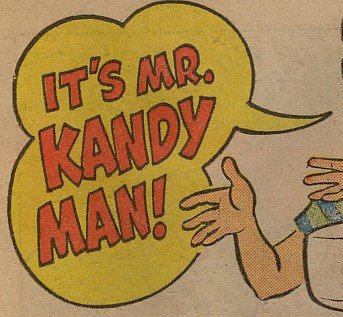
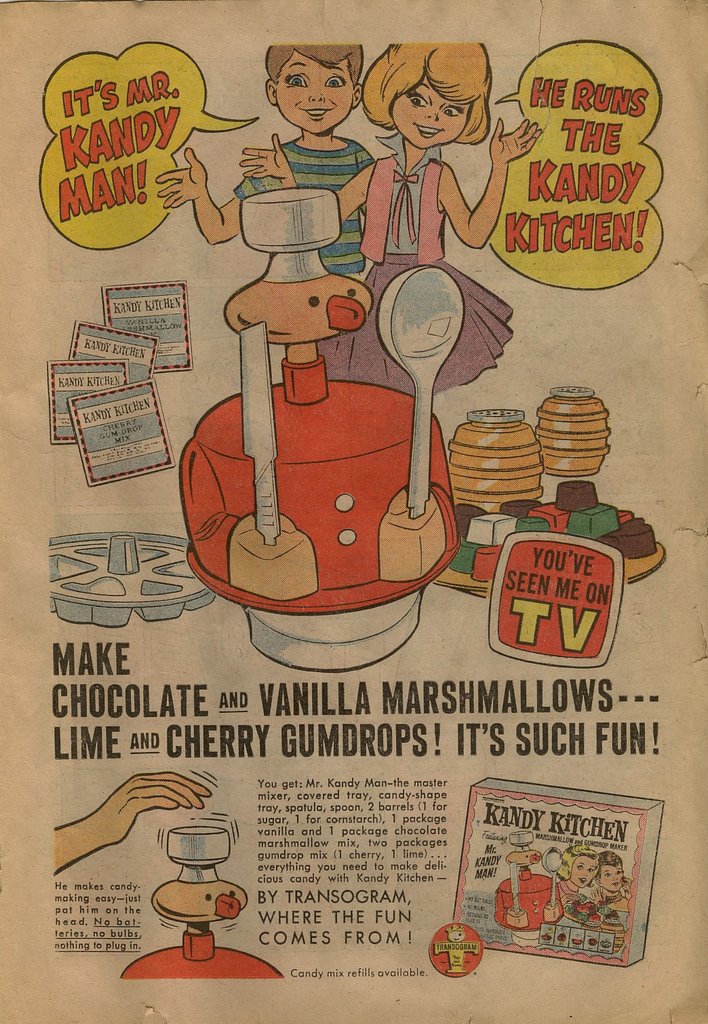
Transogram Kandy Kitchen


Just found this ad from an old Gold Key or Dell Porky Pig comic. The loose page was just fluttering around the deserted Aberfoyle Antiques Market last Wednesday (the market is only open Sundays). Quite odd that this torn comics page was the only piece of litter in the whole place.

Anyway, I had never heard of this toy before --the Transogram Kandy Kitchen. Transogram was one of the greatest U.S. toymakers.

Wednesday, September 20, 2006